Yes. The Grevelingenmeer is about 1h45 to 2h from Brussels depending on where you start. A day trip is feasible, but a weekend on-site is more comfortable for two dives and time to settle into the conditions.
What certification level is required to dive in Zeeland?
Open Water for most shallow Grevelingenmeer sites. For the Oosterschelde, experience with tidal currents is strongly recommended. Advanced Open Water is advised for more demanding sites.
What is the visibility like in Zeeland?
The Grevelingenmeer offers some of the best visibility in northern Europe: 8 to 15 metres in summer, sometimes more in autumn as algae subside. The Oosterschelde is more variable depending on tidal currents (3-10 m).
What is the best season for underwater photography in Zeeland?
June to October for light and marine life (seahorses, nudibranchs, jellyfish). Autumn typically delivers the best visibility of the year. Winter is cold but productive for wreck diving and bottom-dwelling species.
Are there seahorses in Zeeland?
Yes. The Grevelingenmeer hosts a population of short-snouted seahorses (Hippocampus hippocampus), one of the densest in northern Europe. June through September is the best window to find them.
Do you need special photography gear for Zeeland?
No. The same gear you use in Belgium works fine: a waterproof compact, action camera, or smartphone in a housing. A macro wet lens is worth bringing if you are targeting seahorses and nudibranchs, as they require close approach.
To learn how to get the most out of your gear underwater, discover the AquaExposure training.
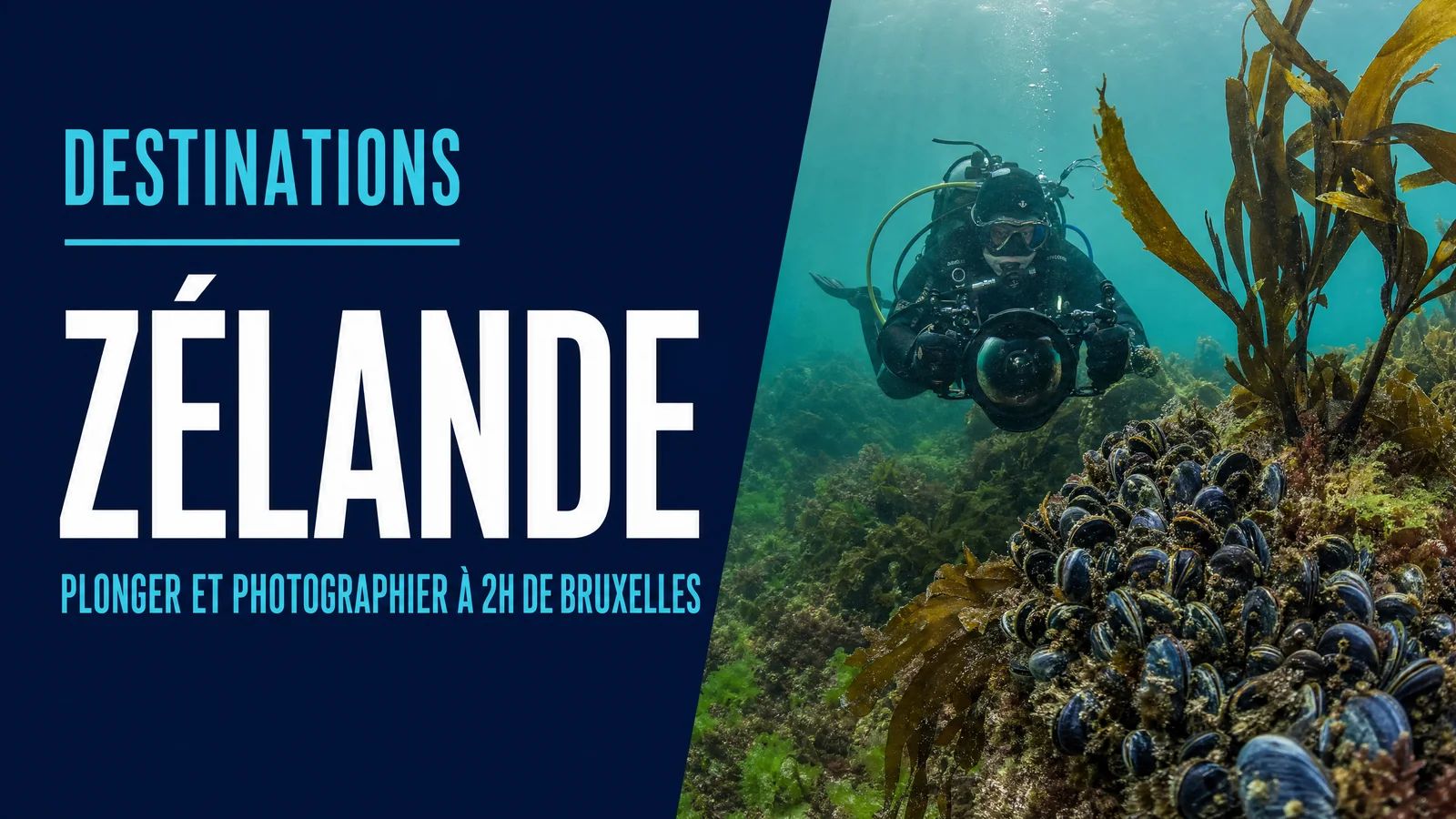
Zeeland: Diving and Underwater Photography 2 Hours from Brussels
When Belgian divers think about a photography weekend, they usually think of the Mediterranean, the Canary Islands, or the Red Sea. Zeeland, two hours up the road, rarely comes to mind first.
That is a mistake.
The first time I dived the Grevelingenmeer, I found seahorses at less than five metres depth, in water with 10 metres of visibility, two hours from Brussels. An experience that many expensive long-haul destinations simply cannot match.
Zeeland is the most underrated underwater photography destination within reach from Belgium. This guide exists to change that.
The Grevelingenmeer: The Lake That Surprises
The Grevelingenmeer is a former tidal estuary that became a saltwater lake after the Delta Works construction in the 1970s. Today it is the largest saltwater lake in western Europe, and one of the most interesting photography diving destinations in northern Europe.
What makes it unique. The water is saline but without tidal currents. Visibility stays stable, usually between 8 and 15 metres in summer and occasionally more in autumn. The bottom is largely sandy or rocky with rich seagrass beds. Wildlife is dense and relatively undisturbed.
Wildlife to photograph. Short-snouted seahorses are the undisputed stars of the site. They live in Zostera seagrass beds between 3 and 12 metres. They are also among the most delicate animals to approach without causing harm. The principles of ethical seahorse photography apply here more than anywhere: no touching, no disturbing the seagrass, no bubbles directed at the animal.
Beyond seahorses, the Grevelingenmeer holds thornback rays, cuttlefish in season, octopus, wrasse, and exceptional macro subjects including nudibranchs, spider crabs and shrimps.
Popular sites. Scharendijke harbour is the classic entry point for first-timers: easy access, sandy bottom, varied wildlife. Battenoord and Dreischor offer wilder conditions and denser wildlife for experienced divers.
The Oosterschelde: Currents and Wrecks
The Oosterschelde is an open tidal channel, protected by the storm surge barrier but still subject to tidal currents. Diving here is more technical than the Grevelingenmeer, and conditions change quickly.
For experienced photographers. The marine life is exceptional: lobsters, conger eels in rock crevices, schools of horse mackerel, rays, turbot. The species diversity is greater than the Grevelingenmeer, but the conditions require solid current experience and disciplined air management.
Diving on current. In the Oosterschelde, current can reach 2-3 knots during spring tides. The productive dive window sits around slack water, often only 30 to 45 minutes. Timing must be planned with Dutch tide tables in advance. It is a real constraint, but it is also what keeps the water clean and rich.
Wrecks. The Oosterschelde holds several accessible wrecks inhabited by conger eels, lobsters and octopus. For wildlife-on-wreck photography, it is one of the best spots in northern Europe.
What to Photograph in Zeeland
The range of subjects covers almost the full diversity of northern Atlantic photography.
Macro. The Grevelingenmeer's strongest suit. Seahorses, nudibranchs, shrimps, sea slugs, larval and juvenile fish in the seagrass beds. A macro wet lens is strongly recommended. The article on macro photography with smartphone and GoPro details configuration options for those without a dedicated optic.
Fish portraits. Wrasse, bream, flatfish, mullet: the Grevelingenmeer's bottom fauna is photogenic and relatively unbothered by divers. The composition rules for underwater photography apply in full: get down to the subject's level, find a clean background, place the eye in the upper third of the frame.
Seagrass landscapes. The Zostera meadows form visually consistent underwater prairies. Summer light between 10am and 2pm creates interesting rays across these grasslands.
Rays and large animals. Thornback rays are common in summer, often partially buried in sand. A slow, bottom-parallel approach produces remarkable portraits.
Logistics from Belgium
Getting to Zeeland from Brussels is straightforward.
By car. Take the E40 toward Ghent, then the A58 toward Goes and Middelburg. Allow 1h45 from Brussels to Scharendijke for the Grevelingenmeer. The route is direct with no tolls.
Accommodation. Zeeland is a well-equipped Dutch coastal tourism area: campsites, bungalows, hotels in Bruinisse, Scharendijke and Zierikzee. Book ahead in July and August.
Gear rental and air fills. Several local dive centres offer equipment rental and tank fills. Check opening hours in advance, as some centres close early in the evening.
Level requirements. Open Water for the Grevelingenmeer (most sites stay within 10-15 metres). Advanced Open Water recommended for the Oosterschelde and current-exposed sites.
Season and Conditions
Spring (April-May). Water is still cold (10-12°C) but visibility starts improving. Wildlife becomes progressively more active.
Summer (June-September). The optimal photography season. Water temperature between 18 and 22°C, seahorses active, cuttlefish present, strong light. Visibility can dip slightly during the July algae bloom. A 5mm wetsuit is comfortable.
Autumn (October-November). My preferred season for visibility: the water cools, algae disappear and transparency can reach 12-15 metres. A 7mm wetsuit is necessary.
Winter (December-March). Water at 5-8°C. A drysuit is strongly recommended. Bottom fauna (conger, lobster, soles) stays active. Few divers on site.
For photographer safety underwater, a reminder: in cold water, hypothermia develops faster than you realise. Keep your time in the water within what your exposure suit genuinely allows, not what your enthusiasm for photography might prefer.
Where to Dive, Concretely
If I were sending a Belgian photographer to Zeeland for the first time, I would start with Scharendijke harbour on the Grevelingenmeer. Easy access, no hazardous terrain, enough wildlife to justify the drive on the very first dive.
For current dives in the Oosterschelde or the more specific seahorse spots deeper in the Grevelingenmeer, connecting with a local dive centre before arriving is essential. Conditions change quickly and a local briefing is worth far more than any online guide. Dive centres around Scharendijke and Bruinisse offer local guides, current-specific training, and up-to-date visibility information.
Two Hours Away
Two hours of driving, wildlife that many expensive long-haul destinations cannot match, simple logistics and a minimal travel cost.
Before planning a photography trip to the other end of the world, it is worth checking what exists within 200 kilometres. Zeeland often answers the question.
If you want to prepare seriously for your Zeeland photography dives, whether on macro technique, animal approach or cold-water post-processing, AquaExposure photography training covers these subjects from the pool through to open-water environments.
Zeeland: Diving and Underwater Photography 2 Hours from Brussels | AquaExposure