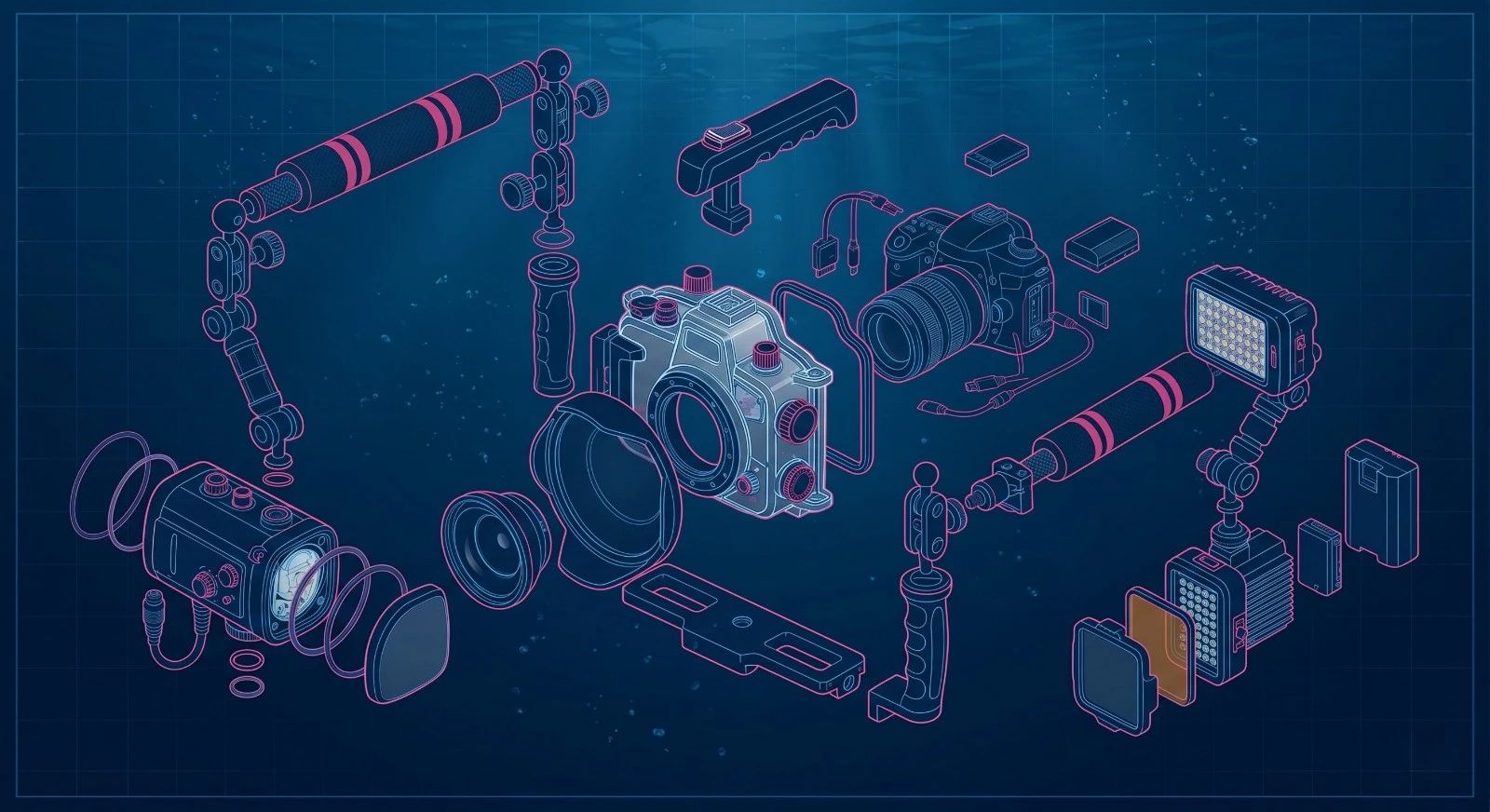
Underwater Photo & Video Rig Builder
How to balance dry weight, housing bulk, and lighting underwater to achieve neutral buoyancy and prevent severe wrist fatigue?
Configuring an underwater photo rig requires balancing dry weight and in-water buoyancy to prevent severe wrist fatigue. Aim for a slightly negative buoyancy between -100g and 0g, verify the 100 Wh per battery limit for air travel, and counterbalance large glass dome ports using hollow carbon fiber float arms.
98 official underwater partsNauticam • Ikelite • Sea&Sea • Retra • Inon • Keldan • BackscatterBuoyancy & IATA live compute
Express Selector Tier 1
Which underwater photo and video rig fits your profile?
Configure in 3 clicks your ideal rig based on your camera body, lighting system, and buoyancy target without getting lost in dozens of technical mounting parts.
Compact body, full-frame mirrorless or pro cinema wide-angle rig
100% natural light, dual underwater strobes or continuous video lights
Slightly negative, neutrally buoyant or positive compensated
Instructor buoyancy and handling diagnosis
The -100g to 0g in-water buoyancy window is the golden standard taught at AquaExposure. It keeps the rig securely planted in your hands without upward drift during vertical portrait framing.
Recommended rig configurations for your profile
Ideal Setup #1Photo + Video
Polyvalent Intermédiaire
Canon R5 + Nauticam NA-R5 + dual Z-330 + bras. Le setup qui couvre photo et video.
Weight in air
7.65 kg
Buoyancy in water
+1574g
Combined battery
54 Wh
IATA airline compliance
Carry-on compliant (< 100 Wh)
Estimated complete rig budget€11,450
Versatile Alternative #2Macro / Super-macro
Macro Specialist
Canon R5 II + NA-R5II + RF 100mm Macro + dual flashs + MF-2 snoot. Tout pour le macro et super-macro.
Weight in air
7.39 kg
Buoyancy in water
+1747g
Combined battery
46 Wh
IATA airline compliance
Carry-on compliant (< 100 Wh)
Estimated complete rig budget€12,860
Specialist Choice #3Polyvalent
Débutant Compact
OM-1 II + caisson Nauticam + flash unique + mini platine. Setup léger et abordable pour debuter.
Weight in air
4.58 kg
Buoyancy in water
+752g
Combined battery
36 Wh
IATA airline compliance
Carry-on compliant (< 100 Wh)
Estimated complete rig budget€7,670
Full Rig Builder & Hydrostatic Calculator
Assemble custom configurations from 98 parts, fine-tune buoyancy arms to the exact gram, and verify IATA airline rules.
Comparative table of the 5 reference rig configurations
Official physical data computed for seawater immersion at 25°C with lenses and batteries loaded.
| Rig Preset | Body & Housing | Lighting | Dry weight | Water buoyancy | Batteries | IATA Flight | Estimated price |
|---|---|---|---|---|---|---|---|
Débutant Compact Polyvalent | OM System OM System OM-1 Mark II Nauticam NA-OM1 Housing | Inon Z-330 | 4.58 kg | +752g | 36 Wh | OK Cabine | €7,670 |
Polyvalent Intermédiaire Photo + Video | Canon Canon EOS R5 Nauticam NA-R5 Housing | 2x Inon Z-330 | 7.65 kg | +1574g | 54 Wh | OK Cabine | €11,450 |
Pro Grand-Angle Grand-angle / CFWA | Sony Sony A1 Nauticam NA-A1 Housing | 2x Retra Flash Pro Max II, Sola Video 3000 | 8.93 kg | +1030g | 77 Wh | OK Cabine | €19,270 |
Macro Specialist Macro / Super-macro | Canon Canon EOS R5 Mark II Nauticam NA-R5II Housing | Inon Z-330, Backscatter Mini Flash 2 (MF-2) | 7.39 kg | +1747g | 46 Wh | OK Cabine | €12,860 |
Videaste Full Video | Canon Canon EOS R5 Mark II Nauticam NA-R5II Housing | 2x Video 8X FLUX 18K | 10.51 kg | +709g | 214 Wh | OK Cabine | €21,180 |
Why to aim for slightly negative buoyancy underwater
Most novice underwater photographers assume an exactly neutral rig is the ultimate goal. In reality, a neutral rig begins floating upward the moment you open your hands to adjust your mask or check your pressure gauge. You spend your dive chasing drifting equipment.
The -100g to 0g in-water range offers the best ergonomic balance. It keeps the camera comfortably seated in your palms without feeling heavy, ensuring your rig remains steady at eye level without drifting away.
From a dive safety perspective, an excessively negative rig (sinking by more than 600g in water) creates rapid wrist fatigue and increases danger in down-currents. Conversely, an overly positive rig introduces runaway ascent risks during shallow safety stops.
Frequently asked questions about underwater rigs
How do you calculate the total weight and underwater buoyancy of a camera rig?
Our rig builder sums the dry weight of each component (camera, housing, port, strobes, arms, and clamps) and calculates saltwater displacement based on Archimedes principle. It reveals apparent in-water weight and buoyancy status.
What is the ideal in-water buoyancy for an underwater photography rig?
The recommended sweet spot is between -100g and 0g (slightly negative). This keeps the camera rig planted securely in your hands without upward drift, eliminating wrist fatigue throughout long repetitive dives.
Is my underwater photography rig compliant with IATA airline baggage rules?
The builder automatically calculates battery capacities. Individual lithium batteries under 100 Wh are permitted in carry-on luggage without airline approval. Batteries between 100 Wh and 160 Wh require airline consent.
How much does a complete underwater photography rig cost?
A beginner compact rig starts around 3,500 EUR, an intermediate versatile setup sits around 7,000 EUR, and a pro cinema wide-angle rig with optical glass domes frequently exceeds 15,000 EUR.
Why choose natural light photography over a heavy strobe-equipped rig?
Shooting in natural light sheds 2 to 4 kg of trays, arms, and heavy strobe batteries. Your rig remains lightweight, air consumption improves, and you approach marine wildlife passively without sudden light flashes.
How do you balance a rig that sinks too heavily underwater?
Add hollow carbon fiber buoyancy arms or high-density Stix Jumbo foam floats. Each buoyancy arm counteracts between 150g and 450g of negative weight, bringing your complete setup back to neutral balance.