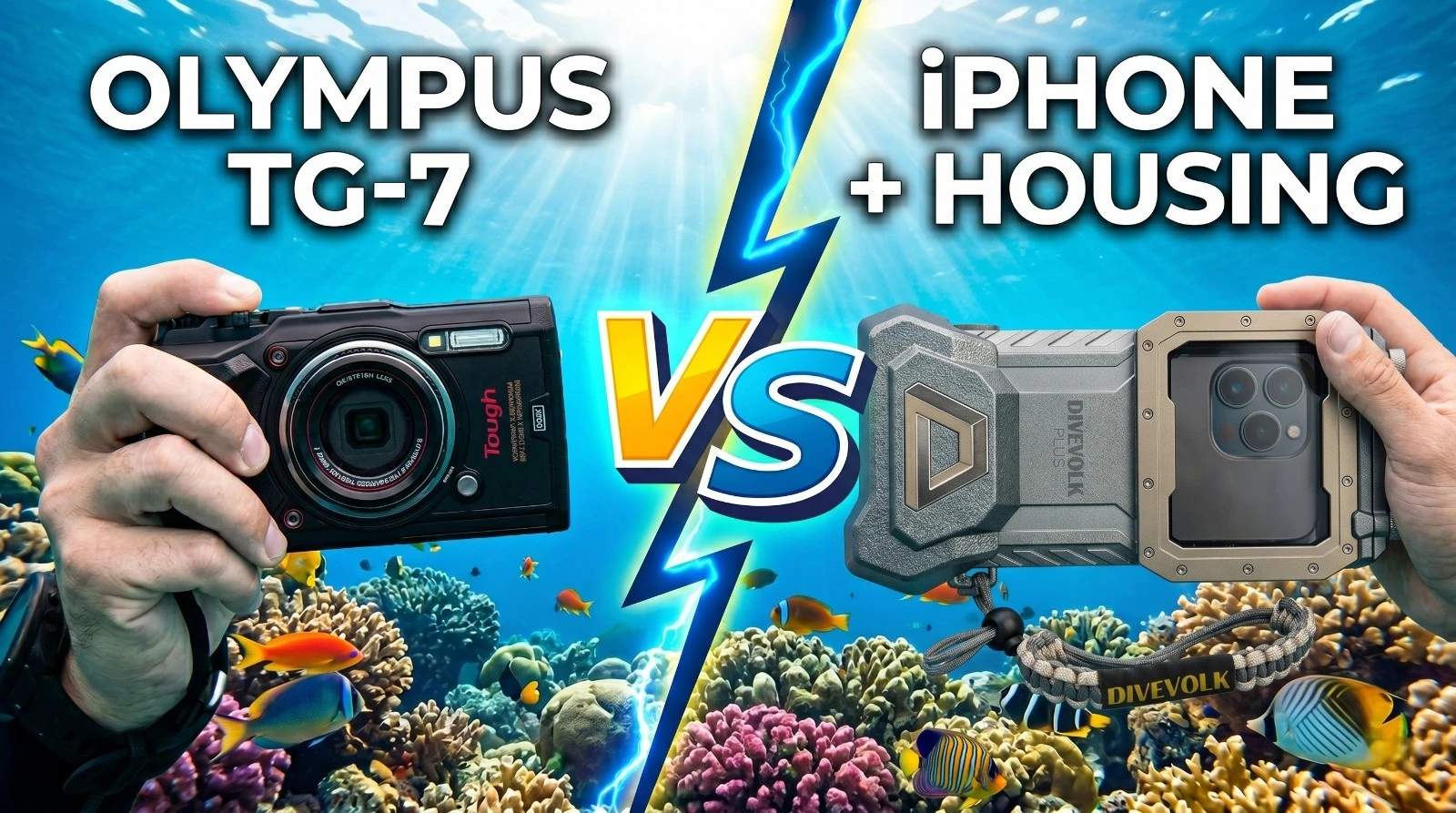
TG-7 or iPhone with a housing to start underwater photography? The field comparison: macro, wide-angle, workflow, budget. No sugarcoating.
Olympus TG-7 vs iPhone in an underwater case: the real comparison for underwater photography
The TG-7 excels in macro (focus at 1 cm, without accessory), supports 15 meters without a housing, and costs approximately 550 euros as a bundle with a Seafrogs housing. The iPhone in the DiveVolk housing offers better wide-angle image quality, instant workflow (no SD card required), and the versatility of a multi-purpose device. If you are a beginner and already have a recent iPhone, get the housing. If you don't have a high-performance smartphone and are passionate about macro photography, the TG-7 remains a solid option.
AquaExposure is a Divevolk partner. Discount code and direct link at the end of the article.
Why this comparison in 2026
In 2026, that's still the question I hear most often before a training: "I'm hesitating between an underwater compact and an iPhone in a housing. What do you advise me?"
The answer depends on three things: what you already have, what you want to photograph underwater, and what you plan to do with the files. Neither is a bad decision - but they are two different philosophies.
This comparison does not cover smartphones versus GoPro or advanced compacts (this is in the article Smartphone, GoPro, waterproof compact: which one to really choose. It focuses on the specific duel between the TG-7 and the iPhone in a housing, because that is the duel that comes up in my conversations before each course.
The TG-7: What it does well and what we don't talk about enough
The Olympus OM System TG-7 is waterproof to 15 meters without a housing. This detail changes the way you use it in practice. For snorkeling, shallow diving, or dives where you don't go very deep, you simply remove the camera from the water, rinse the body, and that's it. No housing to open, no seal to check, no waterproof gel to inspect. The TG-7 is ready in 10 seconds.
To go deeper, the Seafrogs PT-059 decompression chamber extends the capability to 45 meters - which covers almost all recreational diving. As a bundle, expect to pay between 550 and 650 euros depending on the seller.
Macro mode is in a special category
Focusing at 1 centimeter from the TG-7 subject, in Microscope mode, is something that very few cameras can do without additional accessories. Not just smartphones - even high-end compact cameras.
At 1 cm, you step into the shoes of a cleaning shrimp. You frame the eye of a nudibranch. You see structures that the human eye barely perceives underwater. This is a completely unique photographic experience, and the TG-7 makes it accessible without an additional lens, without a focusing arm, without anything else.
The iPhone with the DiveVolk housing can take macro shots with an additional lens. The Platinum does this better than the Max Plus thanks to its Almighty mount (see our comparison of DiveVolk versions). However, it is an additional accessory, an extra cost, and requires installation before entering the water.
What the TG-7 doesn't do
The TG-7 doesn't have a full manual mode. It offers Program mode, Aperture Priority, and Shutter Priority - but not a manual mode where you control both aperture AND shutter speed simultaneously. This is sufficient for many underwater situations. However, for some (difficult light, fast-moving subjects, desired blur effects), it's a real limitation.
The sensor on the TG-7 has a resolution of 12 megapixels. An iPhone 15 Pro or 16 Pro has a resolution of 48 megapixels in ProRAW mode. The difference in cropping and the ability to recover an image in post-production is significant - but it is not noticeable on a smartphone screen. It becomes noticeable when you print in large format or crop heavily.
The workflow is also more cumbersome. SD card, transfer to computer, import software. Nothing dramatic, but it's an extra step that the iPhone doesn't require.
The iPhone in a Dive: What it Does Well and Its True Limitations
I use an iPhone Pro in a DiveVolk housing for over 1,000 dives. The details of this experience are in the article iPhone + DiveVolk: why I replaced all my equipment. I will focus here on the direct comparison points with the TG-7.
Wide-angle is where the smartphone dominates the compact camera
In wide-angle, the recent iPhone is better than the TG-7 in most conditions. The larger sensor (compared to the TG-7), the computational processing, and the higher resolution produce images with more detail, that are more usable in post-production, and that are more recoverable in poor lighting.
To photograph a manta ray swimming above you, a whale shark in a wide shot, or a school of barracuda in formation, the iPhone in natural light produces results that the TG-7 cannot achieve at an equivalent budget.
This is a point that the industry now officially recognizes: the smartphone category in the UPY 2026 competition was won with a DiveVolk + smartphone setup, in macro - which demonstrates that even in the preferred discipline of the TG-7, the competitive smartphone can win with the right accessories.
Instant workflow really changes habits
Take your iPhone out of the water in a DiveVolk box: you open the box, and your phone is there with all your photos. You can share them immediately, edit them in Lightroom Mobile on the boat, or send an image to someone while you're eating.
This is not a matter of cosmetic comfort. If you are creating content for social media, to document your dives, or for personal use, this immediate workflow changes the way you process and share what you have filmed.
The Real Limits of Smartphones Underwater
The iPhone consumes more power when recording 4K video than a dedicated device. Be sure to charge between dives if you are recording a lot.
Surface heat is a point of caution. An iPhone in a closed housing in direct sunlight can quickly overheat. Keep it in the shade or open the housing between dives.
And the housing - it needs maintenance. Inspect the seals before each dive, rinse with fresh water after each outing, and replace the grease periodically. It's 5 minutes of discipline per dive - but it's 5 minutes that the TG-7 doesn't require (up to 15m).
The real deciding factor: how you dive, not what you photograph
After years of training, I noticed that the most predictive criterion for a good choice is not the type of subjects photographed, but the way to dive.
If you are diving for exploration, often alone or with minimal equipment, you frequently change locations and don't know what you will encounter in advance: the smartphone in a housing is more consistent. One object for everything, a short workflow, and optical versatility (zoom, wide-angle, macro with lens) that the TG-7 cannot match.
If you are doing intensive macro photography, if you regularly return to the same locations for the same subjects, or if you often dive at shallow depths: the TG-7 deserves serious consideration. Autofocus at 1 cm without accessories is a real and documented advantage in this specific practice.
If you already have an iPhone 13 Pro or later: take the DiveVolk housing. You already have the best wide-angle in your pocket. The housing alone (400-450 euros) costs less than the TG-7 + Seafrogs bundle (550-650 euros) and gives you a superior result in two-thirds of situations.
If you don't have a high-performing smartphone and aren't planning to buy one soon: the TG-7 is a solid, standalone option. It doesn't require a phone ecosystem; it operates independently, and the Seafrogs housing at 45 meters covers the vast majority of recreational dives.
The budget, frankly
TG-7 alone: approximately 549 euros. With the Seafrogs PT-059 case: between 550 and 650 euros depending on the retailer. This is the starter kit, without additional lenses.
iPhone 16 Pro alone: between 1100 and 1300 euros. DiveVolk SeaTouch 4 Max Plus housing: approximately 420 euros. If you already have an iPhone, your entry cost is 420 euros. If you are starting from scratch, it is 1500 to 1700 euros.
In a direct comparison with a similar budget (around 600 euros), the TG-7 + Seafrogs is the only fully autonomous and complete underwater photography setup. The iPhone alone, at this budget, is a mid-range device with a sensor that is inferior to a 16 Pro.
The real question about the budget is: Do you already have a good iPhone? If so, the choice is simple. If not, the total budget for the smartphone ecosystem changes the calculation.
Frequently Asked Questions
Does the TG-7 produce better photos than the iPhone underwater? In close-up (less than 10 cm), yes, the TG-7 without accessories performs better than the iPhone without an additional lens. In wide-angle and natural light, the latest high-end iPhone produces superior images. The verdict depends on what you are photographing.
Can we really control an iPhone underwater in a DiveVolk enclosure? Yes. The physical buttons on the enclosure cover the essential functions (taking a picture, zooming, switching between photo and video). The touchscreen remains functional in most configurations. In practice, you configure the app before entering the water.
Does the TG-7 have RAW? Yes, the TG-7 captures RAW files. The dynamic range is correct but lower than that of an iPhone 15/16 Pro's ProRAW. For standard editing (white balance correction, exposure), both formats are usable.
What if I want to do both: macro AND wide-angle? With the iPhone + DiveVolk Platinum housing + additional macro lens, you cover both. It's a more significant investment, but you only have one device to manage.
Is the TG-7 better than the TG-6? Slightly. The TG-7 offers improvements in highlight management and an enhanced Microscope mode. If you have a TG-6 that works well, this is not an urgent upgrade.
Can the TG-7 be used while snorkeling without a housing? Yes, it is certified for use up to 15 meters without a housing. This is a real advantage for snorkeling between 0 and 10 meters. An iPhone without a housing is only certified for a maximum of 6 meters (and cheap soft housings are not suitable for repeated use).
What is the lifespan of a TG-7? With normal maintenance, 7 to 10 years. This is one of the advantages of a waterproof compact camera over the long term: it doesn't become obsolete when a new generation of phone comes out. The disadvantage is the opposite: you can't upgrade the sensor by changing phones.
To Go Further
- iPhone + DiveVolk: review after 1,000 dives
- DiveVolk SeaTouch 4, Max Plus or Platinum: which one to choose
- Smartphone, GoPro, compact waterproof: the complete comparison
- Getting started with underwater photography: where to begin
- The complete AquaExposure training
Benjamin Coste is an underwater photography expert. He is also a certified PADI instructor. His courses cover various aspects of underwater photography. He teaches composition, lighting, and post-processing techniques. His AquaExposure products are highly regarded in the industry.
If you decide to purchase the DiveVolk, please use our affiliate link (transparency is important): Automatic 6% discount on your entire order by clicking on this link to divevolk.com, without needing to enter a code. The discount reaches up to 25% during special offers. All our equipment partnerships are listed on the partners page.
Partager
Sommaire
- 01Why this comparison in 2026
- 02The TG-7: What it does well and what we don't talk about enough
- 03Macro mode is in a special category
- 04What the TG-7 doesn't do
- 05The iPhone in a Dive: What it Does Well and Its True Limitations
- 06Wide-angle is where the smartphone dominates the compact camera
- 07Instant workflow really changes habits
- 08The Real Limits of Smartphones Underwater
- 09The real deciding factor: how you dive, not what you photograph
- 10The budget, frankly
- 11Frequently Asked Questions
- 12To Go Further
Questions sur le Journal
Puis-je utiliser les photographies de ce journal ?
Toutes les images sont protégées par le droit d'auteur. Pour toute utilisation commerciale ou éditoriale, merci de nous contacter via notre formulaire.
Comment être informé des nouveaux articles ?
Suivez-nous sur nos réseaux sociaux ou rejoignez le Cercle des Sentinelles pour recevoir nos récits d'immersion en avant-première.
Proposez-vous des ateliers pratiques ?
Oui, nous organisons des masterclass et des expéditions sur le terrain pour les membres de notre école. Consultez la page Formations pour les détails.


