Table of Contents
Underwater photography in the Canary Islands: angelsharks, sea turtles, basalt organs of La Rapadura, and El Hierro pelagics. Complete site guide and ambient light settings.
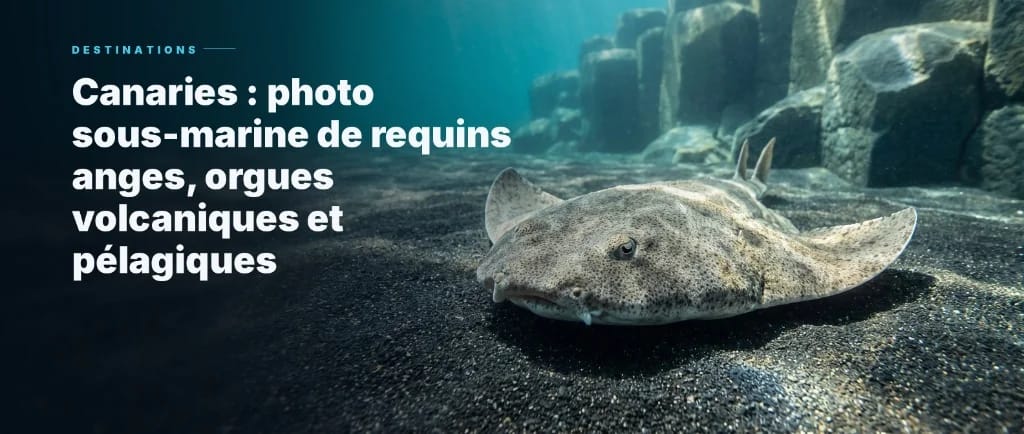
At El Cabrón, on the east coast of Gran Canaria, you can drift for ten minutes over a volcanic black sand plain without detecting anything. Then, easing your fin kicks and letting the water settle, two small elevated eyes and a subtle triangular contour emerge right at seabed level. The angelshark was there the entire time, perfectly motionless beneath a millimeter of sediment.
Underwater photography in the Canary Islands thrives on this permanent interplay between meticulous benthic camouflage and monumental volcanic seascapes. Here, the Atlantic Ocean meets ancient volcanic fire to carve out singular underwater backdrops where the elusive angelshark, colossal basalt cathedrals, and unexpected open-ocean pelagics share the same blue water.
This guide outlines key dive locations, iconic marine wildlife, and practical ambient light techniques for successful imagery.
A volcanic archipelago swept by the Canary Current
Located barely a hundred kilometers off the coast of Western Sahara, the seven main Canary Islands enjoy a stable subtropical climate and water temperatures ranging from 18°C in winter to 24°C in late summer. This mild environment ensures productive diving and photography conditions twelve months a year.
A turbulent geological history has sculpted varied underwater terrain. Towering vertical drop-offs, lava tubes, expansive volcanic black sand fields, and petrified magma arches create dramatic mineral compositions below the surface.
The angelshark: a global sanctuary in the Canaries
The European angelshark (Squatina squatina) is classified as critically endangered by the IUCN. Having disappeared from nearly all of its historic ranges in the Mediterranean and North Sea, it has found its last reliable global stronghold across the Canary archipelago.
Ethical observation and approach techniques
The angelshark relies on an ambush hunting strategy. Flattened against the seafloor, it buries itself in sand, leaving only its eyes and breathing spiracles exposed. Its granular skin matches volcanic sediments with extraordinary precision.
For the photographer, approaching requires disciplined control:
- Maintain precise neutral buoyancy to avoid kicking up sand clouds that ruin visibility and disturb the animal.
- Never descend vertically directly on top of the shark. Approach from the side, gliding slowly just above the bottom.
- Use a wide-angle perspective incorporating surrounding sand textures to highlight this masterpiece of biological camouflage.
Remarkable underwater geology and volcanic cathedrals
Beyond its iconic marine life, the underwater architecture of the Canary Islands provides imposing photographic compositions.
La Rapadura in Tenerife: the cathedral of basalt organs
Off the northern coast of Tenerife, near La Quinta, lies the extraordinary dive site of La Rapadura. This geological formation consists of colossal submerged basalt columns. Polygonal volcanic prisms rise in regular pillars from 20 meters down to 45 meters depth, evoking a submerged Giant's Causeway.
Diving among these mineral colonnades is breathtaking. Midday sunlight streaming across dark volcanic stone creates dramatic contrast, making it a prime site for wide-angle perspectives and depth-of-field exploration.
El Hierro and the Mar de Las Calmas Marine Reserve
At the southwestern tip of the archipelago, the tranquil island of El Hierro protects the La Restinga Marine Reserve (Mar de Las Calmas). Shielded from trade winds by island topography, this area offers tropical clarity with visibility frequently reaching 30 to 40 meters.
The El Bajón seamount, rising from abyssal depths up to 9 meters below the surface, is a premier site for wide-angle ambient photography and pelagic encounters. Deep underwater canyons, massive lava arches, and vertical walls form the backdrop of daily dives.
El Cabrón and Fuerteventura
On Gran Canaria, the El Cabrón marine reserve features lava caves, arches, and black sand plateaus rich in macro life. Meanwhile, off Fuerteventura and Lanzarote, sites like Bajón del Río and Veril Grande showcase dramatic volcanic shelves sculpted by Atlantic swells.
Open-ocean pelagics and rare visitors
Thanks to its position off the African coastline, the Canary Islands serve as a crossroads for large ocean wanderers.
The rare basking shark: an exceptional pelagic sighting
The basking shark (Cetorhinus maximus), the second-largest fish on Earth, is a harmless filter feeder reaching 8 to 10 meters in length. While it typically prefers temperate and boreal plankton-rich waters, individuals travel southward during winter and spring migrations.
Occasional sightings of basking sharks swimming mouth-open at the surface have been recorded off Tenerife and La Palma. Encountering this massive silhouette filtering plankton remains one of the rarest privileges in Atlantic diving.
Whale sharks and hammerhead sharks
In late summer and early autumn, when water around El Hierro and southern Gran Canaria peaks at 23-24°C, whale sharks (Rhincodon typus) occasionally cruise along the walls of El Bajón. Schools of smooth hammerheads (Sphyrna zygaena) are also spotted in blue water during the same window.
Stingrays and sea turtles
Canarian waters host a remarkable variety of elasmobranchs:
- Common stingrays (Dasyatis pastinaca) and round stingrays (Taeniura grabata), frequently exceeding 1.5 meters across.
- The striking spiny butterfly ray (Gymnura altavela), concealed beneath sand like the angelshark.
- Passing schools of eagle rays and coastal mobula encounters.
- Resident loggerhead (Caretta caretta) and green sea turtles around Tenerife and Lobos Islet (Fuerteventura).
To pinpoint the peak sighting months for each pelagic species across global dive spots, check our interactive marine species seasonality calendar.
Camera settings for the Canary Islands
The marked contrast between dark volcanic rock and crystal-clear water benefits from specific adjustments:
- Exposure and dynamic range: dark lava rock absorbs significant light while surface water remains bright. Use center-weighted or spot metering on your subject to preserve shadow details.
- Shutter speed: set 1/160s to 1/250s for turtles and resting angelsharks, increasing to 1/320s when fast pelagics pass overhead.
- ISO sensitivity: between 100 and 400 ISO during daylight hours. Generous Canarian sunshine allows low ISO values for optimal image sharpness.
- Housings and optics: a wide-angle dome is the primary choice. If using a mobile phone, explore our smartphone underwater housing comparison tool to select an appropriate system for coastal diving.
To develop your composition and learn to capture volcanic textures without artificial lights, the AquaExposure training curriculum details ambient light techniques for high-contrast marine settings.
Planning your Canary Islands photography trip
The Canary Islands stand out for their logistical convenience:
- Seasonality: open year-round. Winter and spring favor angelshark sightings and rare pelagic visits, while summer and autumn deliver peak water clarity, ray aggregations, and pelagic action at El Hierro.
- Logistics: daily direct flights connect European hubs to Tenerife, Gran Canaria, Fuerteventura, and Lanzarote, with regular inter-island ferries reaching El Hierro and La Gomera.
- Gear preparation: inspect your safety gear, cords, and dome ports before departure with the guides in our tools section.
The Canaries within the Macaronesian circuit
The Canaries represent the most versatile and accessible leg of the Eastern Atlantic. They balance the steep topography of Madeira and the offshore seamounts of the Azores.
From the patient search for camouflaged angelsharks to the grand scale of La Rapadura's basalt organs, the Canary Islands offer underwater photographers an exceptional natural palette.
Benjamin Coste is a diving instructor and underwater photography educator. He has been teaching available light photography since 2014 on aquaexposure.com.
Share
/blog/canaries-photo-sous-marine-tortues-anges-en
Table of Contents
- 01A volcanic archipelago swept by the Canary Current
- 02The angelshark: a global sanctuary in the Canaries
- 03Ethical observation and approach techniques
- 04Remarkable underwater geology and volcanic cathedrals
- 05La Rapadura in Tenerife: the cathedral of basalt organs
- 06El Hierro and the Mar de Las Calmas Marine Reserve
- 07El Cabrón and Fuerteventura
- 08Open-ocean pelagics and rare visitors
- 09The rare basking shark: an exceptional pelagic sighting
- 10Whale sharks and hammerhead sharks
- 11Stingrays and sea turtles
- 12Camera settings for the Canary Islands
- 13Planning your Canary Islands photography trip
- 14The Canaries within the Macaronesian circuit
Questions about the Journal
Where can you see angelsharks in the Canary Islands?
El Cabrón (Gran Canaria) and sheltered bays around Tenerife and Fuerteventura offer the highest encounter rates for the angelshark (Squatina squatina). The animal rests motionless, buried beneath a thin layer of sand between 5 and 20 meters depth.
What are the most dramatic volcanic dive sites in the Canaries?
La Rapadura in northern Tenerife features a monumental underwater cathedral of hexagonal basalt organs descending to 45 meters. In El Hierro, the Mar de Las Calmas Marine Reserve at La Restinga features the El Bajón seamount, volcanic arches, and dramatic lava canyons.
Can you encounter basking sharks or whale sharks in the Canary Islands?
The basking shark (Cetorhinus maximus) is an extremely rare but documented pelagic visitor during winter and spring migrations. In late summer and early autumn, whale sharks (Rhincodon typus) and hammerhead sharks are occasionally spotted off El Hierro and Gran Canaria.
Are sea turtles present year-round in the Canary Islands?
Yes. Loggerhead sea turtles (Caretta caretta) and green turtles are resident 12 months a year around Tenerife, Gran Canaria, and the islet of Lobos off Fuerteventura.
What camera gear is recommended for Canary Islands diving?
A wide-angle or ultra wide-angle lens is ideal to capture both large volcanic formations and close-up wildlife while maximizing generous natural ambient light.