How far in advance should I prepare my dive photography checklist?
Ideally 5 days before: that leaves time to order a missing accessory or get equipment serviced. Final verification happens 48 hours before, and one last check 2 hours before leaving the house.
Should I have separate checklists for diving and photography?
No - a single checklist organised by category is more efficient. Dive and photo gear travel together, airline rules apply to both, and packing the bag must anticipate both needs at once.
Which photo and housing gear should go in cabin or hold luggage?
The underwater housing, lithium batteries and primary camera travel in cabin luggage (never check lithium batteries). Arms, trays, heavy wet lenses and non-fragile accessories can go in a hard-shell checked case.
How many memory cards should I bring on a dive photography trip?
Rule of three: at least as many cards as planned dive days. For 10 days, 10 cards minimum. Shooting RAW, one action-heavy dive can easily fill 64 GB. Also bring an external hard drive for daily backups.
Are travel adapters necessary for dive photography trips?
Essential. Battery chargers, housing accessories and cameras all use different plugs. A universal multi-country adapter usually does the job, but in Indonesia or the Maldives, power can be unstable - a surge-protected power strip is real insurance.
Should I carry my dive certification card physically or digitally?
The physical card is always the reference. But a photo of the card and the last page of your dive log on your phone saves the situation if the card is lost. Some centres also accept PADI or SSI apps directly.
How do I check my housing before a trip?
Empty immersion test 24 hours before departure: close the housing without the camera, submerge it under 50 cm of water for 30 minutes. Open and inspect: the interior must be perfectly dry. If any trace of moisture appears, inspect every O-ring and repeat the test. Never leave without this test.
In the Maldives, 2018. I open my camera bag on the first morning and reach for my memory cards. I left them on my desk in Brussels. Two days of travel, six planned dives in one of the best underwater photography destinations in the world, and zero memory cards.
The dive centre had an old 8 GB card to sell. 8 GB in RAW is around 200 photos. Safe to say I shot very selectively those first two days.
Since then, I travel with a checklist. Not in my head - on paper, that I actually tick.
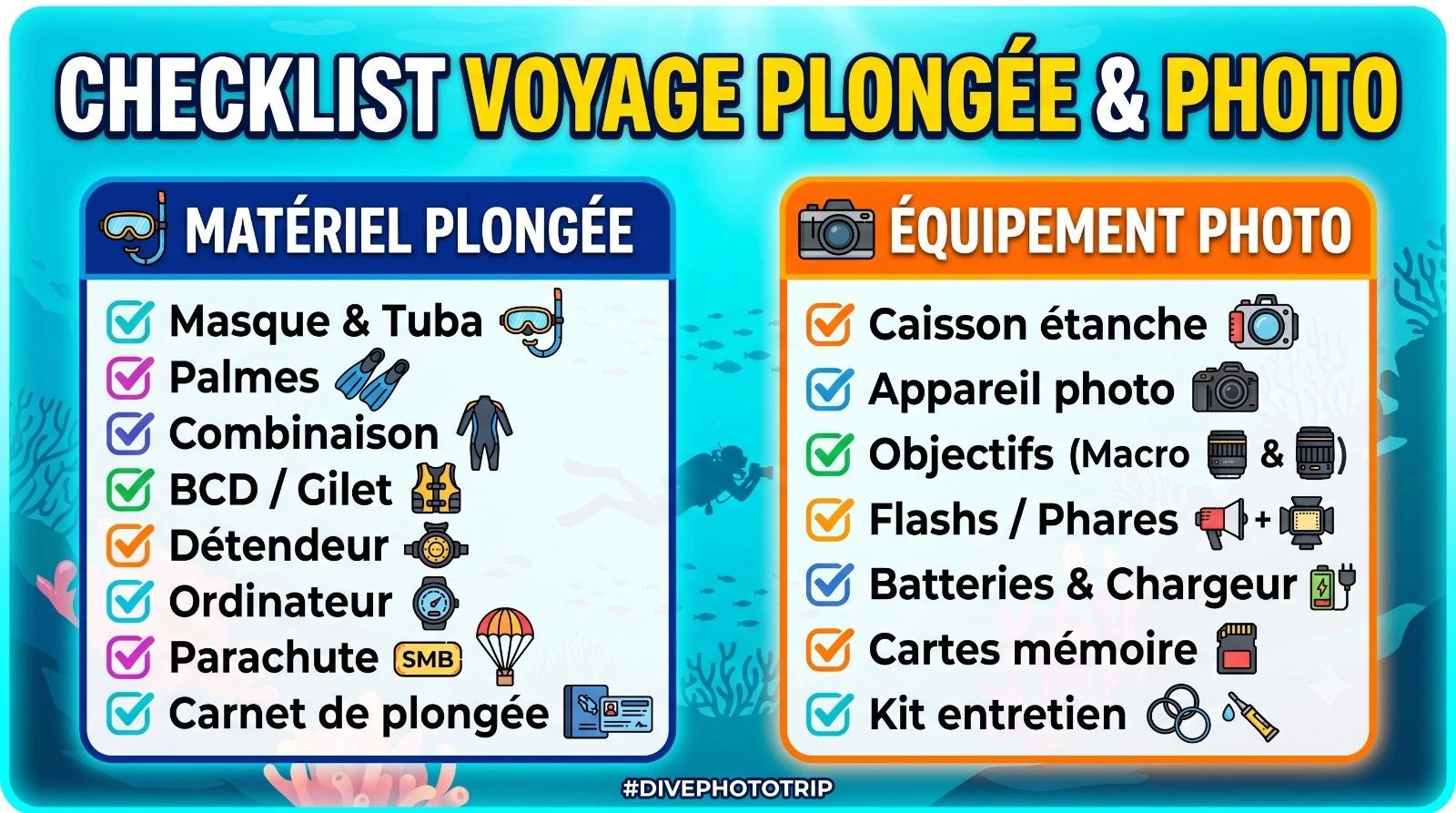
Here is the complete version, tested on a dozen dive photography trips. Organised into 8 categories for speed. Print it, tick it, never skip it.
Category 1 - Documents and Administration (7 items)
1Passport valid at least 6 months after the return date
2Visa (check processing times by destination)
3DAN dive insurance active with emergency number saved in your phone - see our full DAN insurance guide
5Medical fitness-to-dive certificate (less than 1 year old, as required by destination)
6Prescriptions for transported medications + list in English
7Emergency contacts: dive centre number, local hotel, DAN emergency line
Category 2 - Dive Equipment (12 items)
1Wetsuit suited to the destination (5 mm Mediterranean summer, 3 mm tropics, 7 mm cold water)
2Mask + anti-fog solution
3Fins (travel fins if space is limited)
4Regulator serviced (annual service recommended, or bi-annual depending on manufacturer)
5Dive computer with battery checked
6BCD appropriate to the trip (some can be rented on site, verify in advance)
7Surface marker buoy (SMB) in its pouch
8
Category 3 - Photo and Video Gear (11 items)
1Primary camera / smartphone
2Waterproof housing with O-rings inspected and empty immersion test completed (see box below)
3Memory cards (minimum as many as planned dive days - see intro anecdote)
4Spare batteries × 2 minimum, charged, in cabin luggage
5Chargers and appropriate cables
6Wet lens (macro or wide angle) if used
7Arms and trays for the housing (checked case in hold)
8
The Housing Test (run 24 hours before departure)
Fill a basin or sink with 30-50 cm of water. Close the housing empty (no camera). Submerge for 30 minutes. Remove and open: the interior must be perfectly dry. If the slightest trace of moisture appears, inspect every O-ring and repeat the test. Never leave without doing this.
5Lithium batteries in cabin luggage (never in hold - absolute IATA rule)
6Fireproof bag for spare lithium batteries
Category 6 - Comfort and Clothing (3 items)
1Neoprene boots (foot protection on boats + coral beaches)
2Quick-dry clothing (technical swimwear, t-shirt) for surface intervals
3Cap or hat for long boat days
Dive Photography Travel Checklist : 50 Things You Should Never Forget | AquaExposure
Category 7 - Organisation and Backup (2 items)
1Daily backup routine defined (card to external hard drive, minimum)
2Weather and tide apps installed and configured for the destination
Category 8 - Final Check (1 item)
1Re-read this checklist on the morning of departure, with the bag closed, calmly.
The last item is the most important. It feels redundant. It is not redundant.
A Checklist Is Not a Guarantee
The checklist covers gear forgetting. It does not cover fatigue, poor judgment underwater, or decisions made under pressure to "not miss the shot." Those aspects are addressed in the AquaExposure underwater photography training - including a module on managing divided attention between photography and safety.