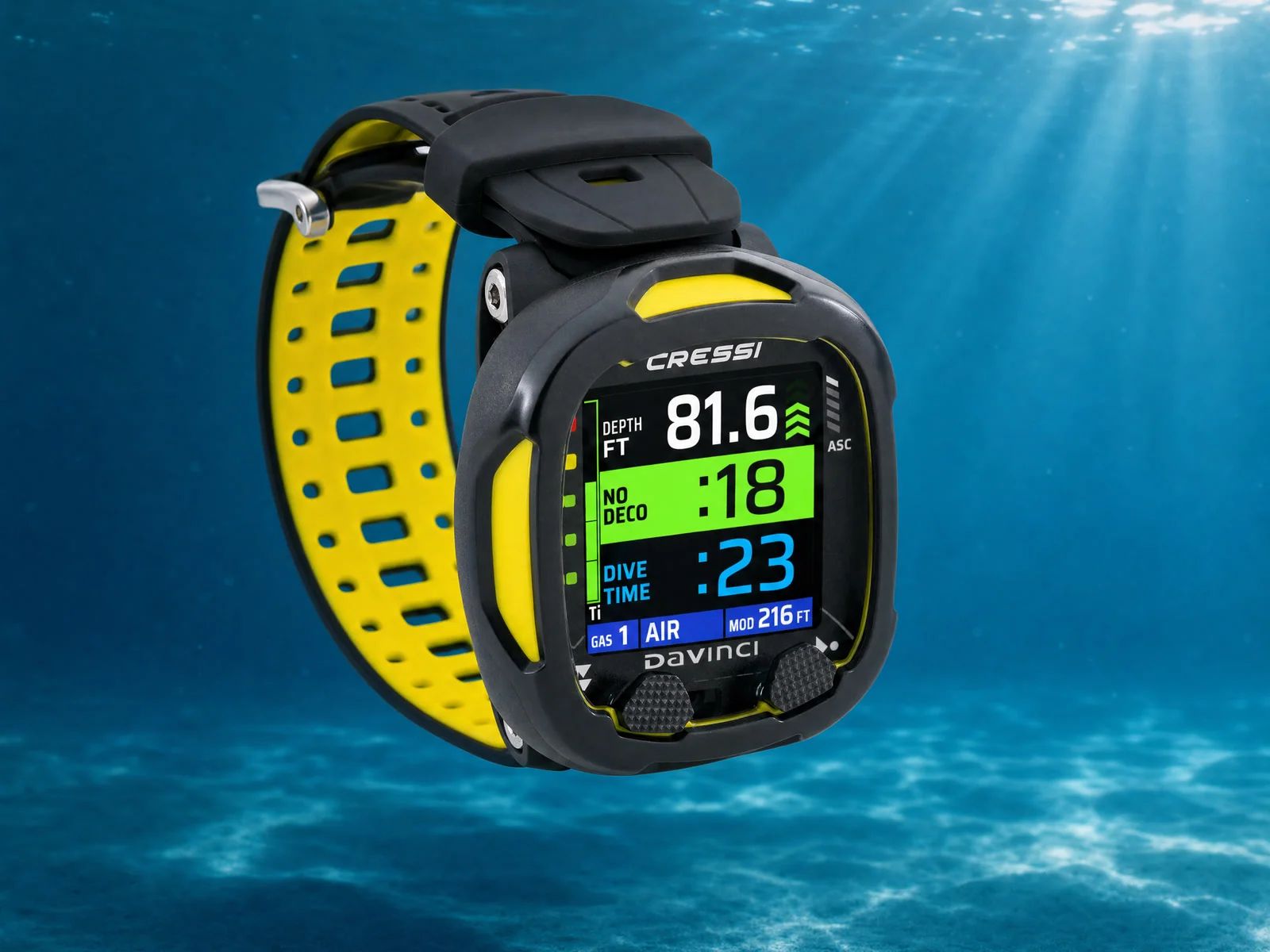
Cressi DaVinci Dive Computer Review: The Color & Multi-Gas Revolution
Read our comprehensive review of the Cressi DaVinci dive computer. Full color screen, Bluetooth, 4 gases, and Bühlmann ZHL-16C algorithm: is it worth it?
All images are protected by copyright. For any commercial or editorial use, please contact us via our form.
How can I be notified of new articles?
Follow us on social media or join the Sentinels Circle to receive our immersion stories before anyone else.
Do you offer hands-on workshops?
Yes, we organize masterclasses and field expeditions for members of our school. Check the Training page for details.
To learn how to get the most out of your gear underwater, discover the AquaExposure Training.
Cressi Lineup Position: This article provides a comprehensive hands-on test of the Cressi DaVinci (featuring a high-resolution TFT color screen, USB recharge, and Bühlmann algorithm). If you are comparing across all models from the Italian manufacturer (Leonardo, Donatello, Giotto, Michelangelo, Neon, Goa, Cartesio), explore our complete Cressi dive computer buying guide and our interactive dive computer comparison tool.
Introduction
With the DaVinci, Cressi takes a major technological step forward. After dominating the entry-level segment for years with the Leonardo and Donatello families, the Italian brand finally delivers a high-resolution TFT-LCD color screen and switches to the well-regarded Bühlmann ZHL-16C algorithm.
But let's not forget our core principle: a dive computer is not just a pretty connected color screen. It is, above all, the critical tool that calculates your decompression and manages your safety at every moment. In this review, we evaluate whether the DaVinci manages to deliver a genuinely technical experience (multi-gas, customizable stops) while retaining the simplicity and readability that made the brand's reputation.
The excellent Bühlmann ZHL-16C with Gradient Factors, ideal for a customized decompression profile.
Air & Multi-gas
2.3/5
Manages up to 4 gases (Nitrox/100% O2) for accelerated decompression, but no Trimix.
Screen & Ergonomics
3.9/5
Superb 1.54-inch TFT-LCD color screen, two-button navigation.
Battery & Power
3.6/5
Rechargeable via USB-C (approximately 30 hours of battery life), no battery replacement needed.
Connectivity & App
5.0/5
Built-in native Bluetooth and the DiveSync app for a fully digital logbook.
Compass & Instruments
4.0/5
Excellent integrated digital compass, but no dedicated freediving mode.
Robustness & Depth
3.8/5
Comfortable mid-size form factor, includes an optional elastic (bungee) mount.
Price & Service
4.5/5
This computer is for: The recreational or Advanced/Level 2 diver who wants a quality color screen, built-in Bluetooth, and the ability to progress toward Nitrox multi-gas diving.
This computer is not ideal for: Committed technical divers who need Trimix profiles or closed-circuit rebreather (CCR) management.
Detailed Analysis
O1 Algorithm & Stops (5.0/5)
This is the internal revolution of this device. Cressi abandons its RGBM algorithm here in favor of the Bühlmann ZHL-16C, a decision that changes everything for divers who want precise control over their decompression.
This shift allows divers to benefit from user-adjustable Gradient Factors (GF), providing enhanced control over conservatism. The display includes no-decompression limits, with user-selectable deep stops and safety stops. Audible and visual alerts cover ascent rate, decompression limits, and PPO2.
O2 Air & Multi-gas (2.3/5)
The DaVinci fits perfectly into an evolving diver's progression. It offers 3 modes (Air, Nitrox, Gauge/Depth gauge) and allows you to configure and switch between 4 gas mixes underwater, covering all accelerated decompression needs with Nitrox.
The ceiling is clear: no wireless air integration on the wrist version, and no Trimix or CCR mode. The 2.3/5 score reflects this limited gas space, but in line with our doctrine, the absence of air integration is not penalized in itself. The limitation is on the range of available mixes compared to technical computers.
O3 Screen & Ergonomics (3.9/5)
The old monochrome LCD displays are gone. The DaVinci displays your data on a 1.54-inch TFT-LCD color screen with 15 available colors. The data fields are large and well-partitioned to avoid any distraction underwater.
The device is controlled via a two-button interface. It is less intuitive than a three-button system (like the Giotto) for those accustomed to forward / back / confirm navigation, but it is consistent with Cressi's standard and perfectly usable with gloves. The case size (approximately 56 x 60 mm) remains reasonable.
O4 Battery & Power (3.6/5)
This model puts an end to manual battery replacement. It integrates a rechargeable battery via a modern USB-C port, which considerably simplifies logistics during travel and club outings.
Battery life is approximately 30 hours of diving at maximum brightness. This is shorter than AA battery models like the Perdix 3, but acceptable for the vast majority of recreational divers. The USB-C cable is universal — a real advantage when traveling to remote destinations.
O5 Connectivity & App (5.0/5)
Unlike older Cressi models where the sync interface was a paid option, Bluetooth is built in as standard here. This is the expected baseline in 2026 and Cressi was right to include it from the start.
You can download your dive history, analyze your profiles, and manage updates directly from the Cressi DiveSync app. The internal logbook holds 60 dives, but the app stores a much more extensive history.
O6 Compass & Instruments (4.0/5)
The computer features a complete digital compass providing heading and reverse heading, which will reassure underwater navigators in low-visibility environments or on wrecks.
However, there is no Freediving (Apnea) mode: the computer is limited to Air, Nitrox, and Gauge (Bottom Timer) modes. For divers who practice both scuba and freediving, this is a point worth factoring into the buying decision.
O7 Robustness & Depth (3.8/5)
Despite its color screen, the DaVinci maintains a contained form factor that will not impede your movements. The soft silicone strap can be removed to install the elastic mounting system (bungee) included in the box, particularly practical for drysuit divers.
The computer is rated to 100 meters. This is more than sufficient for all recreational diving, including advanced Nitrox with decompression stops.
O8 Price & Customer Service (4.5/5)
Generally positioned below the €300 mark, the DaVinci shakes up the color screen dive computer market considerably. At this price point, you get TFT color display, a Bühlmann algorithm, 4-gas management, and built-in Bluetooth.
Cressi's distribution network is well-established and reliable across Europe. Customer service, while less iconic than Shearwater's, meets the standards expected at this price range.
Who is this computer for?
The Cressi DaVinci is designed for the regular recreational diver, the Advanced/Level 2 diver, or the instructor who wants a readable color screen, Bluetooth without extra cost, and Nitrox multi-gas flexibility — all under €300. It is an excellent gateway to the Bühlmann algorithm for those upgrading from the Leonardo or Donatello series.
It will accompany your technical progression for accelerated decompression up to 100% oxygen with 4 gases, but will need to be replaced if you move into Trimix or rebreather diving. The two-button navigation will require slight adaptation for those used to three buttons, and the lack of a Freediving mode may disappoint versatile practitioners.
Power Source
The Cressi DaVinci eliminates the search for specific batteries thanks to its internal battery rechargeable via USB-C. In practice, you charge the computer like your phone: a standard cable, a USB power source, and you are done.
The 30-hour battery life comfortably covers an intensive diving weekend with multiple dives per day. For longer expeditions, keeping a charging cable in your bag is the only precaution needed.
For divers wondering about the respective advantages of rechargeable batteries versus replaceable cells, our complete guide to dive computer batteries breaks down the selection criteria for your profile.
Links to other models from the same brand
The DaVinci occupies the mid-range segment in the Cressi lineup. For a simpler single-button entry point, the Cressi Leonardo remains a solid choice for beginners. For a three-button interface with more navigation flexibility, the Cressi Giotto is the mid-range benchmark. And for a compact watch format, the Cressi Cartesio offers a sleek alternative.