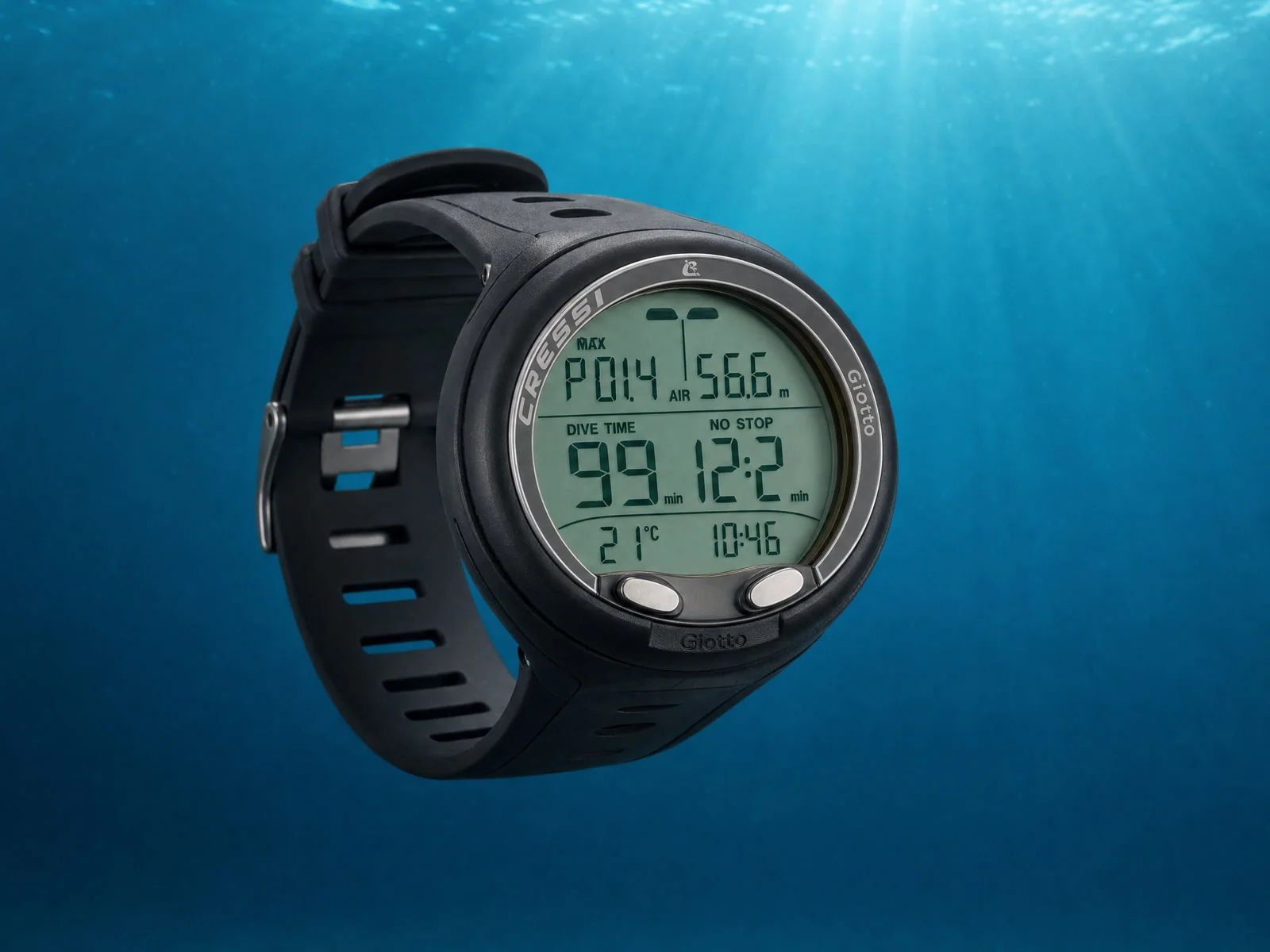
What is the major difference between the Cressi Leonardo and the Cressi Giotto?
The Leonardo has only one button, which can make navigation tedious. The Giotto integrates 3 physical buttons, greatly simplifying settings and navigation, and manages 2 different Nitrox gases compared to only 1 for the Leonardo.
Does the Cressi Giotto have a color screen?
No, it is equipped with a high-definition segmented LCD screen (UFDS system). Although not color, it offers very large characters and excellent contrast.
Can I change the Giotto's battery myself?
Yes, it works with a standard CR2450 button cell battery that is easy to replace at home without specialized tools or factory return.
Does the Giotto have an integrated compass?
No, the Cressi Giotto does not have an electronic compass or booklet.
To learn how to get the most out of your gear underwater, discover the AquaExposure training.
Introduction
When preparing for a technical or exploration dive, especially in the cold and dark quarries of Belgium, the choice of instruments is a non-negotiable safety factor. We look above all for simplicity of handling and immediate readability, especially if our hands are cluttered with an Insta360 pole or the tray of a compact expert camera housing like the Sony RX10V. The Cressi Giotto is the logical evolution of the famous Leonardo. While retaining a robust wrist-puck format, it solves the greatest defect of its predecessor by replacing the single button with 3 physical steel buttons. In addition, it opens up to advanced diving by managing gas switching between two mixtures during the dive. Let's see in detail how this classic from the Italian brand stands up to modern decompression criteria.
Summary Verdict
Global Score: 3.3/5
Criterion
Score
What this means
Algorithm & stops
4.0/5
Reliable Cressi RGBM algorithm for leisure, with 3 levels of conservatism, but not modifiable by Gradient Factors.
Air & multi-gas
2.0/5
Management of 2 distinct Nitrox mixtures underwater (up to 99% O2), but no Trimix or CCR.
Screen & ergonomics
3.0/5
Very clear segmented UFDS LCD screen, readable but fixed. 3-button interface is excellent with thick gloves.
Battery & power
4.5/5
Replaceable CR2450 battery with excellent performance over time.
Connectivity & app
3.0/5
Transfer possible via optional interface or dock (Bluetooth/USB).
Compass & instruments
3.0/5
No built-in compass, but an effective depth gauge (Gauge) mode.
Robustness & depth
3.3/5
Solid technopolymer casing, certified to 120 meters with a removable screen protector.
Price & service
4.2/5
Excellent value for money in entry/mid-range and very solid Cressi after-sales service in Europe.
This computer is suitable for: The recreational or advancing diver (Advanced Nitrox) looking for a simple, solid, readable, and affordable tool, or as a backup depth gauge.
This computer is not ideal for: Technical divers (Trimix, rebreather) or lovers of permanently backlit color AMOLED screens.
[!NOTE] Range positioning alert: The Cressi Giotto is a classically styled computer. It does not have a wireless transmitter module, which requires keeping your classic mechanical pressure gauge on the regulator's first stage.
Detailed Analysis
O1 Algorithm & stops (4.0/5)
The Cressi Giotto embeds a calculation engine based on recognized physical foundations for safety, particularly on repetitive dive profiles.
Algorithm: Cressi RGBM (9-tissue Haldane model, developed in collaboration with Bruce Wienke). (Score: 3.5/5)
Gradient Factors: Not freely adjustable. Instead, there are 3 predefined conservatism levels (SF0, SF1, SF2) to adapt the profile's safety to one's physical condition or cold water. (Score: 1.5/5)
Deco display: Clear display of ceiling, total ascent time (TTS), and safety or deep stops. (Score: 5/5)
Ascent alert: Very explicit audible and visual alarms for checking ascent speed and tissue load (nitrogen bar graphs). (Score: 5/5)
Software reliability: No major documented issues or recalls on this highly stable platform. (Score: 5/5)
O2 Air & multi-gas (2.0/5)
The Giotto allows the diver to progress by integrating Nitrox decompression cylinders to shorten stops.
Number of gases managed: 2 gases (Air and Nitrox adjustable from 21% to 99% O2, with PO2 adjustable from 1.2 to 1.6 bar). (Score: 3/5)
Trimix: Not supported. (Score: 1/5)
CCR Mode: Absent. (Score: 2/5)
O3 Screen & ergonomics (3.0/5)
The readability of an instrument is a crucial safety factor when darkness sets in.
Useful display size: Generous (65mm diameter casing), data displayed in large characters. (Score: 4/5)
Readability: Very high contrast. For the dark quarry waters, the backlight is activated by a simple button press. (Score: 3.5/5)
Navigation: Its 3 stainless steel buttons allow for easy scrolling and validating options, a huge improvement over the single-button system of the Leonardo, especially when wearing thick drysuit gloves. (Score: 4/5)
Customization: The layout on the home screen is fixed. (Score: 1.5/5)
O4 Battery & power (4.5/5)
The Giotto is a powerful tool when it comes to energy logistics: it does not fear a black screen during an intense weekend.
Autonomy: Excellent, announced for about 2 years of average use (approx. 50 dives/year). (Score: 5/5)
Charge indicator: Simple battery level gauge on the screen. (Score: 3/5)
Cold water performance: Robust casing and very stable electronics, no sudden loss of performance reported below 10°C. (Score: 5/5)
O5 Connectivity & app (3.0/5)
To export dive profiles, the Giotto relies on external interface modules.
Synchronization: No native Bluetooth. Requires the use of a contact interface console (USB or Bluetooth) sold separately. (Score: 2.5/5)
App quality: Functional, if utilitarian, Cressi desktop software and mobile app. (Score: 3/5)
Updates: Possible via cable and a PC. (Score: 3.5/5)
Standard export: Partial proprietary export. (Score: 3/5)
O6 Compass & instruments (3.0/5)
The computer focuses on primary physical instrument and decompression functions.
Built-in compass: Absent. (Score: 1/5)
Temperature sensor: Accurate, with continuous display on the screen. (Score: 5/5)
Free/gauge mode: Presence of a very complete depth gauge (Gauge) mode with stopwatch. No advanced dedicated freediving mode on standard versions. (Score: 3/5)
O7 Robustness & depth (3.3/5)
Under its robust puck shape, the unit is built to handle shocks against wreck metal or rocky limestone.
Protection glass: Robust polycarbonate glass, delivered with a clipsable and replaceable plastic screen guard. (Score: 2.5/5)
Certifications: Complies with current CE standards. (Score: 3.5/5)
O8 Price & service (4.2/5)
The strength of an industrial giant like Cressi is reflected in the long-term support of its products.
Value for money: Very good, the unit is generally found under €250, which is aggressive for a 3-button 2-gas model. (Score: 4/5)
Service availability: Extremely dense network of dealers and technical service centers in Europe. (Score: 5/5)
Warranty: Standard 2-year manufacturer warranty. (Score: 3.5/5)
What to know before buying
Night ergonomics: The segmented LCD screen requires pressing one of the buttons to activate the backlight. If your hands are occupied by camera equipment (trays, poles), anticipate this need before entering a shadow zone.
Connectivity cost: If you like to regularly extract your dives to analyze your profiles, plan for the acquisition of the optional interface console (dock) in your initial budget.
Screen guard included: Cressi provides a clear clip-on plastic protector. This is an essential accessory to leave in place to protect the computer from abrasive scratches during transport or on the boat.
Safety Reminder
Diving is an demanding activity that requires careful planning. A dive computer, no matter how reliable, only models your desaturation mathematically using an algorithm. There is no method or technology to "maximize your bottom time"; attempting to push limits or manipulate safety settings is a serious error and is strictly forbidden.
All your setting adjustments (such as changing Nitrox mixtures) or prolonged reading of your stops during ascent must be done calmly and without disrupting your buoyancy or attention. Remember that your regulator must remain firmly and constantly in your mouth from water entry to complete surface return. No technological distraction or instrument consultation justifies compromising immediate access to your breathing gas.
Our Verdict
The Cressi Giotto is a safe haven for the recreational diver or those progressing to Advanced Nitrox. By resolving the complex ergonomics of the single button to adopt a fluid 3-button navigation, it establishes itself as a simple, robust, and highly functional instrument. Its large segmented display offers excellent visibility, while the use of a user-replaceable CR2450 battery eliminates logistical anxiety during trips. While it lacks native wireless connectivity or a Gradient Factors-adjustable algorithm to appeal to pure technical profiles, it stands as one of the best value-for-money options in its class for exploring the underwater world.
Power Source
The computer runs on a standard CR2450 Lithium button cell battery. Thanks to the simplicity of its segmented LCD screen, power consumption is extremely low. The average battery life is two years for about fifty dives per year, and the battery can be changed directly by the diver.
For other Cressi options, you can look at the Cressi Leonardo for the ultra-simple 1-button entry-level model, or the Cressi DaVinci for a more modern watch format with multi-gas support.
Take your practice further
Mastering the management of two Nitrox mixtures underwater is a skill that opens the doors to deep exploration. To perfect your knowledge and secure your stop calculations during your gas switches, discover the AquaExposure training.