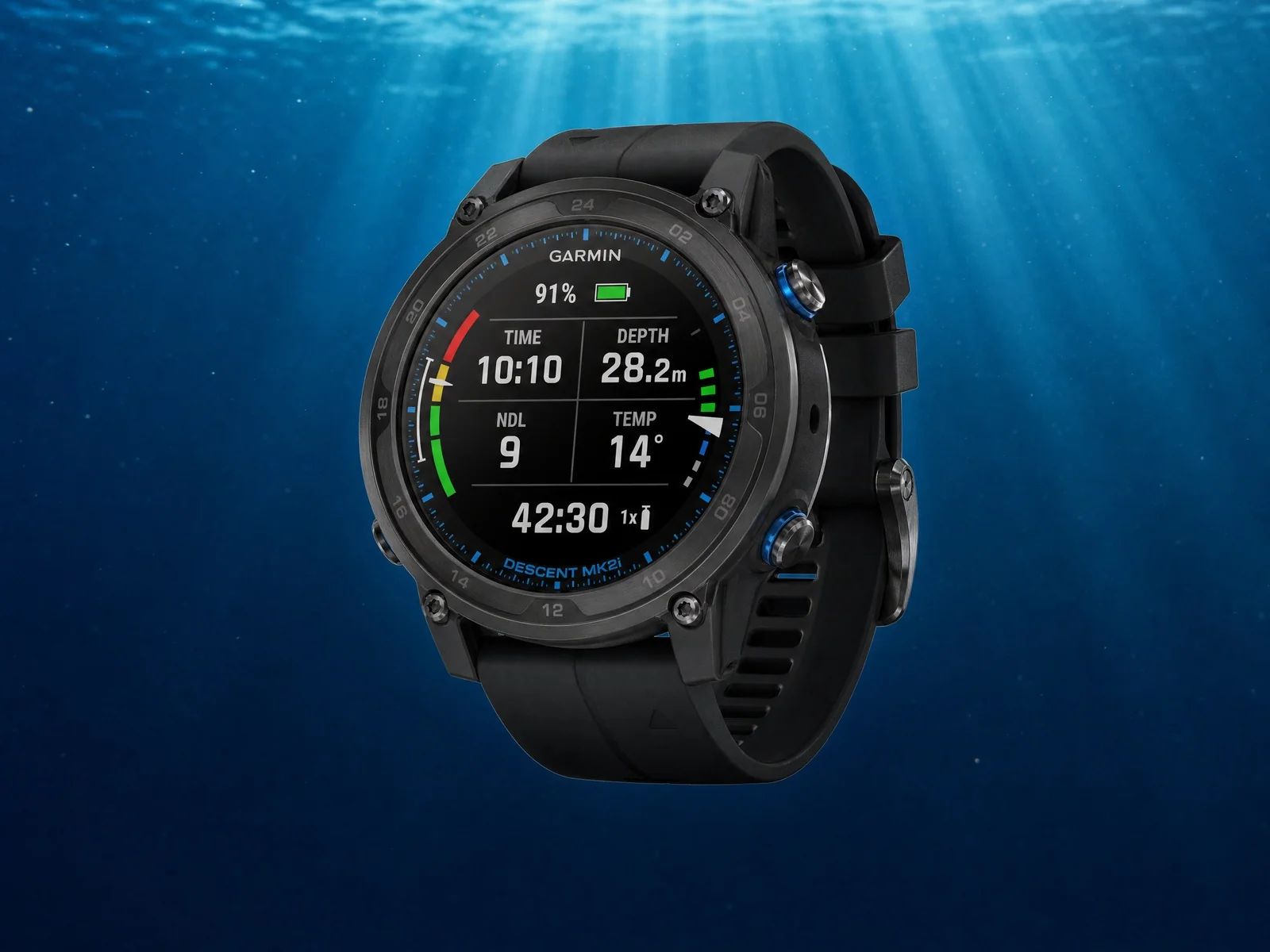
Garmin Descent Mk2i Test: Is the Do-it-All Watch a Good Dive Computer?
Technical review and full test of the Garmin Descent Mk2i. Discover our AquaExposure evaluation of this Trimix and CCR dive computer with SubWave air integration.
Is the Garmin Descent Mk2i suitable for beginners?
Yes, but it is oversized. Its Trimix and CCR functions are designed for technical diving. A beginner diver will only use 10% of its capabilities.
Can I change the battery myself?
No, the battery is lithium-ion and rechargeable via a proprietary cable. If it loses capacity after several years, a return to Garmin service center is required.
Is the Bühlmann algorithm adjustable?
Yes, this is one of its great strengths. You can freely adjust your Gradient Factors (Low and High) to match your physiology and dive planning.
Should I buy the transmitter with it?
At AquaExposure, we advise against it as a precautionary principle for marine life and to avoid underwater noise pollution.
To learn how to get the most out of your gear underwater, discover the AquaExposure training.
On a boat deck, it has become common to see divers navigating their watch to read a message before entering the water. Yet, a dive computer is not just a stopwatch or a connected gadget. It is the critical tool that manages the diver's decompression safety at every immersion. The Garmin Descent Mk2i promises to bridge the gap between the premium daily smartwatch and the most advanced technical decompression station. This test seeks to establish whether this technological split holds up underwater and whether the massive investment it represents is justified for your practice. We will explore the capabilities of this device together, weighing each aspect with the rigor that diving safety demands, without ever losing sight of the human experience beneath the surface.
Summary Verdict
Global Score: 4.5/5
Criterion
Score
What it means
Algorithm & stops
5.0/5
Adjustable, transparent and reassuring Bühlmann model.
Air & multi-gas
4.6/5
Manages all configurations, from air to rebreather.
Screen & ergonomics
3.9/5
5 perfect buttons with gloves, but screen less bright than an AMOLED.
Battery life & cell
4.6/5
Excellent 80h dive battery life for a rechargeable battery.
Connectivity & app
4.5/5
The Garmin software ecosystem is one of the best on the market.
Compass & instruments
5.0/5
Highly responsive 3D compass and accurate auxiliary sensors.
Robustness & depth
4.6/5
Scratch-resistant sapphire, certified for 100 meters depth.
Price & Service
4.0/5
A heavy investment, balanced by an ultra-responsive support network.
This computer is made for: The regular or technical diver looking for a single, comprehensive instrument for both diving and daily life. It is ideal for those who value versatility and technological integration in their gear.
This computer is not ideal for: The diver with a strict budget or those who struggle to read small characters underwater. Its complexity and cost can be obstacles for beginners or occasional divers.
Detailed Analysis
Algorithm & stops: Transparent and adaptable management
The Garmin Descent Mk2i relies on the Bühlmann ZHL-16C algorithm, a key reference in the technical diving world. This choice, combined with the ability to adjust Gradient Factors, gives the diver complete control over their decompression profile. It is not a black box, but a tool whose transparency allows you to adjust conservatism according to diving conditions, fatigue, or goals. The full display of decompression ceilings, total time to surface (TTS), and deep stops ensures clear and continuous information, essential for safe planning and execution. Ascent alerts and tissue loading graphs are valuable aids for visualizing saturation status and anticipating decompression needs, without ever replacing diver vigilance.
Air, multi-gas, and air integration: Confirmed technical versatility
The Mk2i's ability to manage up to six different gases, including Nitrox up to 100% and normoxic and hypoxic Trimix, positions it as a computer of choice for divers moving towards more demanding practices. The native rebreather (CCR) mode is an undeniable asset for those practicing or planning closed-circuit diving, offering fluid and secure integration. Wireless air integration, via the proprietary SubWave technology, is a feature that simplifies reading tank pressure. However, it is crucial to note that this technology uses ultrasonic waves at around 30 kHz, a point on which AquaExposure advises caution due to its potential impact on marine life and the noise pollution perceived by some divers. Redundancy with a mechanical pressure gauge remains, in all cases, an absolute safety rule.
Screen & ergonomics: An interface designed for action
The 1.4-inch high-resolution color screen, of the transflective MIP type, offers excellent readability on the surface, even in direct sunlight. Underwater, and particularly in low light or turbid conditions, backlighting becomes indispensable to maintain this clarity. The lack of a touchscreen is a strength here, as navigation is done via five physical buttons. These are perfectly sized and responsive, even with thick gloves, ensuring easy and reliable manipulation. The ability to fully configure data fields allows each diver to adapt the display to their preferences and the information they deem most relevant for their dive, a very welcome flexibility.
Battery life & cell: The serenity of durable energy
The rechargeable lithium-ion battery of the Garmin Descent Mk2i offers an announced battery life of up to 80 hours in dive mode. This performance provides peace of mind, especially during cruises or extended stays where access to a charging source may be limited. The accurate percentage indicator allows you to monitor battery status with confidence, avoiding unpleasant surprises. Furthermore, its highly reliable behavior in cold water is a considerable advantage for divers in demanding environments, where gear performance is put to the test. This comfortable autonomy also avoids frequent casing openings, which are often sources of water intrusion risks.
Connectivity & app: A mature digital ecosystem
The Mk2i integrates Bluetooth and Wi-Fi technologies, ensuring automatic and rapid synchronization of dive data. The comprehensive and regularly updated Garmin Dive app serves as a true digital logbook, allowing you to analyze profiles, share experiences, and track progress. Over-the-air (OTA) firmware updates simplify device maintenance, ensuring access to the latest features and fixes. Exporting in the standard Garmin FIT format offers welcome interoperability, particularly with third-party software like Subsurface via an export, which is a positive point for personal data management.
Compass & instruments: Precision and completeness
The 3D tilt-compensated electronic compass of the Garmin Descent Mk2i is remarkably responsive and precise, a major asset for underwater navigation, especially in cave or wreck diving. The temperature sensor, accurate and continuous, provides constant information about the dive environment, a detail that can be important for post-dive analysis. The highly complete freediving mode demonstrates the versatility of this computer, making it attractive to freedivers and spearfishes looking for a high-performance tool dedicated to their specific practice. All of these instruments contribute to an enriched and safe diving experience.
Robustness & depth: Built for demands
Certified to 100 meters according to the EN13319 standard, the Garmin Descent Mk2i is a computer built to withstand the constraints of technical diving. The ultra-scratch-resistant sapphire glass effectively protects the screen from the harsh marine environment, ensuring optimal long-term readability. This physical robustness, combined with careful design, ensures the device's durability, an essential criterion for safety equipment. It is designed to accompany divers in their most demanding explorations, without compromising on reliability.
Price & Support: An investment justified by service
Launched at a price around 1500 EUR and currently observed between 1100 and 1300 EUR, the Garmin Descent Mk2i represents a significant investment. However, this cost must be put into perspective with the device's versatility and rich functionality. Garmin customer support, very well established in Europe, is renowned for its responsiveness and efficiency, with fast replacements when needed. This quality of support, combined with a standard two-year warranty, offers significant peace of mind for equipment of this value. It is essential to consider after-sales service as a key component of the overall value of a dive computer, especially for such a sophisticated device.
Who is this computer for?
The Garmin Descent Mk2i is primarily aimed at regular or technical divers looking for a single instrument capable of accompanying them in their most demanding underwater explorations as well as in daily life. It is a relevant choice for those who value versatility, technological integration, and the reliability of a complete digital ecosystem. If you are a multi-disciplinary diver, switching between air, Nitrox, and Trimix, and you want to streamline your gear without compromising on performance, this computer is designed for you. On the other hand, it will not be the wisest choice for occasional divers with a strict budget, or for those who struggle to read small characters underwater, as its functional richness and cost may be oversized for a less intensive practice.
Support and Service
After-sales service is a criterion often underestimated when acquiring a dive computer, and yet it is capital. For Garmin, support fits into the logic of a consumer electronics multinational. This means that in case of a failure recognized under warranty, replacement with a new unit is often the norm, which is an undeniable advantage. However, the journey can sometimes be frustrating. Interlocutors are not always specialized in diving, which can lengthen diagnostic and handling times. It is also possible that shipping the device is at your expense. Despite these potential frictions, the responsiveness of the Garmin support network in Europe is generally very good, and the fast replacement of defective devices is a reality. It is therefore essential to well document any issue and show perseverance if the first contact does not lead to an immediate solution. This is not a penalty on the overall score, but a factual reality to consider.
Power Supply
The Garmin Descent Mk2i is powered by a rechargeable lithium-ion battery. This technological choice provides a substantial battery life, announced up to 80 hours in dive mode, which is very comfortable for trips of several days without access to an electrical outlet. The advantage of a rechargeable battery is manifold: it avoids frequent opening of the casing, thus reducing the risk of water intrusion, and it fits into a more environmentally friendly approach by limiting the consumption of disposable batteries. For cruises or distant expeditions, it is wise to bring a charging cable and, if possible, a compatible external battery to ensure maximum battery life. The accurate percentage indicator allows you to manage the remaining charge serenely, thus avoiding any bad surprises underwater. If the battery were to lose capacity after several years of intensive use, a return to Garmin service would be necessary for its replacement, as it is not designed to be changed by the user.
Links to other models of the same brand
If the Garmin Descent Mk2i has captured your attention with its versatility and performance, it is interesting to explore the brand's other offerings. Garmin offers a wide range of dive computers, each with its own specificities. For a more compact approach focused on the smartwatch, the Garmin Descent G1 could be an alternative. If you are looking for an even more intuitive interface and a brilliant AMOLED screen, the Garmin Descent Mk3i represents a notable evolution. Each model meets specific needs, and it is essential to clearly define your practice to make the most appropriate choice.
Comparator CTA
To compare this computer with other models, check out our dive computer comparator. This tool will allow you to view the specifics of each device and make an informed choice, based on your requirements and budget.