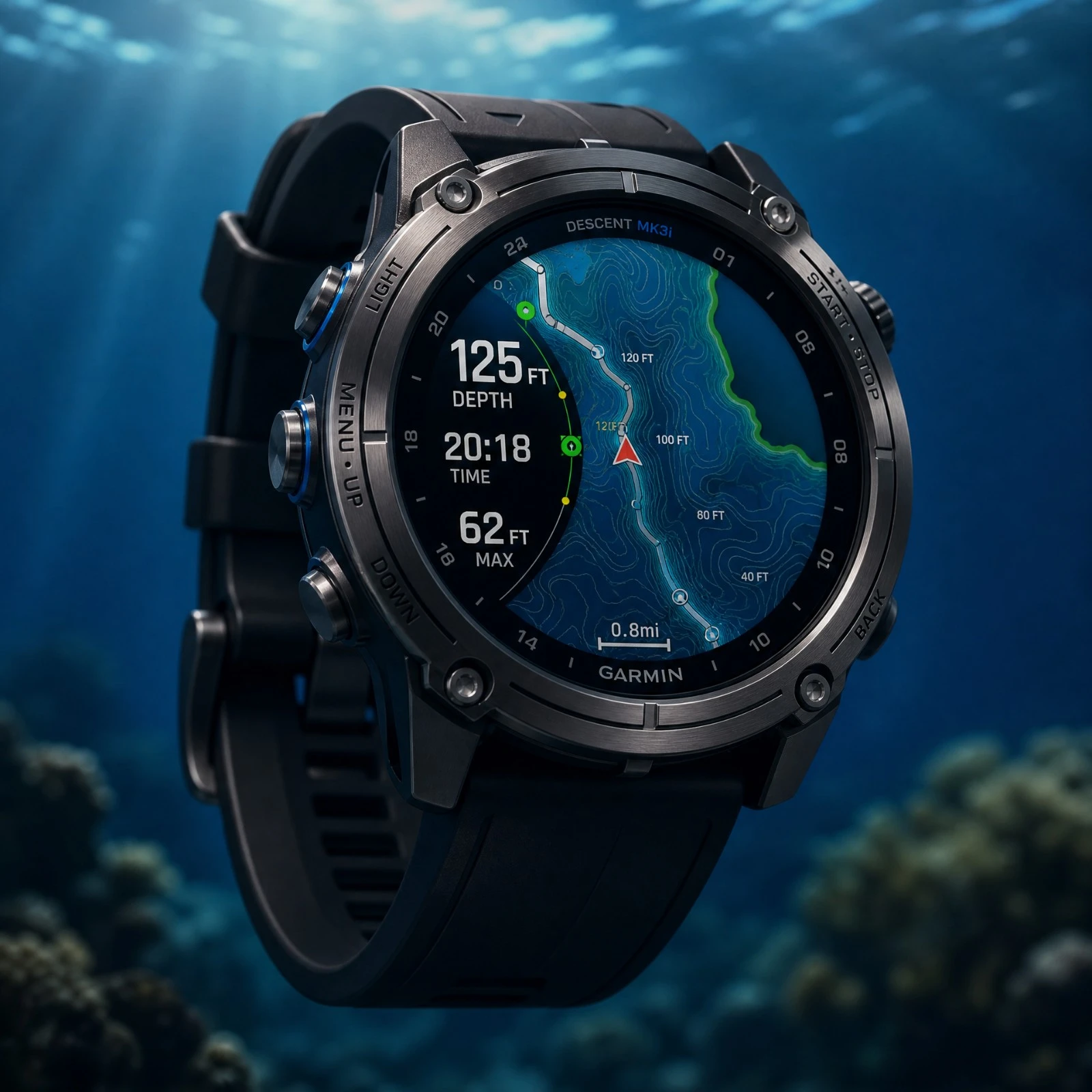
Complete review of the Garmin Descent Mk3i dive computer. Discover our AquaExposure rating for this Trimix and CCR device with AMOLED screen and air integration.
To learn how to get the most out of your gear underwater, discover the AquaExposure Training.
Introduction
Preparing for a dive begins long before entering the water. It involves the meticulous selection of equipment that allows for no compromises. The choice of the primary computer often dictates the peace of mind of the entire diving group.
It's a decision that impacts safety, readability, and absolute confidence from the outset. The current market offers increasingly sophisticated tools that compete on technical merit. The Garmin Descent Mk3i fits into this trend with a strong promise.
It attempts to combine the precision of a certified instrument for deep-sea use with the visual comfort of modern display technologies. We will examine its technical specifications to understand its true value in practical applications.
This analysis is based on manufacturer data and our strict evaluation criteria. The goal is to determine whether this transition to the ultra-bright screen provides a real safety advantage underwater.
Safety always takes precedence over all other material considerations. A dive computer does not replace training or good seamanship. It is imperative to always have a backup plan for diving.
We reiterate here that redundancy is mandatory if you are using the air integration. The transmitters tend to consume the battery much faster than the rest of the electronics.
The Verdict in Summary
Overall score: 4.7/5
| Criterion | Score | What it means |
|---|---|---|
| Algorithm & levels | 5.0/5 | A configurable Bühlmann model that offers transparent and ultra-secure management. |
| Air & multi-gas | 4.6/5 | Handles all configurations from pure air to rebreathers with great flexibility. |
| Screen & ergonomics | 4.8/5 | The AMOLED screen offers striking contrast, complemented by impeccable physical buttons. |
| Battery life | 4.6/5 | Excellent battery life of 66 hours during dives despite a power-hungry screen. |
| Connectivity & app | 4.5/5 | The Garmin ecosystem remains the best in its category for logbook management. |
| Compass & instruments | 5.0/5 | A highly responsive 3D compass accompanied by auxiliary sensors of great precision. |
| Robustness & depth | 5.0/5 | Certified to 200 meters and with an impenetrable sapphire glass for extreme environments. |
| Price & customer support | 4.1/5 | A very significant budget, fortunately supported by global technical support. |
Detailed Analysis
O1 Algorithm and Milestones
Understanding decompression is the cornerstone of our diving practice. The heart of this computer operates according to the highly regarded Bühlmann ZHL-16C algorithm. This technical choice guarantees complete transparency in the calculation of your dive profiles.
The Bühlmann mathematical model has proven its effectiveness for decades in the world of technical diving. The maximum score of 5.0/5 reflects the ability to adjust your own gradient factors across a complete range.
You can adjust the conservatism with surgical precision according to your physiological profile. This personalization is essential for deep dives, which require rigorous planning.
The visibility of the ceilings is remarkably clear, which makes it easier to maintain a stable depth. The diver knows exactly at what depth they need to stop and for how long.
The time to surface is calculated continuously for seamless ascent planning. Comprehensive alerts and a reliable history complete this clinical picture of decompression.
It is a very, very, very precise system that leaves no room for doubt during complex procedures. Mastering these parameters requires study, repetition, and the rigorous application of desaturation principles.
O2 Air and Multi-Gas
The evolution of a diver towards complex mixes requires equipment that can keep up with this progress. With the ability to manage three to seven gases, the Mk3i meets all the requirements for technical diving.
It achieves a score of 4.6/5 thanks to its full support for Trimix. Hypoxic and normoxic mixtures are natively managed for deep dives.
The native CCR (Closed Circuit Rebreather) mode is also available for users of closed-circuit rebreathers. The computer calculates the decompression based on a constant partial pressure of oxygen.
The air integration is well-documented through the SubWave technology, which uses sound waves. However, this feature does not affect our overall evaluation score.
Air integration remains a comfort feature and not an absolute quality criterion at AquaExposure. It is crucial to address the issue of the ultrasonic transducer used by this model.
Some marine species can detect the ultrasonic signals emitted by this type of equipment. Current scientific literature does not demonstrate any established harm to wildlife.
Uncertainty favors environmental caution. In practice, a noticeable and often bothersome signal is frequently observed by divers in the vicinity.
Based on this information, AquaExposure strongly advises against purchasing a computer with an ultrasonic transmitter. The preservation of the marine environment should guide our equipment choices.
O3 Screen and Ergonomics
Visual perception underwater is often impaired by turbidity and lack of light. It is this significant improvement in the model that justifies its score of 4.8/5.
The high-resolution AMOLED color display offers deep blacks and vibrant colors. The generous size exceeds 1.0 inch, with 1.2 inches for the 43mm model and 1.4 inches for the 51mm model.
The readability is so direct that even in the densest information display, the key data stands out clearly. This visual clarity reduces the amount of time spent staring at your wrist.
Underwater, the touchscreen intelligently disables itself to prevent accidental operation. The hybrid navigation system is replaced by five physical buttons that are perfectly usable even with thick gloves.
The data fields are fully configurable according to your visual preferences. This user-friendly design, focused on action, greatly facilitates the management of deep stress.
The user interface is designed to highlight critical information. Bright colors immediately alert the diver if parameters are exceeded.
O4 Autonomy
Energy management is crucial for a device with such a bright screen. The Mk3i performs exceptionally well, earning a score of 4.6/5 in our evaluation grid.
The rechargeable lithium-ion battery offers a claimed battery life of over 25 hours. Garmin even claims up to 66 hours in dive mode for the 51mm version.
The precise percentage indicator allows you to plan your dives without anxiety. The system proves reliable even in cold waters, which put the batteries under a lot of stress.
It's a remarkable achievement for an AMOLED screen, which requires a lot of resources. The intelligent brightness management contributes greatly to this exceptional battery life.
The diver no longer has to fear running out of air in the middle of a decompression stop. Energy reliability is a cornerstone of safety in technical diving.
O5 Connectivity
Post-dive analysis is a fundamental step for understanding and improving one's diving skills. The software ecosystem of the brand fully justifies its score of 4.5/5.
Automatic Bluetooth makes syncing easy as soon as you get out of the water. The Garmin Dive app is extremely comprehensive for analyzing your decompression profiles.
Firmware updates are performed wirelessly via the Wi-Fi network. This is a definite convenience for keeping your hardware up to date with the latest fixes.
The export in the open FIT format is possible, although it is considered partial. The software offers a smooth and modern user experience that simplifies dive log keeping.
Connectivity also allows you to share your profiles with other divers or instructors. It is a powerful educational tool for debriefing a complex dive.
O6 Compass and Instruments
Underwater navigation requires tools with absolute reliability to find your way. A perfect score of 5.0/5 rewards a 3D electronic compass that is exceptionally smooth and responsive.
This compensation allows for accurate readings even if the wrist is not perfectly horizontal. The temperature sensor displays precise data continuously throughout the immersion.
A dedicated apnea mode complements the range of integrated instruments. These additional sensors transform the computer into a true underwater measurement station.
The precision of these instruments aids in decision-making within complex environments. Navigation becomes more intuitive thanks to the clear display on the AMOLED screen.
The diver can focus on their surroundings rather than deciphering their instruments. The fluidity of the compass is a major advantage in waters with high particle content.
O7 Robustness
Resistance to pressure is the first line of defense against material failures. Garmin has redesigned its casing to withstand the pressures of the deep sea.
The Mk3i is now certified for dives up to 200 meters in depth. This 5.0/5 rating validates a design that makes no compromises for extreme exploration.
Protected by a thick layer of sapphire glass, the screen is resistant to impacts. The titanium bezel withstands friction against the metal of shipwrecks without any issues.
The construction standards are clearly documented by the manufacturer. This is a tool designed for durability, even in the most challenging environments we encounter.
The quality of the materials used partly justifies the device's price point. Titanium offers exceptional strength-to-weight ratio for optimal comfort on the wrist.
O8 Price and Customer Support
Acquiring such equipment represents a significant financial investment. The pricing for this type of equipment is decidedly high-end.
Priced between €1600 and €1800 depending on the size, it receives a rating of 4.1/5. The price-to-performance ratio remains good considering the density of features offered.
The customer service network is extensive, and the two-year warranty provides reassurance to the buyer. We will detail how this technical support system works in a dedicated section.
It is a significant investment that requires careful consideration and analysis of one's actual needs. The device's capabilities justify this positioning for a targeted audience.
The value of a dive computer is measured by its ability to bring you safely back to the surface. The price fades into insignificance compared to the reliability of a life-saving instrument.
Who is this computer for?
The compatibility between the equipment and the diver's profile is key to a comfortable diving experience. This computer is primarily aimed at demanding divers who want absolute readability in dark waters.
It is perfectly suited for the advanced Tek or CCR diver who wants a single device to do everything. These functions require specific training before use.
It is not ideal for the budget-conscious diver who seeks simplicity. It will also not be suitable for those who refuse to use rechargeable batteries that are not user-replaceable.
Investing such a sum without utilizing its Trimix capabilities is a financial choice that one must be prepared to accept. The technology should serve the diver, not the other way around.
Customer Service and Support
The longevity of your equipment depends greatly on the quality of after-sales service. Garmin's support is that of a multinational consumer electronics company.
In case of a failure covered by the warranty, replacement with a new unit is standard practice. This is a very reassuring aspect for an investment of this magnitude.
However, the customer journey can sometimes be frustrating for a technical diver. The people you interact with are not always specialists in the field of scuba diving.
Processing times may be longer, and returns are often at your expense. This does not negatively impact the overall rating of the device.
It is simply necessary to take this into account when making your purchase. Patience, clarity, and perseverance are often required during interactions with customer support.
Nutrition
The power source of your computer dictates part of your diving logistics. Choosing a rechargeable lithium-ion battery changes how you manage your equipment.
The 66-hour battery life in dive mode is very comfortable for daily use. You won't have to worry about charging between successive dives.
In cruising mode, things are slightly different. It will be necessary to have regular access to a power source in order to maintain the battery at an optimal level.
The proprietary cable must be an essential part of your travel kit. The percentage gauge allows you to precisely anticipate your charging needs.
It's a habit that quickly becomes integrated into the diver's routine. Rigor in energy management is an essential component of safety.
Links to other models from the same brand.
The Garmin range offers other alternatives depending on your specific needs and budget. If a depth of 200 meters is not a critical factor, you can consult our review of the previous model.
Find our complete review at [>-](/en/blog/Garmin Descent Mk2 Review: The technical benchmark without unnecessary frills.i). For smaller wrists or tighter budgets, the G1 series offers a different approach.
Discover our detailed review of the Garmin Descent G1 at [Review of the Garmin Descent G1: A dive computer disguised as an affordable watch.](/en/blog/review-of-the-garmin-descent-g1-a-dive-computer-disguised-as-an). Each model meets specific requirements that should be carefully considered.
CTA Comparator
To compare this computer with other models, see our diving computer comparison tool.
© 2026 AquaExposure. All rights reserved. Reproduction prohibited without authorization.
Share
Table of Contents
- 01Introduction
- 02The Verdict in Summary
- 03Detailed Analysis
- 04O1 Algorithm and Milestones
- 05O2 Air and Multi-Gas
- 06O3 Screen and Ergonomics
- 07O4 Autonomy
- 08O5 Connectivity
- 09O6 Compass and Instruments
- 10O7 Robustness
- 11O8 Price and Customer Support
- 12Who is this computer for?
- 13Customer Service and Support
- 14Nutrition
- 15Links to other models from the same brand.
- 16CTA Comparator
Questions about the Journal
Can I use the photographs from this journal?
All images are protected by copyright. For any commercial or editorial use, please contact us via our form.
How can I be notified of new articles?
Follow us on social media or join the Sentinels Circle to receive our immersion stories before anyone else.
Do you offer hands-on workshops?
Yes, we organize masterclasses and field expeditions for members of our school. Check the Training page for details.


