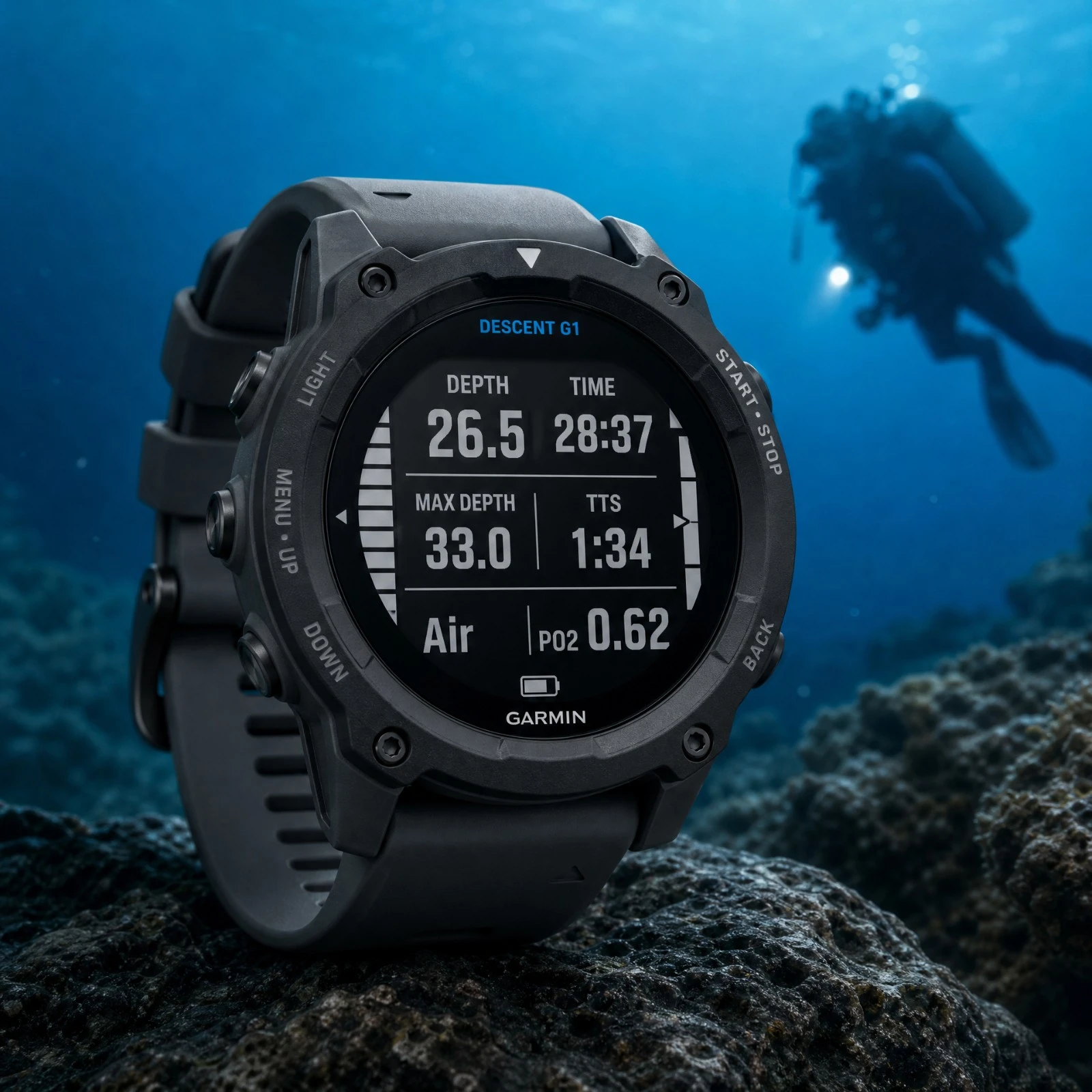
Our technical review of the Garmin Descent G1 dive computer watch. Monochrome but powerful, it handles Trimix and CCR diving.
To learn how to get the most out of your gear underwater, discover the AquaExposure Training.
Introduction
Observing the wristwatches on the deck of a semi-rigid boat is always informative. You see giant, ultra-bright OLED screens, and increasingly, smartwatches that closely resemble running models. The Garmin Descent G1 fits perfectly into this second category. With its robust polymer case and monochrome screen, it has the look of an all-terrain G-Shock watch.
But a dive computer is more than just an activity timer, it's the tool that manages the diver's decompression safety during each dive. The real question is whether this reduced format sacrifices what's essential: the readability and reliability of vital information. This test aims to determine whether the G1 is simply a low-end gadget or a genuine technical instrument, and whether the cost savings compared to higher-end models from the same brand justify the compromises made on the screen.
The Verdict in Summary
Overall score: 4.5/5
| Criterion | Score | What it means |
|---|---|---|
| Algorithm & settings | 5.0/5 | Customizable Bühlmann model, identical to high-end models. |
| Air & multi-gas | 4.6/5 | Surprisingly complete, it handles Trimix and CCR without any issues. |
| Screen & ergonomics | 3.5/5 | The contrast is good, but the 0.9-inch size requires good eyesight. |
| Battery life | 4.3/5 | Approximately 25 hours of dive time, very reliable lithium-ion battery in cold temperatures. |
| Connectivity & app | 4.5/5 | Perfect synchronization and a remarkable software ecosystem. |
| Compass & instruments | 5.0/5 | Precise sensors with an excellent compensated compass. |
| Robustness & depth | 4.6/5 | Scratch-resistant sapphire glass and certification to 100 meters. |
| Price & customer service | 4.5/5 | An unbeatable value for accessing technical software. |
Detailed Analysis
O1 Algorithm & Tiers: The Engine of a Ferrari in a City Car.
The Descent G1's greatest strength is that Garmin hasn't compromised on its entry-level model. It features the exact same Bühlmann ZHL-16C algorithm as models costing over €1000. The gradient factors are freely adjustable, allowing you to make your decompression more or less conservative based on your physiological profile. The classic display of decompression information (ceiling, TTS, deep stops) is clear, and is complemented by audible and vibration alerts, which are a plus for safety.
O2 Air & Multi-Gas: A Swiss Army Knife for Underwater Use.
The G1 can do everything: from simple single-tank diving to multi-bottle Trimix planning, and even serve as a backup computer for a rebreather (CCR). It manages up to 6 different gases (Air, Nitrox up to 100%, Trimix), which is flawless for its category. However, note that this model completely lacks air integration: it cannot connect to a pressure transmitter. This absence is a design choice that helps keep the price down, but it must be considered by the diver.
O3 Screen & Ergonomics: The Necessary Compromise
This is where things get slightly problematic. To offer this price, Garmin uses a small, monochrome 0.9-inch screen with a dual-window design. While the MIP (Memory in Pixel) contrast is excellent and the sapphire glass avoids reflections caused by scratches, the display is objectively small. The five physical buttons make up for it: they are firm and perfectly operable, even when wearing waterproof gloves. The display fields are configurable, allowing you to adapt the information to your preferences.
O4 Battery Life: Reliable and Predictable
The rechargeable battery (lithium-ion) provides approximately 25 hours of underwater use in dive mode. This is more than enough for a weekend or a week of cruising without having to search for a power outlet every night. The Solar mode, available on some versions, adds battery life in watch mode on the surface, but its impact is negligible underwater. The reliability of the battery in cold temperatures is a strong point, ensuring consistent performance even in colder waters.
O5 Connectivity & App: The Garmin Ecosystem at Your Fingertips
The Descent G1 offers Bluetooth connectivity for automatic synchronization with the Garmin Dive app. This workflow is smooth and addictive: you exit the water, Bluetooth activates, and your dive is already in your digital logbook on your smartphone. OTA (Over-the-air) updates ensure that your computer is always up to date with the latest features and software improvements. The standard data export is partial, but the software ecosystem is impressive.
O6 Compass & Instruments: Precision and Versatility
This model incorporates a compensated 3D electronic compass, offering precise navigation underwater. A temperature sensor is also included, providing continuous data. The G1 particularly excels with its very comprehensive freediving and spearfishing modes, making it an excellent companion for divers who practice these disciplines. The accuracy of the sensors is undoubtedly a major advantage.
O7 Durability & Depth: Designed to Last.
Certified to 100 meters (EN13319 standard), the Descent G1 is designed to withstand the rigors of the underwater environment. The ultra-scratch-resistant sapphire crystal is standard on all G1 models, providing superior protection against scratches and impacts. The reinforced polymer case also contributes to its durability, making this computer a reliable instrument for many years of diving.
O8 Price & Customer Support: Democratized access to technology.
Priced around €550 (or €650 for the Solar model), the Garmin Descent G1 offers excellent value for the software features it includes. Having access to an unlocked Bühlmann algorithm and Trimix/CCR management at this price point, in a case with a sapphire crystal, is remarkable. Regarding customer service, Garmin, as a multinational consumer electronics company, offers a replacement if a defect is recognized under warranty. However, the process can sometimes be frustrating, with representatives who are not specialized in diving, potential delays, and return shipping costs that are your responsibility. It's important to be aware of this, although it doesn't excessively penalize the overall rating, as the service is ultimately provided.
Who is this computer for?
The Garmin Descent G1 is designed for the adventurous diver, whether recreational or technical, who wants the power of Garmin software without breaking the bank. It's perfect for Level 1 or 2 divers, but its software capabilities are truly exploited by confirmed Nitrox or technical divers. It's ideal for those seeking a reliable and versatile computer for everyday use and demanding dives, without the bulk of a larger model. Its watch format makes it discreet and practical.
This computer is not ideal for presbyopic divers or those who require wireless air integration. If you have difficulty with close-up vision, the small screen size could become a major drawback. Similarly, if air integration is a feature you plan to use in the future, you will need to switch to a different device, as the G1 does not offer any possibility of adding it later.
Customer Service and Support
Garmin's after-sales service is that of a large multinational consumer electronics company. In the event of a recognized defect covered by warranty, a replacement with a new unit is usually offered. However, the user experience can sometimes be complex. The representatives are not always specialized in diving, which can lead to delays or misunderstandings. It is also possible that you will be responsible for the return shipping costs of the equipment. This is a point to consider, but the brand provides support for its products, even if the process may seem less direct than with specialists in diving.
Nutrition
The Garmin Descent G1 is equipped with a rechargeable lithium-ion battery. This feature offers great convenience for everyday use, eliminating the need for disposable batteries. The battery life of approximately 25 hours in dive mode is comfortable for most trips and cruises. It is recommended to recharge it regularly, but it can last for several days of intense activity. The power management is reliable, even in cold water, which provides peace of mind for divers.
Links to other models from the same brand.
If the Garmin Descent G1 has piqued your interest, you might be interested in other models from the brand. For an experience with integrated air functionality, the Garmin Descent Mk2i offers advanced features. If you are looking for a larger color screen and more extensive customization options, the Garmin Descent Mk2 might meet your expectations. Each Garmin model offers a different approach to diving, but all share the same software reliability.
CTA Comparator
To compare this computer with other models, see our diving computer comparison tool.
© 2026 AquaExposure. All rights reserved. Reproduction prohibited without authorization.
Share
Table of Contents
- 01Introduction
- 02The Verdict in Summary
- 03Detailed Analysis
- 04O1 Algorithm & Tiers: The Engine of a Ferrari in a City Car.
- 05O2 Air & Multi-Gas: A Swiss Army Knife for Underwater Use.
- 06O3 Screen & Ergonomics: The Necessary Compromise
- 07O4 Battery Life: Reliable and Predictable
- 08O5 Connectivity & App: The Garmin Ecosystem at Your Fingertips
- 09O6 Compass & Instruments: Precision and Versatility
- 10O7 Durability & Depth: Designed to Last.
- 11O8 Price & Customer Support: Democratized access to technology.
- 12Who is this computer for?
- 13Customer Service and Support
- 14Nutrition
- 15Links to other models from the same brand.
- 16CTA Comparator
Questions about the Journal
Can I use the photographs from this journal?
All images are protected by copyright. For any commercial or editorial use, please contact us via our form.
How can I be notified of new articles?
Follow us on social media or join the Sentinels Circle to receive our immersion stories before anyone else.
Do you offer hands-on workshops?
Yes, we organize masterclasses and field expeditions for members of our school. Check the Training page for details.


