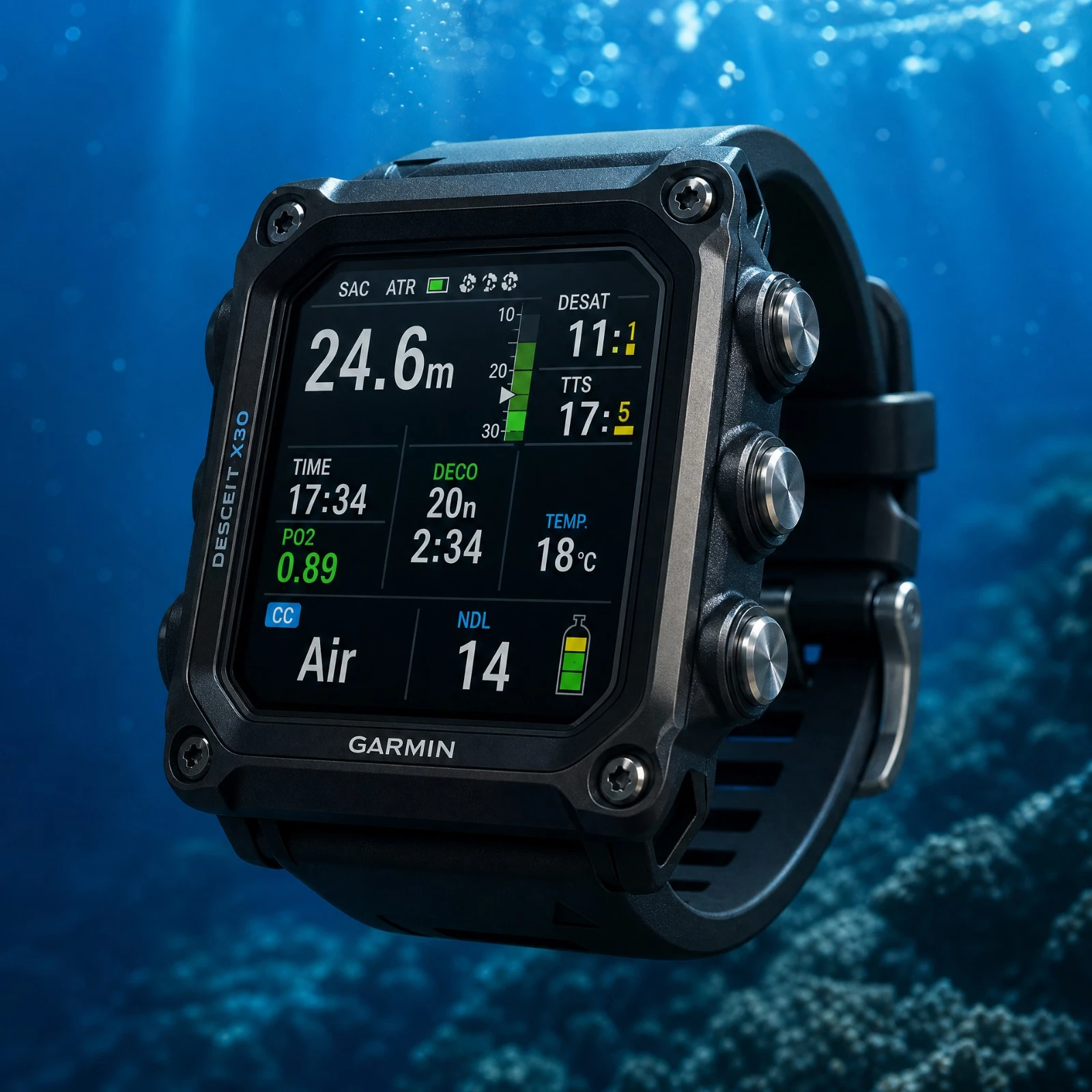
Complete review of the Garmin Descent X30 dive computer. Features Bühlmann ZHL-16C, trimix support, surface GPS, and a rechargeable battery. Versatile for all divers.
To learn how to get the most out of your gear underwater, discover the AquaExposure Training.
Introduction
There's something special about the way Garmin approaches diving.
The brand comes from the world of GPS, outdoor sports, and aviation navigation. And when it creates a dive computer, it brings with it a culture of consumer electronics engineering that translates into well-designed interfaces, mature connected ecosystems, and an approach to hardware that appeals as much to divers as it does to hikers or cyclists.
The Descent X30 follows this logic. It's the entry-level model in the high-end Descent range, positioned below the X50i, with a more compact design and a more accessible price. This review aims to precisely determine what it offers, what it doesn't do, and for which type of diver it represents a relevant choice.
The Verdict in Summary
Overall score: 4.7/5
| Criterion | Score | What it means |
|---|---|---|
| Algorithm & levels | 5.0/5 | Bühlmann ZHL-16C with adjustable Gradient Factors, complete TTS display. |
| Air & multi-gas | 5.0/5 | Multi-gas, Trimix and native CCR mode, without air integration (not scored). |
| Screen & ergonomics | 4.5/5 | Very readable 2.4 inch color screen, intuitive navigation. |
| Battery life & power | 4.5/5 | High-performance rechargeable battery, suitable for multiple consecutive days. |
| Connectivity & app | 4.5/5 | Complete Bluetooth, well-integrated Garmin Dive ecosystem. |
| Compass & instruments | 5.0/5 | Compensated 3D compass and surface GPS for tracking entry points. |
| Robustness & depth | 4.5/5 | Certified to 100 meters (10 ATM), proven Garmin construction. |
| Price & customer service | 4.5/5 | Competitive price-performance ratio in the range, customer service to be aware of before purchase. |
This computer is designed for: The versatile diver who also enjoys other outdoor activities and wants a single connected device to manage everything. It's an excellent backup dive computer when paired with a Shearwater for more demanding dives.
This computer is not ideal for: Tech divers who need the integration of multiple sensors for air supply, or those who dive exclusively and want specialized customer support focused on diving.
Detailed Analysis
O1 Algorithm & Milestones (5.0/5)
The Descent X30 is based on the Bühlmann ZHL-16C model with fully adjustable gradient factors. It uses the same algorithmic foundation as Shearwater products, which is a strong indication of its reliability.
The display of the Total Ascent Time (TAT) and decompression limits is complete and legible. For a computer positioned in the mid-range of Garmin products, this is an algorithmic foundation that makes no compromises on safety.
O2 Air & Multi-Gas (5.0/5)
The gas management is comprehensive. The X30 handles air, Nitrox, and Trimix, and includes a native CCR (Closed Circuit Rebreather) mode. This capability far exceeds what the majority of recreational divers will use, but it positions the device as a serious tool for those moving towards technical diving.
A point to note clearly: the X30 does not have wireless air integration. Unlike the X50i, which supports the T2 probe, this model does not read bottle pressure in real time. If this feature is important to you, you will need to upgrade to a higher-end model or keep a mechanical pressure gauge.
O3 Screen & Ergonomics (4.5/5)
The 2.4-inch color screen is one of the strengths of this device. The readability is excellent, even in low-light conditions. Navigation through the menus is intuitive, following the traditional Garmin design.
The design is more compact than the Mk3 or the X50i, which makes it more comfortable to wear on the wrist for everyday use or sports activities outside of the water.
O4 Battery Life & Autonomy (4.5/5)
The X30 features a rechargeable battery. This is a choice that simplifies logistics for most divers. No need to find batteries during a dive trip, and no need for emergency replacements before a dive.
The battery life is designed to cover several consecutive days of diving. In practice, this depends on the functions that are activated (surface GPS, backlight, Bluetooth synchronization). It's still a good habit to check the battery level before each dive.
O5 Connectivity & App (4.5/5)
The Garmin Dive ecosystem is well-established. The Bluetooth synchronization is reliable, the dive logs are clear, and the integration with other Garmin devices (watches, GPS units) is a real advantage for divers who already use the brand in other activities.
The firmware update is done through the application, which simplifies maintenance.
O6 Compass & Instruments (5.0/5)
The compensated 3D compass is accurate and responsive. The surface GPS is an interesting addition for tracking entry and exit points, particularly useful in coastal diving or Zodiac navigation.
It's one of the strengths of the Garmin range compared to brands that focus solely on diving.
O7 Robustness & Depth (4.5/5)
The 100-meter water resistance rating (10 ATM) covers the vast majority of recreational and light technical uses. Garmin's construction is proven in a variety of outdoor conditions.
For dives that regularly exceed 80 meters, a model certified for greater depths would be preferable.
O8 Price & Customer Support (4.5/5)
The X30 offers a competitive price-to-performance ratio within the Garmin range. At around €668, it provides a benchmark algorithm, a color display, and comprehensive connectivity.
Regarding after-sales service, it's important to be factual: Garmin is a multinational consumer electronics company. If a defect is recognized under warranty, replacement with a new unit is standard procedure. However, the process of getting there can be frustrating, with representatives who may not always be familiar with diving, administrative delays, and potential out-of-pocket expenses for you. This is a reality to be aware of before making a purchase, it's not necessarily a reason not to buy, but rather an argument for choosing a specialized dive retailer who can handle the process for you.
Who is this computer for?
The Descent X30 is designed for divers who do more than just dive.
It's the computer for the hiker-diver, the cyclist-diver, or the traveler who wants a single connected device for all their activities. Integration into the Garmin ecosystem is a real advantage for this type of user.
It's also an excellent backup computer for technical divers who have a Shearwater as their primary and want a reliable backup with a serious algorithm.
It is not ideal for divers who dive exclusively and want specialized after-sales service, or for those who need the integration of multiple sensors for air supply.
Customer Service and Support
Garmin handles its customer service directly, through web portals and general call centers. Replacement with a new unit is standard if the failure is recognized under warranty. However, the process to achieve this often leads to frustration: unspecialized representatives (not familiar with diving equipment), administrative delays, and being sent back to you at your own expense.
The practical recommendation: purchase through a specialized diving retailer that is familiar with handling Garmin products. They will handle the necessary paperwork and simplify the process if any problems arise.
Nutrition
The X30 operates on a built-in rechargeable battery. This is a real logistical advantage for most uses. When cruising, be sure to bring a charging cable and check its compatibility with the outlets available onboard. The battery life is sufficient for several consecutive days, but daily recharging remains good practice.
Other Garmin models to explore
If you are interested in the X30, other models in the Descent range deserve to be compared based on your intended use:
For recreational diving with a tighter budget, the Garmin Descent G1 offers the essential features of the Garmin algorithm in an even more affordable package.
For technical diving with integrated air supply, the Garmin Descent Mk3 and the Garmin Descent Mk3i add pressure transmitter management capabilities.
For the absolute top of the range, the Garmin Descent Mk2i remains a benchmark for the most demanding divers.
Compare this computer.
To compare the Descent X30 with other models based on all criteria O1-O8, see our dive computer comparison tool.
© 2026 AquaExposure. All rights reserved. Reproduction prohibited without authorization.
Share
Table of Contents
- 01Introduction
- 02The Verdict in Summary
- 03Detailed Analysis
- 04O1 Algorithm & Milestones (5.0/5)
- 05O2 Air & Multi-Gas (5.0/5)
- 06O3 Screen & Ergonomics (4.5/5)
- 07O4 Battery Life & Autonomy (4.5/5)
- 08O5 Connectivity & App (4.5/5)
- 09O6 Compass & Instruments (5.0/5)
- 10O7 Robustness & Depth (4.5/5)
- 11O8 Price & Customer Support (4.5/5)
- 12Who is this computer for?
- 13Customer Service and Support
- 14Nutrition
- 15Other Garmin models to explore
- 16Compare this computer.
Questions about the Journal
Can I use the photographs from this journal?
All images are protected by copyright. For any commercial or editorial use, please contact us via our form.
How can I be notified of new articles?
Follow us on social media or join the Sentinels Circle to receive our immersion stories before anyone else.
Do you offer hands-on workshops?
Yes, we organize masterclasses and field expeditions for members of our school. Check the Training page for details.


