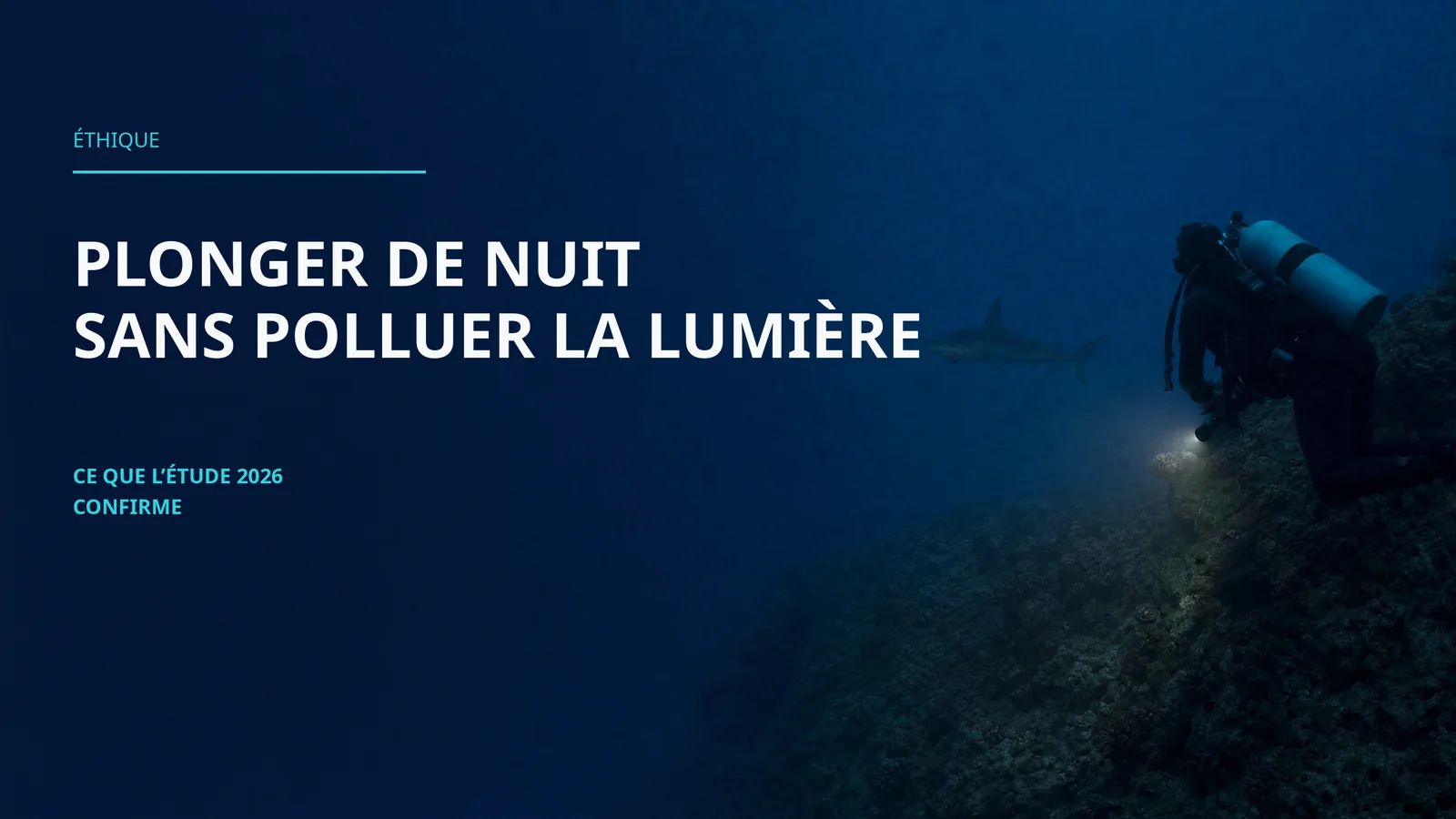
Light Pollution on Night Dives: What a 2026 Study Just Confirmed About Sharks (and Our Dive Lights)
A study published in January 2026 shows that artificial light at night disrupts shark melatonin. Practical reading for the underwater photographer who dives at night.
What light power is acceptable on a night dive when sharks are present?
No absolute number, but a behavioural rule: use the lowest setting that lets you see your instrument and your buddy, and only light the animal at the precise moment of the shutter release, not continuously. A 1500-lumen torch aimed for ten seconds is better than a 600-lumen torch aimed for five minutes.
Does a red filter on the torch really protect nocturnal wildlife?
Red light disturbs some fish species less, but not all, and the effect on sharks is not clearly documented. The cautious rule stays the same: less time lit, less power aimed, more observation with adapted night vision.
Does the 2026 study completely invalidate night diving?
No. It invalidates massive and continuous lighting in the presence of sensitive wildlife. Night diving remains a wonderful and instructive practice, as long as you significantly reduce the light dose imposed on the environment.
What is the connection between this study and the AquaExposure natural light doctrine?
Direct. The AquaExposure doctrine says that natural light is preferable to artificial light whenever the situation allows it. The 2026 study adds a precise ecological reason to a principle we had been defending on aesthetic and technical grounds.
What if I still want to photograph a shark at night?
Work the image as a silhouette by lighting only the background (the reef, the surface), not the animal directly. Set up your framing before the shark enters the frame. Fire one or two shots at most, then cut the light. The animal deserves your discretion.
To learn how to get the most out of your gear underwater, discover the AquaExposure training.
Light Pollution on Night Dives: What a 2026 Study Just Confirmed About Sharks (and Our Dive Lights)
In January 2026, a research team from the University of Miami (Rosenstiel School) published in Science of the Total Environment a study with a direct title: Sharks at night, exposed to city light: Melatonin concentrations in two shark species differ in response to artificial light at night. The summary is short and it stings to read: shark melatonin, the hormone that regulates their sleep-wake cycle and their nocturnal physiology, changes significantly when they are exposed to artificial light at night.
The researchers were working on the impact of coastal urban lighting. But reading the paper as a diving instructor, I arrived at a different question, a more immediate one: what does this say about our dive torches on night dives? And what it says is that we need to talk about it.
This article is not a prosecution of night divers. It is a shift in perspective. We are not neutral light sources. Our torches are part of the nocturnal light environment, just like the lit jetties of marinas. And our lighting decisions have consequences.
What the Study Actually Measured (and Why It Is Solid)
The study was conducted on two distinct shark species, under controlled conditions that reproduce exposure to artificial light at night. The researchers measured circulating melatonin levels in exposed animals and in control animals (in natural darkness).
The main finding: the melatonin levels of exposed animals are significantly altered. Melatonin is not a minor hormone. In vertebrates (and therefore in sharks), it regulates the sleep-wake cycle, nocturnal metabolic activity, and several immune processes.
Altering the melatonin of a wild animal is not killing it. It is also not nothing. It means changing its internal clock, its physiology, and probably its longer-term behaviour. For animals that hunt, reproduce and migrate according to nocturnal rhythms refined over millions of years, the dose matters.
The study's context is coastal cities. The practical reach, for us divers, is broader. If artificial light disrupts melatonin at the coastal fringe, there is no reason to think that a 3000-lumen torch aimed for ten minutes at a reef has no effect.
The AquaExposure Doctrine: Natural Light First, and Now for One More Reason
Since the beginning of AquaExposure training, I have held a simple position: natural light is preferable to artificial light whenever the situation allows it. Until now, this doctrine rested on three reasons.
The first is aesthetic. Underwater natural light has a quality that neither a strobe nor a torch can reproduce. Ambient light images tell the story of the water, while flash images often tell the story of the subject alone. The guide mastering natural light underwater covers this point in detail.
The second is technical. Working in natural light forces the photographer to compose with what is available (framing, position, depth), rather than compensating with equipment. It is harder at first, and it is the learning process that builds a lasting underwater photographer.
The third is ethical. Underwater animals do not have eyelids. They cannot look away from a flash burst. A brief, powerful light on a reef fish is the equivalent of a stadium spotlight pointed at an unprepared human. This is the point that made me abandon red filters several years ago and focus the teaching on white balance in post-processing.
The 2026 study adds a fourth reason, and it is the one that makes the doctrine truly difficult to argue against: artificial light at night measurably alters the physiology of wild animals. Not just their immediate behaviour. Their internal regulatory hormone.
When you have four independent reasons that converge toward the same rule, you are holding something solid.
What This Changes for Night Diving in Practice
I want to be specific. The 2026 study does not say we should stop night diving. It says we should stop night diving while lighting the water as if it were broad daylight.
Here is what I have been adjusting since January 2026 in my night dive briefings, and what I recommend you adopt even without reading the full paper.
Reduce power by default. A 3000-lumen torch on a night dive is almost always oversized. On most sites, 600 to 1000 lumens on wide mode is enough to orient yourself and see your buddy. The power is something you pull out briefly for the shutter release, not for navigation.
Reduce exposure time. An animal lit continuously for ten minutes is far more impacted than an animal lit twice for three seconds for framing and firing. Prepare your image in darkness (framing, focal length, pre-set exposure), switch on, fire, switch off. The total duration of active lighting should be ridiculously short compared to the dive time.
Reduce lighting distance. A torch at one metre from the animal delivers fifty times more light than a torch at seven metres. Approach in adapted darkness, fire from close, and you can use far less power.
Light the background, not the subject. For many night scenes (shark against a reef backdrop, ray on the hunt), a backlit silhouette image tells a better story and disturbs less. The subject is in shadow, the background carries the light. It is harder to execute, but the image lives differently.
These four adjustments cost nothing in equipment. They have changed the look of the night images my students bring back, and they have eliminated the feeling of chasing the animal with a searchlight.
These principles will be integrated into AquaExposure training in the next iteration of the modules on night diving and low-light photography. The 2026 melatonin study will be part of the scientific references cited in the ethics module, alongside the work on the social behaviour of Fiji bull sharks and the field observations on Fuvahmulah tiger sharks. The natural light doctrine gains a more solid foundation with each study, and it is that foundation that makes the training credible when you defend it in a course.
The Predictable Objection: "But Without Light, I Cannot See Anything"
That is the objection I hear at every briefing. It is legitimate, and it has two answers.
The first: without light is not the instruction. The instruction is with less light, and more precisely. You need a torch for safety, for reading your instruments, for your buddy. You do not need one to sweep a reef over six metres for twelve minutes.
The second: the human eye adapts to darkness much faster and much deeper than most divers believe. After fifteen minutes in true darkness, you see silhouettes, movement, contrast. Many animals become visible precisely because you stop imposing a light that washes them out. It is the opposite of intuition, but it is the experience I have on every night dive.
The most striking night photo I have taken in recent years contains almost no artificial light. It contains attention, framing, and the acceptance that darkness is part of the subject.
One Doctrine, Multiple Proofs: What Makes the AquaExposure Position Stable
I will end on something that goes beyond this article.
When a teaching doctrine rests on a single reason (aesthetic, technical, or ethical alone), it is fragile. The day the argument is contradicted, the doctrine falls.
The AquaExposure doctrine on natural light is now supported by four independent reasons: aesthetic, technical, ethical, and now ecological in the physiological sense. Each stands on its own. Together, they form a position that no single argument can topple.
That is what I wanted to share. Not a trend, not an opinion. A convergence.
The next night dive you do, your torch will determine both the quality of your image and the quality of your passage. The two are linked. Now you know why.