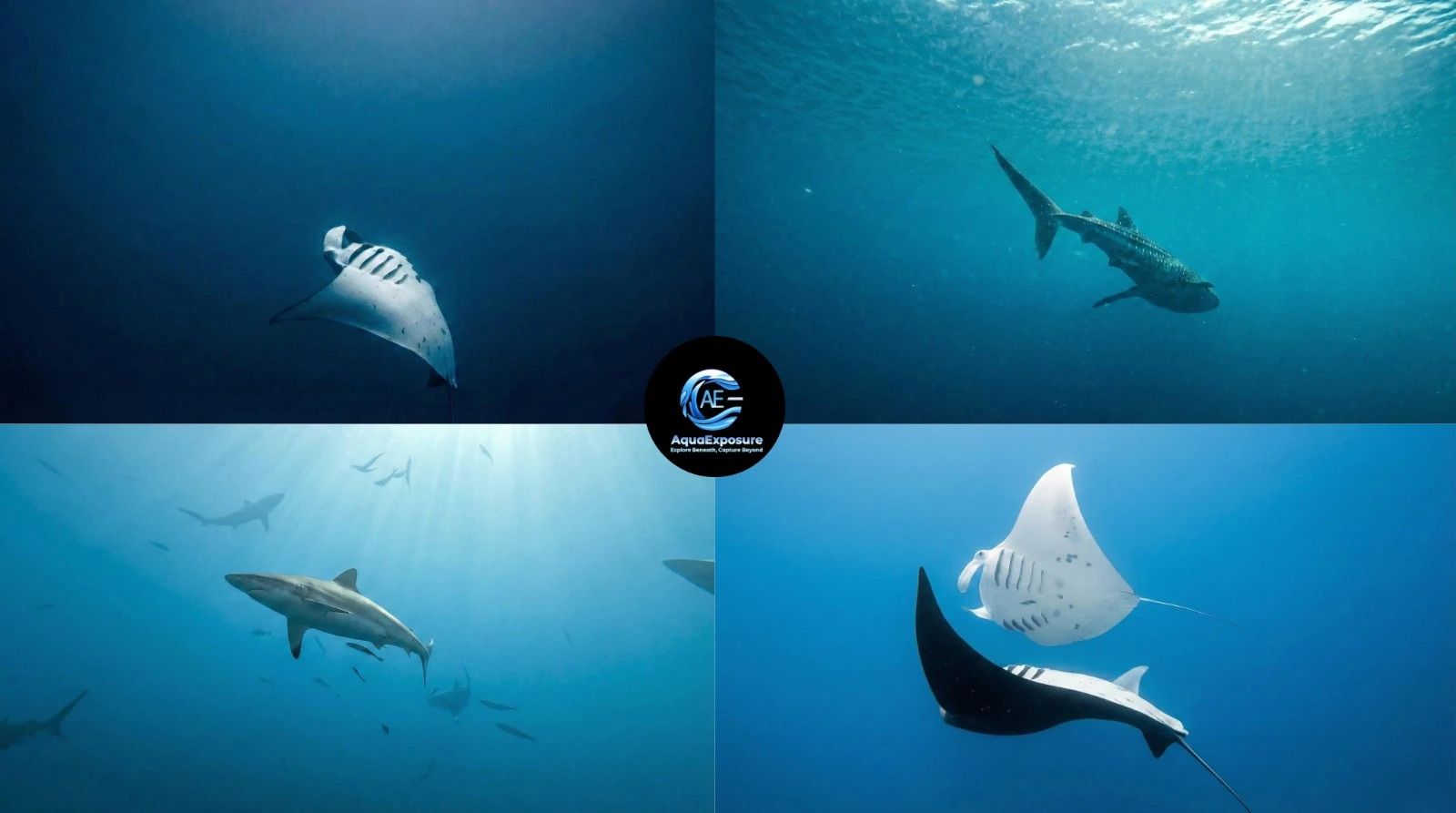
Can you really take good underwater photos with a GoPro?
Yes, provided you master the three variables that make the difference: white balance (5000K fixed, not auto), color profile (Flat), and distance to subject (50-80 cm for still subjects, minimum 2 meters for wildlife). A properly set GoPro with good technique produces images far superior to a 3,000-euro camera used poorly.
What GoPro settings should you use underwater in the Maldives?
The recommended protocol: 4K 60fps, white balance at 5000K or Native (not Auto), color Flat, bitrate High, ISO max 1600, exposure compensation at -0.5. Dive between 10am and 2pm to take advantage of vertical light. Do not use a red filter.
GoPro or iPhone for photographing mantas and sharks in the Maldives?
Both work. The GoPro is lighter and less bulky. The iPhone with DiveVolk housing offers better manual control and more workable RAW output in post-production. For pelagic species in wide angle, the GoPro is often more effective thanks to its wide field of view.
I brought back my best photos from the Maldives with a 350-euro GoPro
Here is something I need to confess. Every photo in this article was taken with a GoPro. Not a Sony. Not a Nikon. Not a 1,000-euro housing bolted onto a full-frame body. A small yellow camera. Total budget for the setup: about 350 euros.
I can see where this is going. "Sure, but GoPros are for fun snorkeling videos, not for real underwater photography."
That is exactly what the diver sitting across from me on the boat was thinking, that first morning in the Maldives.
He had the complete setup: a 3,500-euro mirrorless body, a custom housing, two external strobes, articulated arms, ergonomic handles. The underwater equivalent of a bomb disposal kit. About 15 minutes to assemble everything before each dive.
He watched me pull out my GoPro. Then he looked at his setup. Then back at my GoPro.
He said nothing. But he had that smile. You know the smile. The one reserved for people who show up to a marathon in flip-flops.
We dived together for three days.
On the last evening, he asked to see my photos.
I will not tell you exactly what he said. But he looked a little less satisfied with his 1,200-euro housing.
What two years in the Maldives actually taught me
When I was a dive instructor in the Maldives, I spent hundreds of hours underwater observing photographers. Beginners, intermediates, semi-professionals. With 500-euro gear and 10,000-euro gear.
And I noticed something that keeps coming back every time: people who invest heavily in equipment before investing in their technique invariably make the same mistakes. Too far from the subject. Bad position relative to the light. Shutter pressed at the wrong moment. The housing cannot help them.
The GoPro, on the other hand, does not forgive those mistakes. It forces you to correct them.
That is its real advantage.
The 3 parameters that make an underwater photo
1. Distance to subject
The simplest and most ignored rule of underwater photography: get closer. Really.
Water is never perfectly transparent. Even in the Maldives, with 30-meter visibility, every meter of water between you and your subject steals sharpness, color, contrast. At 3 meters away, you are photographing blue soup with something in it.
The GoPro, with its native wide angle, naturally encourages you to get closer for framing. Result: your photos are naturally better than if you stayed at a "comfortable" distance.
The rule I teach: 50 to 80 cm maximum for small subjects. For a manta or a stingray, you can go to 1.5 meters if the animal allows it. No more.
2. Position relative to the light
Underwater, light comes from above. Always. And that light does everything.
If your subject is between you and the surface, you are photographing a shadow. If you are between your subject and the surface, with the sun at your back, you are photographing colors.
The GoPro has no powerful flash to correct a bad position. It forces you to naturally seek the right orientation, to anticipate the animal's trajectory, to position yourself before it arrives.
That is exactly what good terrestrial wildlife photographers do. And it is what most divers with expensive gear never learn, because they assume their strobes will fix everything.
Strobes do not fix everything.
3. The moment of capture
A manta opening its gill slits. A fish turning its head toward you. A shaft of sunlight cutting through the surface at the right angle. These images last a fraction of a second.
With a GoPro in burst mode or video, you can capture these moments by extracting frames. But more importantly, working with this tool teaches you to anticipate, to read animal behavior, to sense when something is about to happen before it happens.
That is what we call scene reading. And it is the most valuable skill in underwater wildlife photography.
"But the GoPro image quality."
I hear you. And you are partially right.
A 1-inch sensor will produce files with more latitude in post-production. An interchangeable lens will allow more versatility. For sales, magazine publication, or serious competition, yes, gear matters.
But for 99% of underwater photographers, it is not the gear that limits their photos. It is their technique.
I have seen GoPro photos published in magazines. I have seen photos from 8,000-euro setups that were worthless because the person was too far away, badly positioned, and pressed the shutter at the wrong moment.
The tool is never the problem.
What I actually recommend
Start with what you have. GoPro, smartphone in a housing, waterproof compact. Master the 3 parameters above until they become reflex. Learn to read the light underwater. Learn to get close without disturbing the animals.
Then, if you want to progress to more advanced gear, you will know exactly why you need it and what you are going to do with it.
Otherwise, you will just spend 5,000 euros to bring back the same blurry photos in a nicer housing.
That is the entire AquaExposure philosophy: understand first, equip second.
If you want to learn the fundamentals that truly make the difference, the course is right here.
FAQ
Can you really take good underwater photos with a GoPro?
Yes, provided you master the three variables that make the difference: white balance (5000K fixed, not auto), color profile (Flat), and distance to subject (50-80 cm for still subjects, minimum 2 meters for wildlife). A properly set GoPro with good technique produces images far superior to a 3,000-euro camera used poorly.
What GoPro settings should you use underwater in the Maldives?
The recommended protocol: 4K 60fps, white balance at 5000K or Native (not Auto), color Flat, bitrate High, ISO max 1600, exposure compensation at -0.5. Dive between 10am and 2pm to take advantage of vertical light. Do not use a red filter. Do not use a torch or flash except in caves or wrecks.
What is the maximum depth without a housing for a GoPro Hero?
The GoPro Hero 13 Black is waterproof to 10 meters without a housing. Beyond that, the Max Lens Dome housing is needed: it goes down to 60 meters and significantly improves optical quality in wide angle. For standard dives between 10 and 30 meters, the housing is essential.
GoPro or iPhone for photographing mantas and sharks in the Maldives?
Both work. The GoPro has the advantage of being lighter and less bulky during long dives. The iPhone with DiveVolk housing offers better manual control and more workable RAW output in post-production. For pelagic species like mantas in the Maldives, the GoPro in wide angle is often more effective: its wide field of view captures the animal even when it passes quickly.