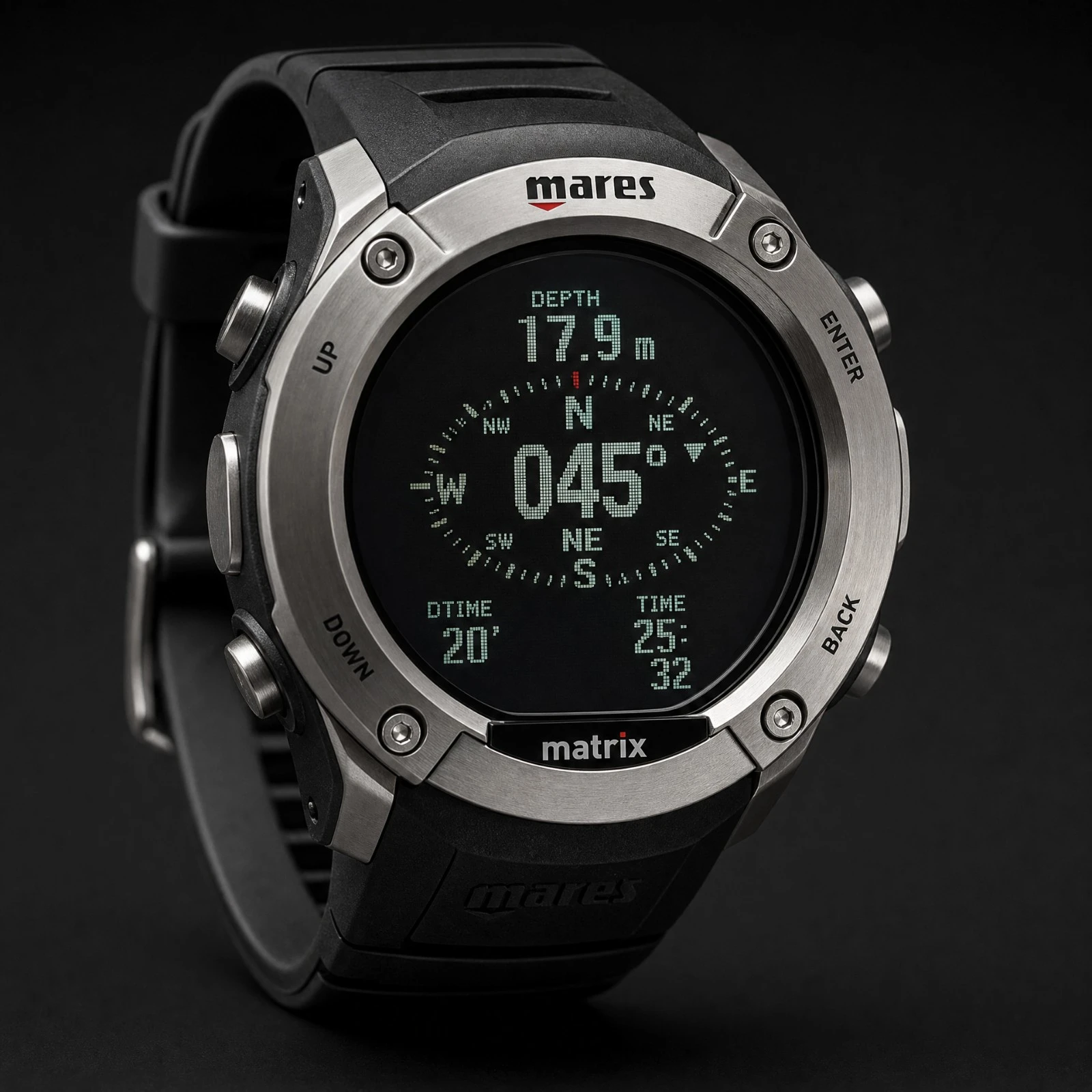
Discover our Mares Matrix dive computer review! This watch-style computer features a full dot matrix display, 3D compass, and rechargeable battery.
To learn how to get the most out of your gear underwater, discover the AquaExposure Training.
1. Introduction
The evolution of our diving equipment often follows predictable cycles, where manufacturers refine existing concepts without truly revolutionizing our underwater experiences.
We are getting used to reading basic digital segments on narrow screens, which drastically limits the clarity of the information displayed during our interactions.
However, the interface that calculates our saturation levels and dictates our safety during each dive deserves special attention from the designers.
The Mares Matrix is part of this effort to offer a different way of interpreting our vital signs, in order to improve our understanding of the environment.
By integrating a high-resolution dot matrix display into the heart of a compact metal casing, the Italian manufacturer sought to redefine the computer watch.
This device eschews the traditional button battery in favor of a rechargeable battery and features a state-of-the-art electronic compass to facilitate navigation.
This technical analysis, based on the manufacturer's specifications and documented feedback from the community, aims to determine whether this model, equipped with the RGBM algorithm, remains a relevant choice in light of the influx of new color displays.
Diving is a discipline that requires rigor, method, and perfect mastery of its measuring instruments.
2. The Verdict in Summary
Overall score: 3.6/5
| Criterion | Score | Meaning |
|---|---|---|
| Algorithm and decompression levels | 3.4/5 | Proprietary RGBM Mares-Wienke algorithm, very safe but without adjustable Gradient Factors. |
| Air and multi-gas | 2.5/5 | Limited to three Nitrox gases up to 99% oxygen for recreational use and minor decompression stops. |
| Screen and ergonomics | 4.0/5 | Full dot matrix screen offering exceptional resolution and real-time graphic display. |
| Battery life | 2.5/5 | Rechargeable battery via USB, very convenient, but battery life is limited to approximately ten to fifteen hours of dive time. |
| Connectivity and app | 3.0/5 | Wired transfer via a proprietary cable to a computer, without native Bluetooth integration. |
| Compass and instruments | 4.5/5 | Excellent 3D compass compensated for inclination with heading memory and chronograph. |
| Robustness and depth rating | 4.5/5 | Extremely robust metal casing and mineral glass certified to a depth of 150 meters. |
| Price and customer service | 4.0/5 | Equipment whose robustness justifies the price, supported by Mares' customer service, which sometimes receives polarized reviews. |
3. Detailed Analysis
Algorithm and Milestones
Decompression management is the core functionality of any self-respecting dive computer that claims to ensure your safety.
Before even looking at the design or additional features, it's crucial to understand the mathematical logic that will determine your base time.
The Matrix relies on a classic mechanism from the Italian manufacturer, which is known for its reliability among the general public and has been proven over many years.
This device operates using the proprietary RGBM algorithm developed by Mares-Wienke, which is based on ten distinct tissue types to model gas absorption and release.
This mathematical model perfectly integrates the management of adjustable deep layers, which smooths the ascent towards the surface and limits the formation of micro-bubbles.
However, it does not allow for the free adjustment of gradient factors in the same way as a Bühlmann ZH-L16C model, which offers complete flexibility.
This closed approach limits customization options for highly demanding technical divers who like to fine-tune their decompression profile based on their physiology.
The device remains very clear about alarms for uncontrolled ascent or excessive saturation, which could occur during a poorly planned dive.
It automatically adjusts to altitudes up to 3700 meters, ensuring your dives in mountain lakes are safe without requiring complex menu adjustments.
Accuracy, caution, and consistency are the key principles of this algorithm, which prioritizes safety above all else for recreational divers.
Air and Mixed Gases
The transition towards independence often involves the use of oxygen-rich mixtures to optimize decompression and reduce post-dive fatigue.
Understanding how a computer manages these gas transitions is fundamental for planning more ambitious dives with an adequate safety margin.
This computer is perfectly sized to accompany your first dives using enriched air mixtures, with a clear interface that minimizes the risk of user error.
It manages up to three gases simultaneously, covering Air and Nitrox from 21% to 99% oxygen for your accelerated decompression stops.
The gas switching during a dive is done very logically using the four buttons on the metal housing, which are conveniently located and easily accessible to the fingers.
On the other hand, no Trimix modes or rebreather management features are present in the device's menus, which remains focused on traditional open-circuit diving.
It also lacks air integration, which means it does not communicate with any pressure gauges attached to the first stage of your regulator.
You will therefore need to continue monitoring your air supply using a traditional mechanical pressure gauge connected to your regulator via a high-pressure hose.
The lack of wireless air management is a technical choice that simplifies the electronics, but it requires constant manual monitoring of your power consumption.
Screen and Ergonomics
The display is undoubtedly the standout feature of this device, setting it apart from the usual standards in the dive watch market.
Forget the large, square digits of traditional segmented displays that limit the display of complex data and restrict the user interface.
The full matrix display, approximately 30x30 millimeters in size, offers excellent contrast and features a very useful color inversion mode for night dives.
It can be read from all angles thanks to its high-quality mineral glass, which prevents unwanted reflections from the sun near the surface.
A very rare feature for this type of watch, the computer directly displays a graph of your dive profile while you are submerged in the ocean.
This detailed reconstruction of the topography of your dive provides a very, very, very valuable visual aid underwater for planning your decompression stops.
The four-button navigation is intuitive and has been praised as excellent by numerous testers who have used it under various visibility conditions.
The interface offers such straightforward readability that even with thick gloves, checking the settings remains a breeze for the equipped diver.
The ergonomics were designed to minimize the cognitive load on the diver when they need to make quick decisions in response to an unexpected event underwater.
Battery Life and Power Source
Energy management is a constant concern for divers who frequently travel far from modern infrastructure and power outlets.
If you are tired of going to a watchmaker to have your computer serviced and its battery replaced, this model offers a concrete solution.
The Matrix features an internal lithium-polymer battery that can be recharged via a wall outlet or a standard USB port, which is commonly found today.
The battery life in pure apnea mode is approximately ten to fifteen hours, depending on usage conditions and the water temperature.
A deep sleep mode helps conserve energy between long journeys, preventing a complete discharge that could damage the battery cells.
While charging from a standard outlet is an excellent solution, this range will require daily attention from the traveling diver.
During very intensive cruises with three or four dives per day, you will need to plug it in frequently in your cabin to avoid the battery running out.
Anticipation, verification, and discipline are essential to avoid ending up with a black screen at the moment of launch.
Connectivity and App
Saving our dive profiles is essential for analyzing our performance and making technical progress over the years of underwater exploration.
The watch features a sophisticated logbook that stores up to thirty-six hours of detailed data in its internal memory before overwriting the oldest information.
High-precision sampling records your parameters every five seconds, allowing for a detailed analysis of your underwater behavior and ascent rate.
However, this device requires a transition to bridge the gap with the era of smartphones and connected apps that dominate the current market.
Due to the lack of an integrated Bluetooth module, downloading the curves to the software is done exclusively via the interface cable provided in the original box.
The firmware update also requires this proprietary wired connection to a PC or Mac, which necessitates installing the appropriate drivers.
This physical limitation requires a bit of patience when you return home, as it allows you to properly archive your dives in your digital dive log.
The dedicated software then allows you to visualize the graphs with remarkable precision, helping you understand your depth variations and optimize your buoyancy.
Compass and Instruments
Underwater navigation requires reliable instruments that won't fail you in murky conditions or complex environments where visual references disappear.
The integrated digital navigation in this model is remarkably accurate for a device of the size of a wristwatch, which is worn daily.
It features a complete digital compass with extremely stable tilt compensation, which minimizes errors in arm positioning during underwater use.
This 3D compass comes with a heading memory function, which greatly simplifies returning to the boat after a long exploration on a steep drop-off.
In addition, there is a very useful timer mode that can be used in dive mode to manage specific decompression stop times or navigation exercises during training.
A depth gauge displays the average depth, which can be reset, for divers who use dive tables or planned decompression and calculate their own profiles.
These additional tools transform the watch into a true miniature dashboard that centralizes all navigation data on your wrist.
Robustness and Depth
The marine environment is harsh on precision electronics that are not properly protected against pressure, salt, and ambient corrosion.
Behind its urban design, this computer is a true tank, capable of reaching very low depths without suffering any deformation.
The elegant metal casing protects proven electronics, allowing it to function flawlessly at depths of 150 meters without being affected by the crushing pressure of the deep sea.
The tempered mineral glass adds a high level of resistance against scratches, which are inevitable when navigating wrecks or sharp rocks that line our routes.
The device also features an exclusive menu that allows you to display your emergency medical information in case of a problem requiring immediate assistance from emergency services.
This exceptional durability guarantees a long lifespan, even when exposed to the corrosive effects of salt and the harsh tropical sun, which can prematurely damage diving equipment.
The mechanical design exudes reliability and inspires complete confidence when conditions deteriorate below the surface and equipment is put under extreme stress.
Price and Customer Support
Investing in a dive computer should be considered as a long-term investment, taking into account the quality of after-sales service offered by the manufacturer.
Initially priced around €610, this high-end model maintains a very good value on the used market thanks to its legendary durability.
The quality of its casing explains this persistent enthusiasm among experienced divers who are looking for durable equipment that can withstand impacts.
Regarding after-sales service, the European Mares network has polarized opinions within the diving community, with users sharing their experiences.
Some users report quick turnaround times of eight days for issues covered under warranty by qualified technicians from the brand.
Other users report delays or a certain inflexibility in handling shipping costs for returns to the workshop for complex repairs.
The local reseller plays a vital role and is crucial for ensuring the smooth process of handling your defective equipment.
4. Who is this computer for?
The choice of a dive computer should accurately match your actual diving activities, and not be based on fantasies of distant exploration that will never materialize.
This model is ideal for regular divers, from Level 2 to 4, who are looking for a true everyday watch that can accompany them underwater.
It will delight those who want a powerful digital compass and the ability to display the curve of their dives in real time on a matrix screen.
Its matrix-style readability will appeal to experienced Nitrox divers, as it allows for the intuitive management of three gases during decompression stops.
On the other hand, this computer is not ideal for divers who are going on a safari where they don't have easy access to electricity to recharge its battery.
Its limited battery life of about ten hours will quickly become a major constraint when cruising alone, far from power outlets and generators.
It will also not be suitable for technical deep divers who require the Bühlmann model or the use of Trimix for their decompression, especially when exceeding recreational diving limits.
5. Customer Service and Support
Technical support after purchase is a fundamental aspect that determines the lifespan of your equipment investment and your peace of mind.
The after-sales service of Mares receives mixed feedback from European users who had to use it for repairs.
The opinions are polarized between very quick solutions and more laborious processes that require patience and perseverance.
Some divers benefit from exchanges that take place within eight business days when the malfunction is clearly identified by technicians from the Italian manufacturer.
Other users are reporting delays in processing or bureaucratic hurdles regarding shipping costs for sending equipment to repair centers.
In this context, the reseller acts as a crucial intermediary between the brand and the end-user who is waiting for their computer to be repaired so they can get back to work.
The quality of your relationship with your local dive shop will largely determine the effectiveness of the support you receive in case of a technical issue requiring a return to the manufacturer.
6. Nutrition
The power source of our computer often dictates our preparation routine before we dive in for a new underwater exploration.
The choice of a rechargeable lithium-polymer battery significantly changes the field workflow for divers who are accustomed to disposable batteries that are replaced once a year.
You should get into the habit of regularly charging the device, at least every two or three days when diving, to avoid any unpleasant surprises.
This structural limitation of approximately ten hours underwater per dive imposes strict discipline to avoid running out of air in the middle of a descent.
Charging via a wall outlet or a USB port remains very convenient when you have access to an electrical outlet in your hotel room or cabin.
The deep sleep mode helps conserve energy between dives, but it does not eliminate the need for a thorough check before departing for the dive center.
Organization, rigor, and method are key to managing this limited autonomy calmly during your intensive stays in the tropics.
7. Links to other models from the same brand.
The Mares ecosystem offers other alternatives that might better suit your specific expectations regarding decompression and user interface.
If you are looking for a larger color screen with a modern interface, you can check out our review of the Mares Genius, which offers exceptional readability.
For die-hard tech enthusiasts who want to experience Bühlmann's gradient factors in a watch format, the Mares Sirius represents a logical and high-performing evolution.
Beginner divers who prefer a large, highly readable segmented display should consider the Mares Quad, which remains an essential reference for those taking their first breaths underwater.
8. Go further with your equipment.
Having a real-time graph of your immersion displayed on a matrix screen is an undeniable advantage for visualizing your profile.
However, understanding why the computer extends your recovery periods during irregular climbs is a fundamental skill for your safety.
To unlock the secrets of the RGBM model and master the nuances of decompression, join our specialized module on desaturation through the AquaExposure Training Course.
Also, learn how to effectively use your electronic compass in real-world conditions so you never get lost again on a complex site.
Learn the strict rules for planning gas changes so you can approach your Nitrox dives with complete peace of mind.
To compare this computer with other models, see our diving computer comparison tool.
© 2026 AquaExposure. All rights reserved. Reproduction prohibited without authorization.
Share
Table of Contents
- 011. Introduction
- 022. The Verdict in Summary
- 033. Detailed Analysis
- 04Algorithm and Milestones
- 05Air and Mixed Gases
- 06Screen and Ergonomics
- 07Battery Life and Power Source
- 08Connectivity and App
- 09Compass and Instruments
- 10Robustness and Depth
- 11Price and Customer Support
- 124. Who is this computer for?
- 135. Customer Service and Support
- 146. Nutrition
- 157. Links to other models from the same brand.
- 168. Go further with your equipment.
Questions about the Journal
Can I use the photographs from this journal?
All images are protected by copyright. For any commercial or editorial use, please contact us via our form.
How can I be notified of new articles?
Follow us on social media or join the Sentinels Circle to receive our immersion stories before anyone else.
Do you offer hands-on workshops?
Yes, we organize masterclasses and field expeditions for members of our school. Check the Training page for details.


