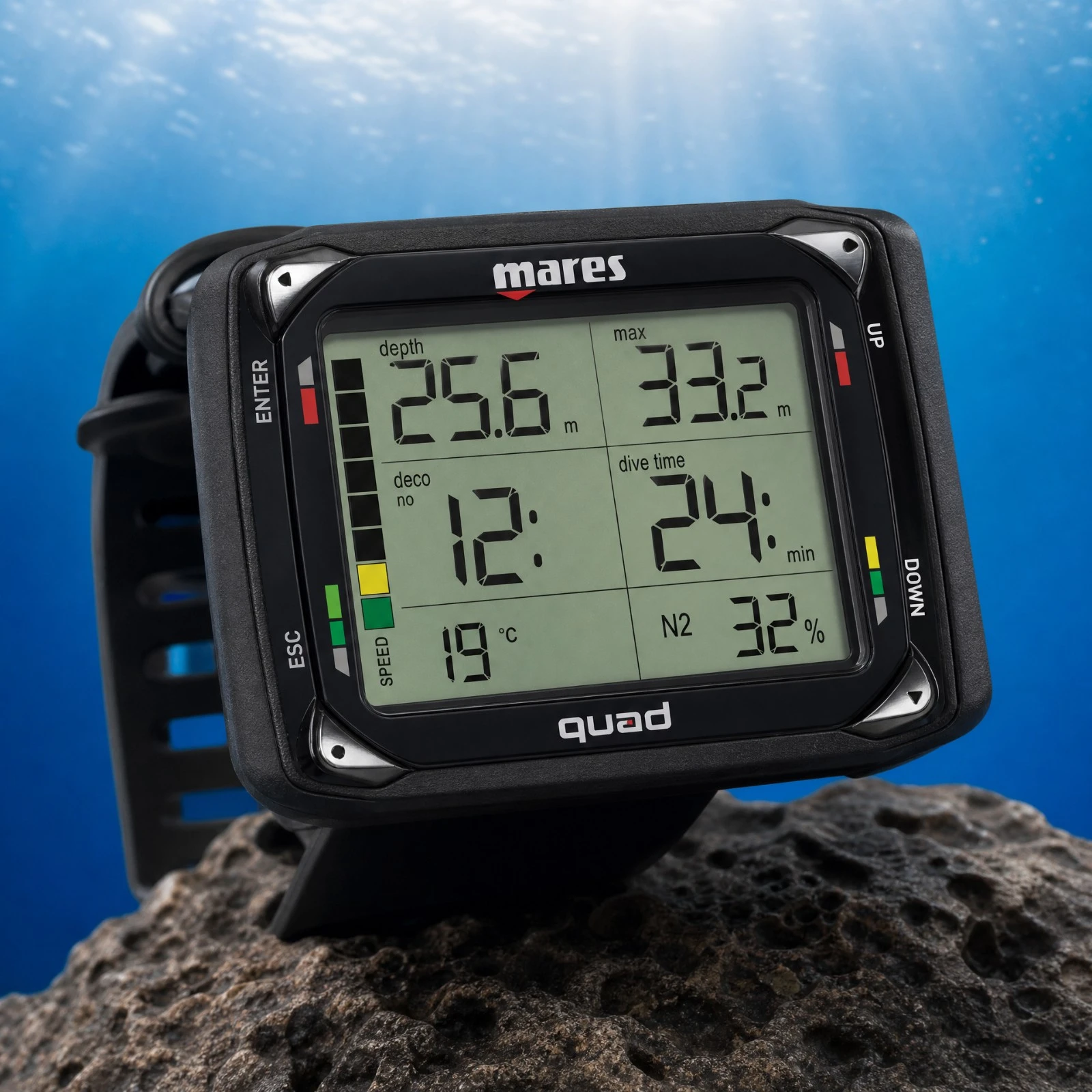
Discover our detailed review of the Mares Quad dive computer. Features a large LCD screen and RGBM algorithm for ultimate visual comfort.
To learn how to get the most out of your gear underwater, discover the AquaExposure Training.
Introduction
The transmission of information below the surface follows strict rules that are often disrupted by fatigue or stress during dives.
We have all experienced those dive ends where the light suddenly diminishes and where condensation subtly appears on the inside of the mask lens.
In those critical moments that require complete focus, the reading of decompression parameters must not suffer from any visual ambiguity.
A calculation tool is only truly valuable if its interface allows for immediate, intuitive reading and requires no effort in interpretation.
It is precisely this philosophy of absolute clarity that guided the Italian manufacturer in the meticulous design of the Mares Quad.
This device fully embraces its utilitarian function by categorically rejecting the aesthetic compromises of an everyday watch.
It features a large, rectangular display that prioritizes character size above all other considerations of design or compactness.
The goal is not to stand out at social gatherings, but rather to provide vital data with surgical precision and readability at a depth of forty meters.
This test relies on a rigorous technical analysis of its algorithmic capabilities and a thorough study of its hardware ergonomics.
Let's explore together whether this classic diving computer, powered by the RGBM model, still holds relevance for recreational divers today.
Technology is evolving at a rapid pace, but the fundamental needs of human beings underwater remain inextricably linked to safety and simplicity.
The Verdict in Summary
Overall score: 3.4/5
| Criterion | Score | What it means |
|---|---|---|
| Algorithm & levels | 3.4/5 | Proprietary RGBM algorithm that is secure but lacks fine-tuning of the Gradient Factors. |
| Air & multi-gas | 2.5/5 | Excellent for recreational diving with 3 Nitrox gas options, but no integration for air or Trimix. |
| Screen & ergonomics | 3.5/5 | Large segmented LCD screen offering unbeatable contrast in bright sunlight. |
| Battery life | 3.8/5 | Replaceable CR2450 battery with very long battery life. |
| Connectivity & app | 3.0/5 | No native Bluetooth, requiring an optional connector to export your dive log. |
| Compass & instruments | 2.5/5 | Omits the compass but includes a solid depth gauge mode. |
| Robustness & depth rating | 4.1/5 | Very durable plastic and scratch-resistant mineral glass certified for 150 meters. |
| Price & customer service | 4.5/5 | Excellent readability at an ultra-competitive price with polarized customer service. |
Detailed Analysis
Algorithm and Milestones
Decompression management is the core function of any diving equipment that claims to ensure your safety underwater.
The Mares Quad relies on the proprietary RGBM Mares-Wienke mathematical model, which models saturation across ten distinct tissue types.
This is a very conservative approach that has proven its effectiveness in thousands of dives around the world over many years.
The algorithm takes into account circulating microbubbles and adjusts its calculations based on your actual diving profile.
The display of mandatory levels and the total ascent time benefits from exceptional clarity, which immediately reassures the user.
The device triggers visual and audible alarms that are particularly noticeable in case of a level breach or excessive ascent speed.
These alerts are designed to cut through the ambient noise of bubbles and draw your attention, even when your mind is wandering while you're on the reef.
However, it is important to keep in mind that this system remains completely closed and does not allow for free adjustment of the gradient factors.
This limitation distances this model from recent Bühlmann standards, which offer a much more refined level of customization for the safety curve.
The technical diver who wants to meticulously plan their decompression schedule will quickly find this calculation tool limiting.
However, for the vast majority of recreational dives, this algorithmic rigidity provides a very appreciable additional margin of safety.
It prevents less experienced divers from getting lost in complex settings that could compromise their physical safety if an error occurs.
Air and Mixed Gases
The evolution of a diver is almost always accompanied by a gradual diversification of the breathing gas mixtures used during dives.
This device will faithfully accompany you from your first dive to extended decompression stops using pure Nitrox.
It can manage up to three gases simultaneously, with adjustable oxygen fractions ranging from 21% to 99%, according to the specific needs of your planning.
This feature allows for declaring a block of accelerated decompression and switching between gases very smoothly underwater.
The interface guides the user during gas changes with a reassuring logic that significantly reduces the risk of errors under stressful conditions.
The transition from a bottom gas to a shelf gas is performed with just a few button presses, and a clear visual confirmation appears on the main screen.
On the other hand, trimix and the settings dedicated to rebreather divers are completely absent from the menus of this model.
This is a deliberate choice that very precisely targets the recreational diving and light technical diving markets.
The lack of wireless air integration in this classic version will also require you to keep a traditional mechanical pressure gauge.
This is a proven configuration that promotes hardware redundancy while keeping the purchase price within an extremely reasonable range.
Reading the pressure on an analog gauge remains a healthy habit that maintains the physical connection between the diver and their air supply.
Screen and Ergonomics
It is in this specific area that the Mares Quad literally crushes a large portion of the current competition.
The segmented LCD screen measures 2.25 inches diagonally and offers a monumental display area that immediately captures the eye.
The main figures are over one centimeter tall to ensure perfect readability in all conditions and from any angle.
The contrast of this monochrome screen is remarkable in bright sunlight on a boat deck or in waters with high particulate content, such as in quarries.
The traditional LCD technology demonstrates its absolute superiority in terms of pure readability compared to unwanted reflections.
Navigation through the various menus is based on four large buttons strategically placed in the corners of the rectangular casing.
This design offers such a straightforward ergonomics that even with very thick waterproof gloves, handling errors completely disappear.
The spacing between the buttons prevents pressing two controls simultaneously when performing operations blindly.
The user interface is straightforward and avoids complex sub-menus that often confuse beginner users during setup.
Each vital piece of information has a dedicated location on the screen that never changes during the experience.
This visual consistency allows the brain to process information at a glance, without having to search for relevant data.
The cognitive load is significantly reduced, which frees up attention for observing wildlife or managing buoyancy.
Battery Life and Power Source
Energy management often dictates peace of mind during extended stays away from the coast and charging infrastructure.
This model completely eliminates the anxiety of a low battery, which often plagues owners of color-screen computers on cruise ships.
It is powered by a standard lithium button cell battery, type CR2450, which the user can replace themselves without needing to contact a certified technician.
The operation only requires a single coin to unscrew the rear cover and takes less than two minutes to complete on a clean surface.
Its battery life far exceeds a hundred dives before showing any signs of weakness or displaying a low-battery warning.
This energy efficiency is explained by the absence of a power-hungry color screen and by perfectly optimized internal electronics designed for this type of display.
It's a major logistical advantage for monitors who work through multiple seasons and don't want to worry about the daily charging of their equipment.
The ability to carry a few spare batteries in a waterproof bag offers virtually unlimited battery life during long expeditions.
The system alerts the user well in advance of a complete failure, which provides ample time to perform the replacement between dives.
Connectivity and App
The transfer of data to a digital dive log has become a standard expectation for divers who enjoy analyzing their profiles.
The Mares Quad is showing its age by omitting a native Bluetooth module directly integrated into the printed circuit board of the housing.
To export your dive profiles to the Mares app or to update the firmware, an additional step is inevitably required.
You will need to purchase either the Dive Link 2 USB clamp or the Bluelink Pro interface, which are sold separately by the manufacturer.
It's a physical constraint that adds a hidden cost to the initial budget and requires an extra step during the return from the dive.
Once the physical or optical connection is established, data transfer remains reliable and allows for the recovery of all saved parameters.
The application allows you to visualize the depth profile, the temperatures encountered, and any alarms that may have been triggered during the dive.
This approach, reminiscent of a bygone era, contrasts sharply with the fluidity of wireless synchronization offered by more recent competing models.
It forces the diver to carry an additional specific cable in their luggage, which goes against the current trend of miniaturization.
Compass and Instruments
Underwater navigation requires specialized tools that some manufacturers integrate directly into the circuitry of their high-end computers.
The Mares Quad deliberately focuses exclusively on desaturation calculations and precise measurement of dive time.
It does not include a digital compass and will require you to use a traditional magnetic compass mounted on your opposite wrist or on a separate plate.
This technical choice allows us to maintain an aggressive selling price while avoiding the frequent calibration problems that occur with electronic compasses.
On the other hand, it features a precise timer and a depth gauge mode that is particularly effective for specific dive profiles.
This Bottom Timer mode displays the resettable average depth during the dive with a single press of one of the main buttons.
It is a feature that is highly appreciated by technical divers who calculate their decompression using dive tables or who use the ratio method.
The absence of an electronic compass significantly reduces the size of the menus and contributes to the overall ease of use of the device.
The readability of depth and time data is enhanced because the screen is not cluttered by a virtual compass rose.
Robustness and Depth
Diving equipment is subjected to mechanical and thermal stresses that few consumer electronic devices can withstand over the long term.
The Mares Quad features a robust, hardened plastic casing designed to withstand repeated impacts during launches from a rigid inflatable boat (RIB).
Its rectangular design effectively protects the internal components from accidental crushing at the bottom of a poorly handled carrying bag.
The entire structure is certified by the manufacturer for a maximum operating depth of 150 meters without risk of deformation.
This structural safety margin ensures a perfect seal even during rapid descents that put significant stress on the O-rings.
The mineral protective glass offers good resistance against light scratches from everyday use and friction against rocks or wrecks.
It is an instrument that immediately inspires confidence due to its solid feel in hand and the perceived quality of its external components.
The oversized push buttons are mounted on robust shafts that show no signs of weakness, even after hundreds of uses.
The original elastomer strap is long enough to fit over even the thickest wetsuits on the market.
Price and Customer Support
The price positioning of this computer undoubtedly makes it one of the most practical choices on the current recreational diving market.
It offers exceptional reading comfort for a very affordable price, which naturally appeals to many beginner divers.
However, the after-sales service of the Italian brand elicits polarized opinions within the community of regular users.
Some users report exchange transactions completed in just eight days, with exemplary professionalism from the manufacturer.
Other users report incomprehensible administrative delays or a certain rigidity regarding the coverage of shipping costs for returning equipment.
In this specific context, the local reseller acts as a crucial intermediary between the isolated diver and the administrative machinery of the brand's headquarters.
Therefore, it is crucial to purchase this equipment from a reputable physical or online store that demonstrates genuine commitment to supporting its customers.
A good professional will be able to defend your case and obtain a quick replacement in the event of premature failure of the electronics.
Who is this computer for?
The Mares Quad is primarily aimed at recreational divers who are looking for a large display without ever having to break the bank to equip themselves.
It excels from the first level of certification all the way to the Confirmed Nitrox courses, thanks to its very smooth management of three different decompression gases.
It is the perfect tool for people with presbyopia, or for those who regularly dive in dark waters with heavy sediment loads.
Work, repetition, and pushing one's limits require reliable tools that don't add unnecessary mental burden during the process.
This computer perfectly meets this requirement by providing essential data with a clarity that borders on audacity.
This computer is, however, not ideal for technical divers who use trimix mixtures or rebreathers.
It will also disappoint those who prefer the discreet design of a dive watch for everyday wear in the office or during land-based activities.
Its bulky size on the wrist makes it suitable exclusively for underwater use, where its generous dimensions become a major advantage.
Customer Service and Support
The longevity of a material investment largely depends on the quality of technical support provided by the manufacturer throughout the product's lifespan.
The Mares network relies on a very dense global distribution system, which greatly facilitates initial support in the event of a confirmed malfunction.
However, feedback regarding after-sales service remains very varied depending on the geographic regions and the individuals contacted.
Some cases are handled with remarkable efficiency, resulting in a quick replacement of faulty equipment without any discussion.
Other cases highlight extended processing times or difficulties in communication with authorized repair centers of the brand.
In this context, the role of the reseller becomes crucial for facilitating transactions and fiercely defending the customer's interests against the manufacturer.
A specialized store will be able to put pressure on the national distributor to expedite a legitimate warranty process that is bogged down in administrative complexities.
It is strongly recommended to keep your proof of purchase carefully and to use official channels for any technical support requests.
Nutrition
The power source of a dive computer directly affects its usability during long trips or isolated expeditions.
The option of a user-replaceable battery offers enormous flexibility compared to factory-sealed rechargeable batteries.
You don't need to desperately search for an available power outlet in the cramped cabin of a crowded cruise ship.
Simply slip a spare CR2450 battery into your toolkit before you leave to ensure dozens of dives with peace of mind.
The watertight compartment opens easily with a coin, and the O-ring can be reinstalled without major difficulty.
This simple mechanical approach avoids planned obsolescence related to the inevitable degradation of the internal lithium-ion batteries over time.
It's a guarantee of longevity for an instrument that can accompany you for an entire decade with minimal maintenance.
The annual replacement of the sealing gasket during battery changes remains the only technical constraint to ensure the long-term reliability of the system.
To find out which battery to buy for this computer, check out our complete guide on batteries for dive computers. To learn how to replace the battery yourself step by step without risking damage, read our complete tutorial on how to change your own battery.
Links to other models from the same brand.
The Italian manufacturer's range offers interesting alternatives if your needs change as your technical skills progress underwater.
If you want to keep this large screen format while also benefiting from wireless air management, the Mares Quad Air is a logical evolution of your equipment.
For divers who want to fine-tune their gradient factors using an open Bühlmann algorithm, the Mares Quad Ci series offers this highly sought-after algorithmic flexibility.
Finally, those who prefer a watch format for everyday use outside of the water can consider the Mares Sirius, which incorporates these technologies into a much more compact case.
Each model meets specific requirements that warrant a thorough analysis before you make your final decision.
CTA Comparator
To compare this computer with other models, see our diving computer comparison tool.
A thorough understanding of your equipment remains the best guarantee of your safety during your future underwater explorations.
© 2026 AquaExposure. All rights reserved. Reproduction prohibited without authorization.
Share
Table of Contents
- 01Introduction
- 02The Verdict in Summary
- 03Detailed Analysis
- 04Algorithm and Milestones
- 05Air and Mixed Gases
- 06Screen and Ergonomics
- 07Battery Life and Power Source
- 08Connectivity and App
- 09Compass and Instruments
- 10Robustness and Depth
- 11Price and Customer Support
- 12Who is this computer for?
- 13Customer Service and Support
- 14Nutrition
- 15Links to other models from the same brand.
- 16CTA Comparator
Questions about the Journal
Can I use the photographs from this journal?
All images are protected by copyright. For any commercial or editorial use, please contact us via our form.
How can I be notified of new articles?
Follow us on social media or join the Sentinels Circle to receive our immersion stories before anyone else.
Do you offer hands-on workshops?
Yes, we organize masterclasses and field expeditions for members of our school. Check the Training page for details.


