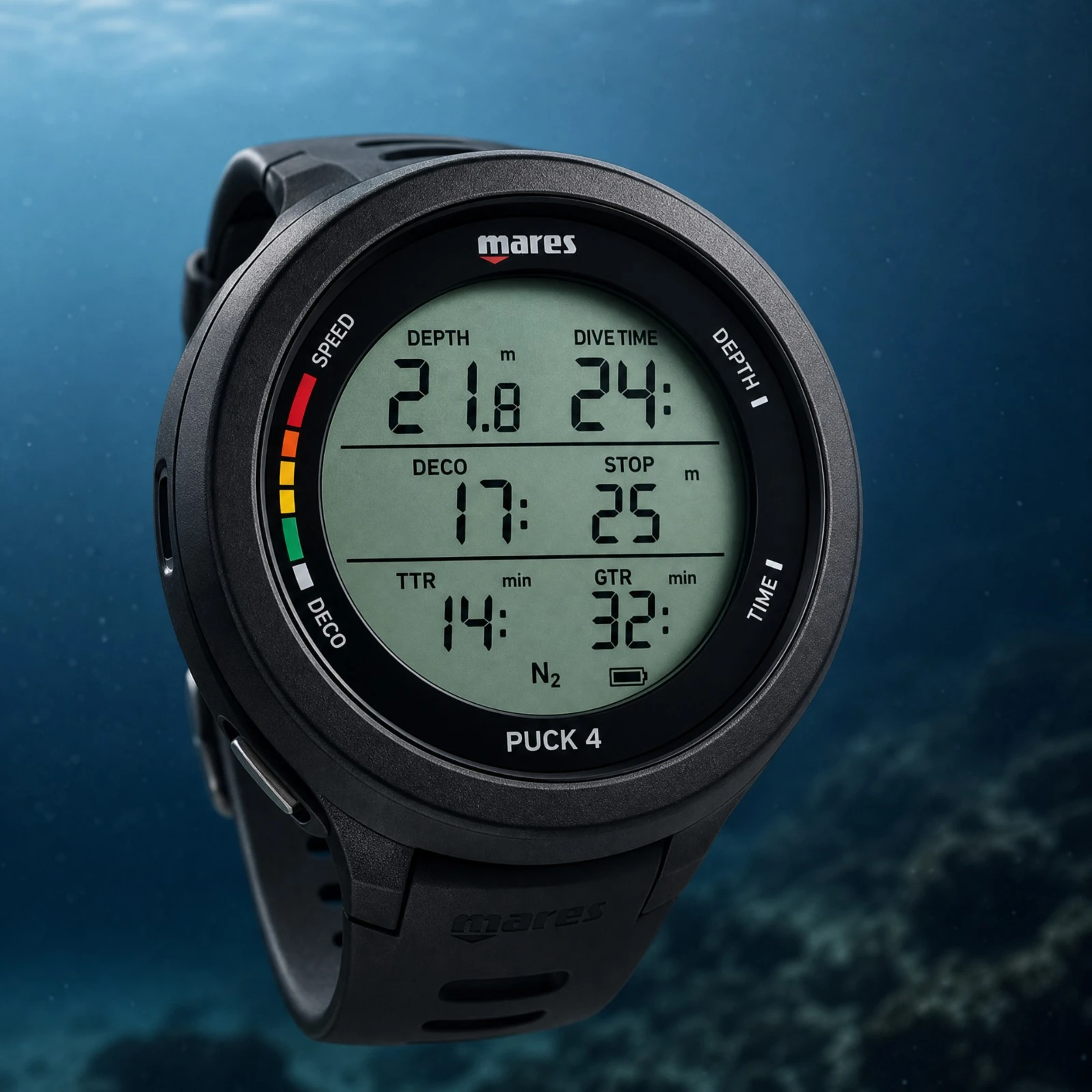
Review of the Mares Puck 4 dive computer. Learn how its Bühlmann algorithm and built-in Bluetooth are changing entry-level diving.
To learn how to get the most out of your gear underwater, discover the AquaExposure Training.
1. Introduction
Rigour, repetition, and self-control are the pillars of our practice. Acquiring the first decompression equipment often marks a decisive turning point in a diver's life. This is the moment when one stops blindly relying on the dive guide and takes full responsibility for their own decompression.
This transition requires a reliable tool that can keep pace with technological advancements without imposing an insurmountable financial barrier. The Mares Puck range has been accompanying divers for decades. It has trained entire generations of underwater explorers thanks to its legendary simplicity.
For years, the entry-level market has been satisfied with offering opaque proprietary algorithms that left little room for physiological understanding. The novice diver had to settle for a black box that dictated their decompression stops without ever explaining its calculations.
Today, the Italian manufacturer Mares is disrupting this historical inertia with the Puck 4. This model, in a very classic puck format, hides a real software evolution under its proven casing. It promises to bring the transparency of the Bühlmann ZH-L16C algorithm at a particularly accessible price.
We will analyze in detail the technical characteristics of this instrument to understand how it is positioned in the current market. This evaluation is based on a thorough study of its specifications and documented feedback from the community, in order to provide you with a clear understanding of its actual capabilities.
The goal is to determine whether this promise of cutting-edge technology at a low price holds up against the inherent ergonomic limitations of a traditional segmented display with a single button. Choosing a computer should never be taken lightly, as it is your primary safety net.
2. The Verdict in Summary
Overall score: 3.5/5
| Criterion | Score | What it means |
|---|---|---|
| Algorithm & settings | 4.4/5 | Complete Bühlmann algorithm with adjustable Gradient Factors, exceptional at this price. |
| Air & multi-gas | 2.2/5 | Three Nitrox gas mixtures ideal for recreational diving, but no Trimix or air management. |
| Screen & ergonomics | 2.4/5 | Classic segmented LCD screen and a single button limiting navigation fluidity. |
| Battery life | 3.3/5 | Replaceable CR2450 battery for approximately one hundred dives. |
| Connectivity & app | 5.0/5 | Native Bluetooth and direct updates via smartphone. |
| Compass & instruments | 3.0/5 | No compass, but an excellent depth gauge mode. |
| Robustness & depth rating | 4.1/5 | Proven casing certified to 150 meters with mineral glass. |
| Price & customer service | 4.5/5 | An outstanding price-to-quality ratio supported by the Mares network in Europe. |
3. Detailed Analysis
Algorithm and Milestones
The mathematical core of a dive computer defines its true value in the long term. The Puck 4 excels significantly by offering the most transparent decompression settings currently available on the market.
No more proprietary algorithms where the calculations remain inaccessible to the user. The Puck 4 uses the Bühlmann ZH-L16C algorithm with fully adjustable gradient factors. This is a huge guarantee of security and future development for this price range.
The Bühlmann model simulates the saturation and desaturation of sixteen distinct tissue compartments. The addition of "Gradient Factors" allows for artificially modifying the degree of oversaturation tolerated by these tissues during ascent.
You can thus adapt your computer's conservatism to your physiological profile, accumulated fatigue, or the specific conditions of your dive. It offers a dive planning tool with decompression calculations, as well as essential ascent alerts to ensure the safety of your dives.
This algorithmic transparency was once reserved for high-end technical computers. Its integration into an entry-level model represents a major advancement for decompression training. The diver is no longer just an executor, they become an active participant in their own safety.
Safety is paramount above all else. A dive computer is a decision-making aid, never an absolute guarantee against decompression sickness. Even with a high-quality, configurable algorithm, this equipment in no way eliminates the need for appropriate training.
It also does not replace the use of a redundant backup system during dives. Always follow the emergency procedures learned during your training. Finally, modifications to the Gradient Factors should only be made with full understanding and after mastering the fundamental principles of tissue desaturation theory.
Air and Mixed Gases
The management of breathing gas mixtures determines the limits of progression in your diving practice. This computer is perfectly suited for recreational diving and for advancing to advanced Nitrox use.
The device can manage up to three different gases. It supports air and Nitrox with oxygen percentages ranging from 21% to 99%. Its gas switching capability is well-managed natively, which simplifies accelerated decompression procedures.
The ability to set up a bottom gas, a travel gas, and a pure oxygen decompression gas covers the vast majority of needs for recreational divers. This is remarkable flexibility for an instrument in this category.
The more complex Tek diving courses, however, are outside its scope. It lacks integrated air supply and does not offer any trimix functions or a dedicated rebreather mode. This is a deliberate choice that perfectly aligns with its price point.
Screen and Ergonomics
The visual interface remains the primary point of contact between the diver and their vital data. The segmented display of the Puck 4 remains a simple, readable, and effective standard.
The monochrome screen is based on Chip-on-Glass technology with eight hundred distinct segments. It is protected by a scratch-resistant mineral glass. However, it cannot compete with the visual comfort of recent color matrix displays.
The advantage of this technology lies in its exceptional contrast even in bright sunlight and its very low energy consumption. Essential information such as depth, dive time, and no-decompression limit are displayed in large characters.
The device is operated via a single central button. This design choice results in a very minimalist interface, allowing for navigation even with thick gloves through long or short presses. However, this ergonomics can sometimes be cumbersome in extremely cold water.
Battery Life and Power Source
Energy management is a constant concern during long journeys or intensive cruises. The immense advantage of this classic format lies in its simple power supply.
The Puck 4 is powered by a standard CR2450 button cell battery. This is a power source that you can replace yourself in three minutes on a boat's table, without needing complex tools or a visit to a workshop.
Mares announces an autonomy of approximately one hundred hours of diving before a replacement is necessary. This represents about a hundred dives, which more than covers the annual needs of the vast majority of regular divers.
This approach contrasts with the current trend of rechargeable batteries. It offers invaluable peace of mind when you find yourself far from any reliable power source. You retain complete control over the basic maintenance of your equipment.
Connectivity and App
The transfer of data to a digital logbook has become a standard expectation for modern users. This subtle evolution of the system greatly simplifies life after the dive.
Synchronization is finally becoming modern and wireless. The Bluetooth module is directly integrated into the computer, eliminating the need to purchase a proprietary interface cable, which is often very expensive.
The device connects to the Mares or SSI app on your smartphone. You can transfer your dive profiles from the internal logbook, which stores up to one hundred dives. You can also easily perform software updates.
Analyzing your dive profiles on a large screen allows you to better understand your consumption and refine your stabilization technique. It is a powerful educational tool that extends the experience long after you leave the water.
Compass and Instruments
Underwater diving requires specific tools that not all computers choose to incorporate. The device meticulously focuses on your decompression settings.
The Puck 4 completely omits electronic navigation features and does not have a built-in compass. Therefore, you will need to equip yourself with a separate analog compass for your orientation exercises.
It does, however, integrate a complete depth gauge mode. This mode includes a timer and a resettable average depth reading. It is a rudimentary but valuable tool for executing square profiles with great precision.
Technical divers particularly appreciate this "Bottom Timer" mode, which allows them to use the computer as a redundant backup instrument during dives planned using dive tables. In this case, simplicity becomes a major asset for the overall reliability of the system.
Robustness and Depth
The durability of a measuring instrument subjected to high pressures is a fundamental purchasing criterion. The pallet format has been renowned for decades for its exceptional longevity.
This model inherits a compact design and is extremely resistant to ambient pressure. It is certified to operate reliably up to a depth of one hundred fifty meters, well beyond the limits of scuba diving.
An interesting detail will delight divers who operate in cold waters. The standard straps can be removed and replaced with an elastic mounting to easily accommodate the compression of a drysuit during descent.
This bungee mounting system ensures that the computer remains perfectly in place on your forearm, regardless of how deeply the neoprene is compressed. This small modification dramatically changes the comfort of everyday use.
Price and Customer Support
The financial investment should always be considered in relation to the services provided and the durability of the equipment. Launched at a price of around two hundred and twenty-nine euros, it offers an excellent value for money ratio.
At this price point, combining native Bluetooth with a genuine, adjustable Bühlmann algorithm completely redefines the standards for entry-level dive computers. This is a value proposition that disrupts the established competition.
The Mares network also provides very easy access to spare parts throughout Europe. We will detail the specifics of the after-sales service in a dedicated section later in this article.
4. Who is this computer for?
The Mares Puck 4 is primarily designed for beginner to intermediate divers who want to acquire a reliable first set of equipment. If you are at Level 1 or Level 3, this device will offer you a state-of-the-art, customizable algorithm to support your technical progress.
It's perfect for those who want to understand their decompression without breaking the bank. Its ability to manage three gases, including Nitrox, makes it an ideal companion for undertaking initial accelerated decompression training courses.
This computer is not ideal for technical divers undertaking Trimix or rebreather training. It will also show its limitations if you require the visual comfort of a large, color screen that is easily readable in water with a high concentration of particles.
The single-button navigation will also deter users who are looking for a smooth and intuitive interface similar to that of a smartphone. One must accept a certain degree of ergonomic "roughness" in exchange for this algorithmic power.
5. Customer Service and Support
After-sales service is an essential safety net for any equipment investment. Regarding the Mares brand, feedback from the diving community highlights polarized opinions that need to be considered.
Some users report that warranty repairs are processed very quickly, sometimes in as little as eight days. Others, however, report delays in processing or a certain inflexibility regarding the handling of shipping costs for returns to the workshop.
In this specific context, the physical or online retailer where you make your purchase acts as an intermediary. It is they who will handle the follow-up of your case with the Italian headquarters.
Therefore, it is wise to choose a store known for the quality of its customer service in order to facilitate any potential claims processes. A good retailer will be able to advocate for your case and provide you with replacement equipment in the event of prolonged downtime.
6. Nutrition
The issue of power supply often dictates the logistical organization of your diving trips. Choosing a battery that can be replaced by the user offers a very appreciable flexibility, especially when traveling to remote areas.
With a standard CR2450 battery, you are not dependent on a specific charging cable or an available power outlet on the boat. You can slip two spare batteries into your waterproof bag and set off with peace of mind for a cruise lasting several weeks.
This autonomy of approximately one hundred hours still requires a certain level of attention. It is important to get into the habit of checking the battery indicator before each trip, because a traditional battery provides less precise information about its remaining life than a modern lithium-ion battery.
When replacing the battery, it is crucial to pay meticulous attention to the sealing O-ring. Careful cleaning and a very light lubrication with silicone grease will ensure the integrity of your instrument for the next hundred dives.
To find out which battery to buy for this computer, check out our complete guide on batteries for dive computers. To learn how to replace the battery yourself step by step without risking damage, read our complete tutorial on how to change your own battery.
7. Links to other models from the same brand.
The Mares ecosystem offers alternatives if the pallet format doesn't perfectly meet your ergonomic expectations. You can explore other approaches to decompression within the same product range.
If you are looking for a more compact watch design for everyday wear, you can check out our detailed review of the Mares Sirius at URL_PLACEHOLDER.
For those who desire a larger color display with air management, the higher-end model is worth your attention in our review of the URL_PLACEHOLDER.
8. CTA Comparator
To compare this computer with other models, see our diving computer comparison tool.
Mastering your decompression isn't something you buy with a computer, it's acquired through study and practice. Take the time to understand the algorithms that ensure your safety during dives.
© 2026 AquaExposure. All rights reserved. Reproduction prohibited without authorization.
Share
Table of Contents
- 011. Introduction
- 022. The Verdict in Summary
- 033. Detailed Analysis
- 04Algorithm and Milestones
- 05Air and Mixed Gases
- 06Screen and Ergonomics
- 07Battery Life and Power Source
- 08Connectivity and App
- 09Compass and Instruments
- 10Robustness and Depth
- 11Price and Customer Support
- 124. Who is this computer for?
- 135. Customer Service and Support
- 146. Nutrition
- 157. Links to other models from the same brand.
- 168. CTA Comparator
Questions about the Journal
Can I use the photographs from this journal?
All images are protected by copyright. For any commercial or editorial use, please contact us via our form.
How can I be notified of new articles?
Follow us on social media or join the Sentinels Circle to receive our immersion stories before anyone else.
Do you offer hands-on workshops?
Yes, we organize masterclasses and field expeditions for members of our school. Check the Training page for details.


