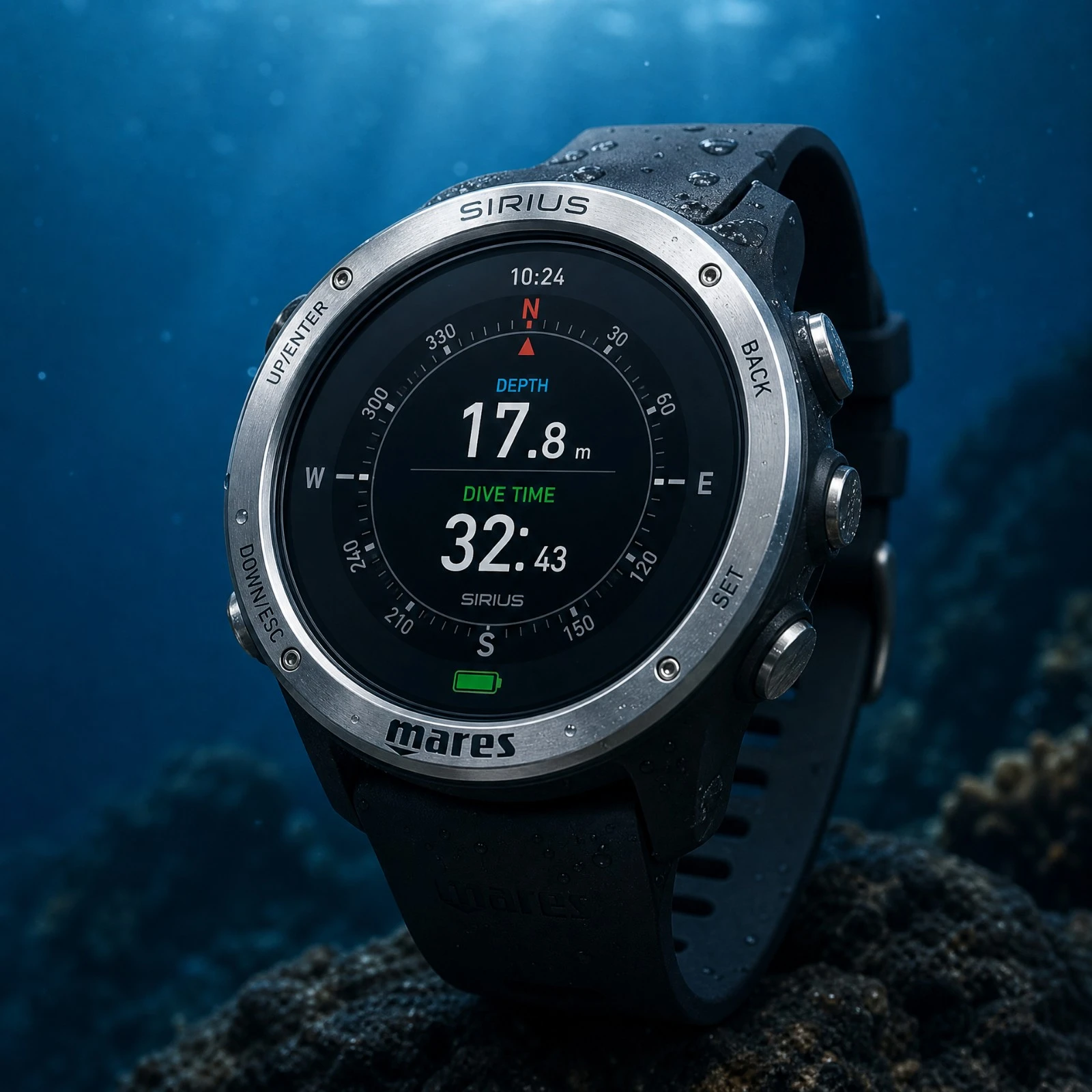
Discover the Mares Sirius dive computer watch, perfect for advanced recreational and technical diving. Features Bühlmann algorithm, air integration, and AquaExposure.
To learn how to get the most out of your gear underwater, discover the AquaExposure Training.
Introduction
In the world of scuba diving, where every detail is crucial for safety and the enjoyment of exploration, choosing the right equipment is of paramount importance. A dive computer, far more than just an instrument, serves as an indispensable companion that manages decompression, a fundamental element for every dive. It is with this perspective that we are now examining the Mares Sirius, a model that presents itself as an elegant watch while promising technical capabilities capable of satisfying the demands of advanced recreational divers and enthusiasts of technical diving.
This in-depth test aims to decipher the actual performance of this computer, evaluate its versatility, and determine if its settings, particularly its Bühlmann algorithm, meet the strict standards of safety and reliability that we expect. We will explore every aspect of this device, from its ergonomics to its technical capabilities, to offer a clear and objective view of what it represents for the modern diver, who seeks both discretion on the wrist and computing power underwater.
The Verdict in Summary
Overall score: 4.3/5
| Criterion | Score | What it means |
|---|---|---|
| Algorithm & settings | 4.6/5 | Highly customizable Bühlmann algorithm with free Gradient Factors, offering advanced decompression safety. |
| Air & multi-gas | 3.7/5 | Management of up to 5 gases, including Trimix for open-circuit Tek diving, but without a complete native CCR mode. |
| Screen & ergonomics | 4.0/5 | Very readable color MIP display, in a compact watch format, although the size limits maximum readability. |
| Battery life | 4.1/5 | Rechargeable battery with excellent autonomy, allowing you to chain dives without worry. |
| Connectivity & app | 5.0/5 | Native Bluetooth, easy updates, and a very well-designed application for profile analysis. |
| Compass & instruments | 5.0/5 | Remarkable precision 3D compensated compass, with heading memory, essential for navigation. |
| Robustness & depth | 4.2/5 | Very solid case, tested to withstand up to 150 meters, guaranteeing reliability in demanding environments. |
| Price & customer service | 4.1/5 | Mares customer service is widely available in Europe, offering a valuable safety net, despite sometimes polarized reviews. |
This computer is designed for: Regular or technical divers (open circuit) looking for a complete and elegant wristwatch-style device, without compromising on the algorithm, that values discretion and performance.
This computer is not ideal for: Divers only CCR (rebreather) users, or those who prefer a large "console"-style screen for maximum readability, and who prioritize display area above all else.
Detailed Analysis
Algorithm and Milestones (O1)
Decompression management is the core of any dive computer, and in this area, the Mares Sirius demonstrates a particularly well-executed technical mastery. It offers complete control over safety parameters, allowing for a very high level of customization, which is essential for even the most demanding diving profiles.
The Bühlmann ZH-L16C algorithm, with its freely configurable Gradient Factors, is the cornerstone of this system. This flexibility is crucial for precisely adapting the decompression profile to the specific characteristics of each dive and the diver's preferences, thereby ensuring optimized safety. The continuous display of the ceiling (Ceiling), total time to surface (TTS), and intermediate stops provides vital information in real-time, while graphical and audible alarms for tissue saturation and rapid ascent act as effective safeguards, alerting the diver in case of exceeding safety limits. This comprehensive approach ensures peace of mind, even in the most complex situations.
Air and Mixed Gases (O2)
The technical evolution of diving is a reality, and the Sirius has been designed to keep pace with this progress, offering the ability to easily switch between different gases while underwater. This feature is crucial for optimizing decompression stops and adapting to the demands of more complex dives.
It manages up to five simultaneous mixes, which is a very, very, very appreciable capacity for technical divers. The native support for Nitrox (from 21% to 99%) and Trimix (normoxic and hypoxic) opens the door to a wide range of technical dives in open-circuit configurations. It's important to note, however, that no complete native mode for rebreathers (CCR) is explicitly highlighted, which primarily positions this computer for open-circuit setups. This specificity should be considered by divers who exclusively use CCRs, as they may find options better suited to their specific needs.
Screen and Ergonomics (O3)
The readability of the screen underwater is a crucial factor for diver safety and comfort. The Mares Sirius's color MIP (Memory In Pixel) display offers remarkable contrast, a feature that minimizes distracting reflections, whether on the surface under bright sunlight or in darker, murkier waters. This visual clarity is an undeniable advantage for quickly and accurately reading essential information.
The color matrix display, approximately 34 mm (or 1.34 inches), is usable even with thick gloves, which is a practical advantage in cold water. However, it's crucial to recognize that the inherent readability of a "watch" format will always be lower than that of a 2.5-inch or larger "console" type display. The Sirius offers two distinct display configurations for diving and three dials for surface use, allowing for adaptation to individual preferences and diving conditions. This flexibility, if well-designed, does not entirely compensate for the reduced size for those with very high visual requirements.
Battery Life and Power Source (O4)
The issue of autonomy is often a major concern for divers, especially during cruises or extended stays. The Mares Sirius offers a modern and practical solution to this problem, eliminating the need to find a service center to replace batteries before an important dive. The ability to simply recharge the computer after each dive represents a significant convenience.
The watch incorporates a 200 mAh battery, rechargeable via a wireless inductive charging base, an elegant and functional solution. It boasts an impressive battery life of up to 30 hours of dive time per charge. However, it is crucial to note that this autonomy reduces to approximately 20 hours if the wireless pressure transmitter is being used, a factor to consider when planning consecutive dives. The battery level is clearly indicated on the screen, allowing the diver to always know the status of their device and anticipate their charging needs, thus avoiding any unpleasant surprises underwater.
Connectivity and App (O5)
In the digital age, a dive computer's ability to seamlessly integrate with other devices and applications is an increasingly important criterion. The Mares Sirius excels in this area, offering fast and efficient synchronization of dive profiles, a process that can be performed directly on the boat deck, immediately after removing diving gear.
The Bluetooth Smart synchronization is perfectly integrated, ensuring a stable and fast connection with compatible devices. The dedicated Mares app not only allows for OTA (Over-The-Air) firmware updates, guaranteeing that the computer always benefits from the latest improvements and corrections, but it also offers detailed analysis of dive logs. With saturation curves and complete data, this application transforms raw information into valuable educational and analytical tools, allowing divers to better understand their profiles and optimize future dives. It's a connectivity so seamless that it becomes a natural extension of the diving experience.
Compass and Instruments (O6)
Underwater navigation is an essential skill, and the presence of a reliable integrated compass in a dive computer greatly simplifies this task. The Mares Sirius features a smooth and responsive compass, a characteristic that eliminates the need for an additional analog compass on the wrist, especially during complex explorations or dives requiring precise orientation.
This is a digitally compensated inclination (3D) compass, offering remarkable precision and stability, even when the computer is not perfectly horizontal. This compass includes a timer and heading memory, features that are very useful for navigation and tracking routes. The computer also offers a dedicated freediving mode and a depth timer mode, expanding its range of applications and making it relevant to various diving disciplines. The accuracy of this instrument is so high that it inspires absolute confidence in the most demanding environments.
Robustness and Depth (O7)
The robustness of a dive computer is a guarantee of reliability and durability, qualities that are essential when facing the constraints of the underwater environment. The Mares Sirius was designed to withstand extreme depths, its casing being machined with precision that allows it to resist even the most demanding technical environments, a testament to its commitment to quality and safety.
The maximum operating depth is certified to 150 meters, a specification that demonstrates its ability to accompany divers in deep and technical explorations. This robustness is the result of careful design and materials selected for their durability, ensuring that the computer remains operational and reliable, even under considerable pressure. It is a device that inspires confidence, capable of withstanding the rigors of the marine environment without fail.
Price and Customer Support (O8)
Acquiring a technical diving computer represents a significant investment, and the value of this investment is not measured solely by its initial performance. The strength of a model like the Mares Sirius also lies in the peace of mind offered by the Italian brand, particularly regarding its after-sales service and local presence.
Mares benefits from one of the largest networks of retailers in Belgium, France, and French-speaking Switzerland, which guarantees easy access to after-sales service and spare parts. This extensive presence is a significant advantage, as it ensures local support when needed. It's true that reviews about Mares' after-sales service can be polarized, with feedback ranging from quick exchanges within 8 days to reports of delays or inflexibility regarding shipping costs. The role of the local retailer is crucial here, acting as a real buffer between the customer and the brand. A good retailer can make all the difference in the quality of the post-purchase experience, transforming a potentially frustrating situation into an effective resolution. This is an important consideration for any diver considering a long-term investment.
Who is this computer for?
The Mares Sirius is designed for regular or technical divers who are looking for a complete and elegant watch that can be worn on the wrist, without ever compromising the freedom to customize its algorithm. It's ideal for those who appreciate the discreetness of a wristwatch format for everyday use, but who demand powerful computing capabilities and advanced features for their technical dives. It is a relevant choice for divers who are transitioning to Nitrox and Trimix, and who want a reliable and customizable tool to manage their decompression with surgical precision.
On the other hand, this computer is not ideal for divers who exclusively use closed-circuit rebreather (CCR) systems, as it does not offer a complete native mode for this configuration. Similarly, someone who prefers a large "console" style screen for maximum readability and has very high visual requirements might find the watch format of the Sirius somewhat limiting. It is essential to carefully evaluate your priorities between compactness and display area before making your choice.
Customer Service and Support
After-sales service (customer support) is a fundamental pillar of the user experience, especially for critical equipment like a dive computer. For Mares, feedback on this aspect is sometimes mixed, but it's important to contextualize these observations. Some users report receiving replacement equipment in as little as eight days, demonstrating remarkable efficiency. However, others have reported delays or some rigidity regarding the handling of shipping costs, which can understandably lead to frustration.
The reality is that the local reseller plays a crucial role in the quality of support. It acts as a true intermediary, capable of accelerating processes and defending the interests of the customer. Therefore, it is highly recommended to choose a reseller with a good reputation for its customer service. The extensive presence of the Mares network in Europe, particularly in Belgium, France, and French-speaking Switzerland, remains a major asset, facilitating access to services and spare parts. It's a safety net that, although sometimes dependent on the local player, provides a solid foundation for managing potential problems.
Nutrition
The power source of a dive computer is a practical consideration that directly impacts the comfort and logistics of dives. The Mares Sirius stands out for its choice of a rechargeable battery, an option that offers significant advantages compared to replaceable batteries.
The integration of a 200 mAh battery, rechargeable via a wireless inductive charging base, greatly simplifies the diver's life. No more stress about having to find specific batteries at the last minute, or having to open the computer, which could compromise its water resistance. Wireless charging is not only convenient but also contributes to the device's durability by avoiding repeated manipulations. For extended trips, this means that you simply need to have the charger within reach to recharge the computer each evening, ensuring consistent battery life. The advertised 30-hour battery life (reduced to 20 hours with the transmitter) is more than sufficient for multiple dives in a day or over a long weekend, offering valuable peace of mind.
Links to other models from the same brand.
For those who wish to explore Mares' offerings further and compare the different options available, we have written detailed analyses of other models from the brand. Each dive computer has its own specific features, and it is essential to find the one that best suits your diving style and expectations.
Discover our comprehensive review of the Mares Quad, a versatile computer known for its readability and ease of use. For divers looking for an even larger screen, our article on the Mares Smart might be of interest. Finally, if you are a technical diving enthusiast and are looking for a more console-oriented solution, feel free to consult our analysis of the Mares Icon HD. These articles will help you refine your choice and understand the nuances of each model.
CTA Comparator
To compare this computer with other models, see our diving computer comparison tool.
© 2026 AquaExposure. All rights reserved. Reproduction prohibited without authorization.
Share
Table of Contents
- 01Introduction
- 02The Verdict in Summary
- 03Detailed Analysis
- 04Algorithm and Milestones (O1)
- 05Air and Mixed Gases (O2)
- 06Screen and Ergonomics (O3)
- 07Battery Life and Power Source (O4)
- 08Connectivity and App (O5)
- 09Compass and Instruments (O6)
- 10Robustness and Depth (O7)
- 11Price and Customer Support (O8)
- 12Who is this computer for?
- 13Customer Service and Support
- 14Nutrition
- 15Links to other models from the same brand.
- 16CTA Comparator
Questions about the Journal
Can I use the photographs from this journal?
All images are protected by copyright. For any commercial or editorial use, please contact us via our form.
How can I be notified of new articles?
Follow us on social media or join the Sentinels Circle to receive our immersion stories before anyone else.
Do you offer hands-on workshops?
Yes, we organize masterclasses and field expeditions for members of our school. Check the Training page for details.


