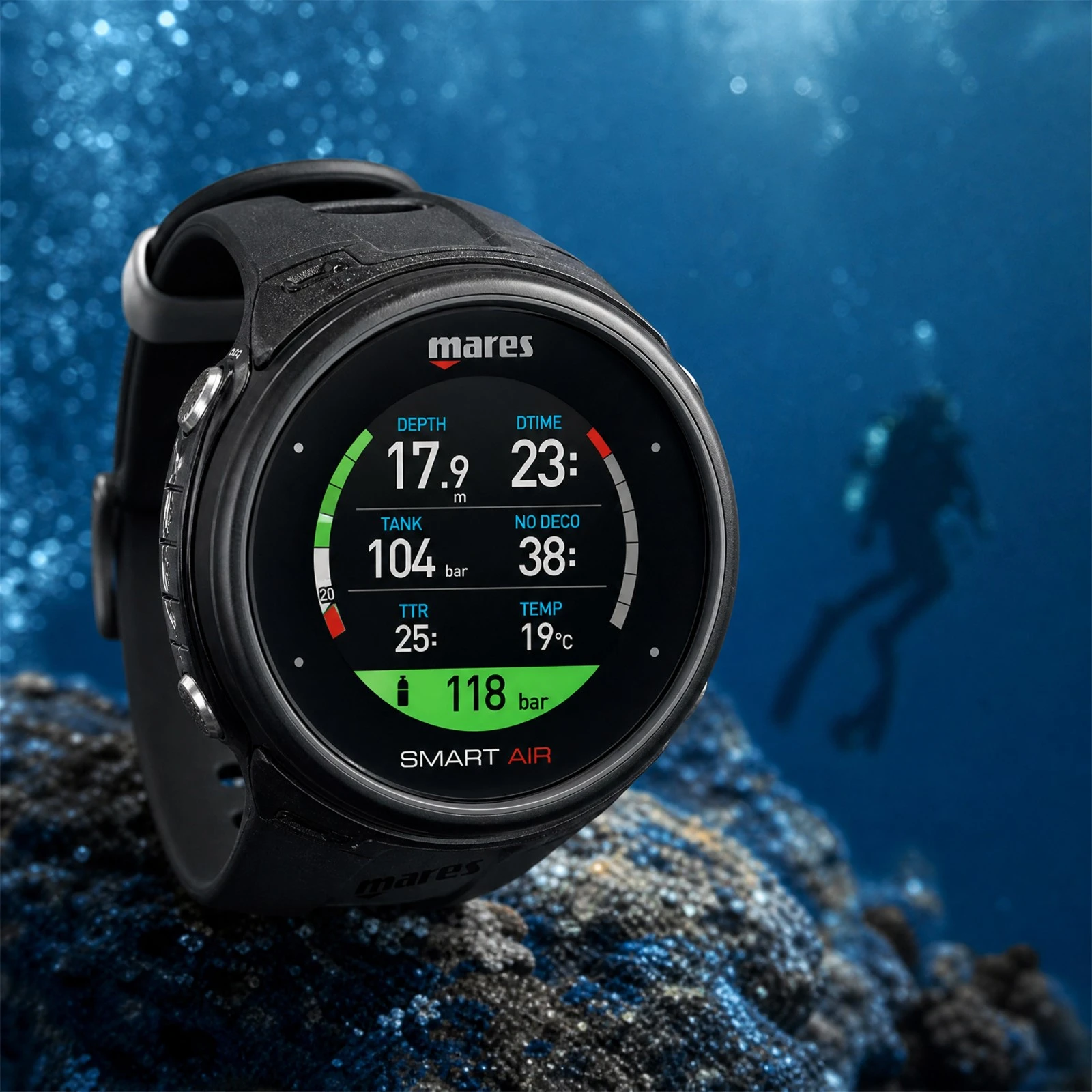
Discover our detailed Mares Smart Air review! This dive computer watch features air management, a RGBM algorithm, and excellent battery life.
To learn how to get the most out of your gear underwater, discover the AquaExposure Training.
Introduction
The choice of a dive computer often involves a delicate balance between readability underwater, everyday comfort, and the reliability of the displayed data.
We spend hours scrutinizing our screens under often suboptimal viewing conditions, where every piece of information must be understood instantly.
Diving requires rigor, preparation, and mastery of one's equipment.
Having a computer in a watch format is an undeniable convenience when traveling, as you can wear it on your wrist from breakfast until you reach the security checkpoint.
However, this device remains the critical tool that manages your safety, your decompression, and your ascent to the surface.
With the Mares Smart Air, the Italian manufacturer is revisiting the very popular Mares Smart design and adding wireless air management capabilities.
This model clearly targets the recreational or regular diving market seeking a simple interface with just two buttons.
It offers an approach so familiar that getting started feels almost natural from the very first use.
This test aims to determine whether this model, based on an older proprietary RGBM algorithm, remains competitive compared to the current range of Bühlmann computers.
We will analyze its technical capabilities, its algorithmic limitations, and its overall ergonomics.
The Verdict in Summary
The Mares Smart Air receives an overall score of 3.4/5 in our technical evaluation grid.
| Criterion | Score | What this means in practice underwater |
|---|---|---|
| Algorithm & decompression levels | 3.1/5 | Proprietary Mares-Wienke RGBM algorithm with 10 tissue types, which proves to be robust but not very customizable. |
| Air & multi-gas | 2.3/5 | Manages air and nitrox up to three gases from 21% to 99% oxygen without Trimix functions. |
| Screen & ergonomics | 2.6/5 | Segmented LCD watch-style screen that is easy to navigate using two side buttons. |
| Battery life | 4.0/5 | Excellent battery life, lasting for 200 to 300 dives with a user-replaceable CR2450 battery. |
| Connectivity & app | 3.5/5 | Bluetooth connection is possible but requires the purchase of an external Bluelink Pro interface. |
| Compass & instruments | 3.1/5 | No integrated compass, but includes a dedicated depth gauge mode and a freediving mode. |
| Robustness & depth rating | 4.1/5 | Very robust casing with mineral glass that is certified to depths of up to 150 meters. |
| Price & customer service | 4.1/5 | A solid quality-to-price ratio for a watch with air management, supported by Mares' customer service. |
Detailed Analysis
Algorithm and Milestones
The management of your decompression relies on a proven and secure model that has been used by divers for many years.
This model does not allow for the opening and fine-tuning options that are found on more recent computer designs.
The Smart Air utilizes the proprietary Mares-Wienke RGBM algorithm, which is based on ten distinct tissue compartments.
This mathematical approach models the dissolution of gases in your body with a method that prioritizes safety above all else.
The reduced gradient bubble model (RGBM) takes into account the formation of silent microbubbles during your ascents.
It penalizes inverted profiles, rapid ascents, and closely spaced successive dives in order to limit the risk of decompression accidents.
This penalty results in potentially longer dwell times if you do not follow an ideal dive profile.
It offers a decompression dive planner that allows you to anticipate your safety stops before even entering the water.
This function is extremely useful for mentally preparing for your dive and verifying that your gas supply will be sufficient.
Planning is the cornerstone of a successful dive, especially when you start pushing the limits of no-decompression diving.
Unlike newer models like the Sirius or Puck 4, it does not use the Bühlmann ZH-L16C algorithm.
Therefore, it does not offer adjustable Gradient Factors that would allow for surgically precise customization of the conservatism level.
This lack of advanced customization makes it suitable for an audience that prefers to trust the machine without delving into complex settings.
It incorporates visual and audible ascent rate alarms, which are crucial for preventing decompression accidents.
These alerts are so clear that you won't be able to ignore them, even during an ascent in open water without any visual reference points.
Precision, repetition, and mastery of buoyancy remain your best allies in avoiding triggering these alarms.
A dive computer is a decision-making aid, and never an absolute guarantee against the unpredictable aspects of human physiology.
Optimal performance does not negate the need for appropriate training and strict adherence to the procedures learned during your studies.
Air and Mixed Gases
This computer is perfectly calibrated to accompany you from your first air bubbles to complex dives requiring a Nitrox decompression block.
The computer can manage up to three gases simultaneously, which offers considerable flexibility for divers who are constantly evolving their techniques.
It accepts Nitrox mixtures ranging from 21% to 99% oxygen, thus covering all the needs of advanced recreational diving.
The use of hyperoxygenated gas mixtures helps reduce post-dive fatigue and increases your safety with regard to decompression sickness.
The gas switch underwater is natively supported by the interface, allowing you to switch to your decompression block with just a few presses.
This maneuver requires practice, focus, and verification with your partner before attempting it underwater.
A selection error regarding gas composition at depth can have dramatic consequences related to the toxicity of oxygen.
The Smart Air can connect via radio frequency to a maximum of three separate pressure transmitters.
These Mares transmitters have a flashing light that indicates the remaining pressure using a simple color code.
Green, yellow, and red colors allow your teammates to visually assess your air supply without even looking at your screen.
This air integration greatly simplifies reading your consumption data and helps you optimize your breathing throughout your dives.
However, the air integration mentioned above always requires a mechanical pressure gauge as a backup on your regulator.
Signal loss or transmitter battery failure are common occurrences that should never compromise your dive.
Trimix and rebreather configurations are completely absent from this device.
This technical choice confirms its purely recreational positioning and excludes deep technical dives that require helium to counteract nitrogen narcosis.
For recreational divers, this limitation is not a hindrance at all, as it simplifies the interface by removing unnecessary menus.
Screen and Ergonomics
The classic liquid crystal display remains a standard that guarantees high contrast in sunlight, while also significantly saving battery power.
The screen is a segmented display protected by tempered mineral glass, which effectively limits everyday scratches.
The screen's readability in direct sunlight is excellent, which greatly simplifies adjustments on the boat's deck.
Navigation through the menus is done using two side buttons that provide clear and reassuring tactile feedback, even when wearing neoprene gloves.
The small screen size, with a diameter of less than fifty millimeters, inevitably means smaller characters compared to those on a computer monitor.
This compactness requires good close-up vision, especially when ambient light decreases with depth or in waters rich in particles.
The interface is so intuitive that navigating it quickly becomes second nature after a few introductory sessions.
It is necessary to accept this compromise between the reduced size on the wrist and the amount of information displayed on the main screen.
The data layout is designed to highlight the current depth, dive time, and no-decompression time.
The secondary information requires pressing buttons to appear, which prevents the display from being overloaded during use.
The backlight is sufficient for night dives or wreck exploration, although it consumes additional power.
It easily activates with a single long press, illuminating the screen with a pleasant bluish glow that is easy on the eyes in the dark.
Readability remains the number one criterion when choosing a computer, and this LCD model lives up to that expectation with remarkable effectiveness.
Battery Life and Power Source
This is a major advantage of this type of liquid crystal display compared to modern color screens, which require frequent recharging.
You won't have to think about charging it every night like a modern smartwatch that drains its battery in just a few hours.
The Smart Air is powered by a CR2450 lithium battery that the user can replace themselves with minimal tools and precautions.
Mares announces an excellent estimated lifespan of between two hundred and three hundred dives over a period of three years.
This level of autonomy is very, very, very comfortable for professionals or travelers who frequently dive and are far from any electrical outlet.
User-replaceable parts are a major advantage that avoid costly and time-consuming returns to the workshop in the middle of a season.
It is important to thoroughly clean the compartment and lightly lubricate the O-ring during replacement to ensure a perfect seal.
Improper handling during battery replacement remains the primary cause of water damage in dive computers with a watch-style form factor.
Warning: Repeated use of the wireless air transmitter will tend to significantly reduce its battery life.
Radio frequency communication requires energy, and you will need to monitor the battery indicator more closely if you are using this feature.
The transmitters themselves are powered by replaceable batteries, which requires careful management of your battery stock before a trip.
The freedom offered by this power system more than compensates for the need to carry a few spare batteries in your dive bag.
Connectivity and App
The transfer of your dive log from your watch to your smartphone does not happen natively.
You need to acquire an additional accessory to bridge the connection between your computer and your mobile phone or tablet.
The internal log can store up to ninety-five hours of dive profiles with a precise sampling rate of five seconds.
This generous memory capacity allows you to go on a cruise without worrying about overwriting the data from your first dives of the week.
To export this data to the MySSI application or update the firmware, you need to equip yourself with the optional Bluelink Pro interface.
This reliance on an external module is a source of difficulty at a time when native Bluetooth is becoming the standard in the market.
Analyzing your dive profiles on a large screen remains a fundamental step in understanding your oxygen consumption and tissue saturation.
Observation, analysis, and correction of your diving profile are key to consistent progress in scuba diving.
The application allows you to visualize your depth profiles, temperature fluctuations, and air consumption on a minute-by-minute basis.
These objective data are valuable for adjusting your weighting, improving your finning technique, and optimizing your breathing during your next dives.
Regularly updating the firmware ensures that your computer benefits from the latest fixes and improvements developed by the manufacturer.
It is always recommended to check for available updates before embarking on a long diving trip abroad.
Compass and Instruments
This model focuses on essential calculations of time and saturation, while omitting advanced electronic navigation features.
There is no integrated electronic compass in this compact casing, which means you will have to wear a separate magnetic compass on the other wrist.
For many divers, an analog compass remains more readable and responsive than a finicky digital compass.
Learning how to navigate using a traditional compass is a fundamental skill that should never be completely delegated to electronic devices.
On the other hand, the Smart Air offers a full watch mode with a dual time zone feature, which is very practical for international travelers.
It includes a depth gauge mode that features a resettable average depth and a precise timer for decompression stops.
This mode is particularly useful for technical divers who use the device as a redundant backup during demanding dives.
It also offers a specific mode for freediving, which will delight lovers of underwater hiking and spearfishing.
This Freediving mode displays instantaneous depth, dive time, and surface recovery time with great clarity.
The versatility of these instruments partially compensates for the lack of a compass, offering tools suitable for various aquatic activities.
A single device on your wrist allows you to switch from scuba diving to freediving without having to change equipment between sessions.
Robustness and Depth
The compact design belies a very robust construction, capable of withstanding environments far beyond the reach of recreational divers.
The casing is certified for a maximum display depth of one hundred and fifty meters, which provides a significant safety margin.
The mineral glass increases its durability against common types of damage that affect equipment, such as sand, salt, and impacts on the boat's deck.
This robustness is so reassuring that you almost forget about the presence of the computer on your wrist when handling heavy objects.
The quality of assembly reflects the Italian brand's expertise in designing durable and reliable instruments for professionals.
It will withstand repeated travel, extreme temperature fluctuations, and daily immersion in saltwater without any issues.
The push buttons are designed to easily discharge salt crystals and sand that could obstruct their operation.
A thorough rinsing with fresh water after each day of diving remains essential for preserving the flexibility of the seals and mechanisms.
The lifespan of your equipment depends as much on its quality of manufacture as it does on the care you give it over the years.
Regular maintenance and storage away from direct sunlight will significantly extend the lifespan of your instrument.
Price and Customer Support
Adding air management functionality transforms this model into a very interesting investment for anyone who wants to improve the reliability of their pressure readings.
It allows access to this technology without breaking your technical budget, offering a particularly competitive quality-to-price ratio in the market.
Mares' after-sales service provides peace of mind throughout Europe, although return policies can sometimes vary depending on the geographic region.
The reviews regarding technical support are polarized within the community of regular divers and diving instructors.
Some transactions involving warranties are completed in as little as eight days, demonstrating the remarkable efficiency of the European repair center.
Other users report occasional delays or some inflexibility regarding the handling of shipping costs for returns.
The local reseller acts as a crucial intermediary between the manufacturer and the end-user, and their involvement will determine the smoothness of your support experience.
It is crucial to choose a trusted partner store that will be able to defend your case in the event of an unexplained hardware failure.
The relationship you have with your dive shop is often more important than the overall brand policy itself.
A good dialogue with your reseller often allows you to find equipment rental solutions during the period your computer is immobilized.
Who is this computer for?
This computer is primarily intended for recreational divers or travelers who want a watch-style device for everyday use.
It is ideal from the very first level of certification and will perfectly support your progress, even up to dives requiring decompression using oxygen-rich gas mixtures.
The visual convenience of wireless air management is a major advantage for those who like to consolidate information on a single screen.
This will be suitable for divers who appreciate the simplicity of a closed algorithm and who do not feel the need to manipulate gradient factors.
Conversely, this computer is not ideal for technical divers who are planning deep dives using Trimix.
It will also frustrate divers who absolutely want to control their decompression using an open and configurable Bühlmann algorithm.
If you are looking for a high-definition color display or native Bluetooth connectivity without any accessories, you will need to consider other models in the range.
The choice of a computer should always reflect your actual diving practice, and not a fantasized projection of dives that you may never actually do.
Customer Service and Support
Technical support for a dive computer is a fundamental criterion that determines the longevity of your hardware investment.
At Mares, the after-sales service receives polarized reviews within the community of professionals and informed enthusiasts.
Some divers report that transactions under warranty are completed in just eight days, which is a testament to well-organized logistics.
Other users report delays in processing applications or bureaucratic inflexibility regarding the handling of shipping costs.
In this distribution network, the reseller acts as a crucial intermediary between the end-user and the brand's headquarters.
The quality of your experience in case of a malfunction will largely depend on the commercial importance and involvement of your dive shop.
It is advisable to prioritize purchasing from a recognized physical establishment rather than seeking the maximum discount online.
A good reseller will be able to lend you a courtesy computer while yours is being shipped to the manufacturer's repair facilities.
This continuity of service is invaluable when you have planned a long diving trip and a breakdown occurs just before departure.
Nutrition
Energy management is a key strength of this model, which uses a standard CR2450 lithium battery that is readily available for purchase.
The fact that the user can replace this battery themselves is a significant advantage when traveling to remote areas of the world.
You are not dependent on a specific charging cable or a finicky electrical outlet on a long cruise ship voyage.
The advertised autonomy of two hundred to three hundred dives offers remarkable peace of mind for intensive teaching or exploration seasons.
It is important to keep in mind that using pressure transmitters via radio frequency puts a greater strain on the main computer's battery.
These Mares transmitters have a flashing light that allows your diving buddies to visually assess your air supply underwater.
This integration simplifies reading your consumption data, but it never replaces the redundancy of a traditional mechanical pressure gauge mounted on the first floor.
Loss of signal or battery failure in the transmitter are incidents that should never compromise your safety underwater.
Having an analog backup pressure gauge is a golden rule that every responsible diver should follow without hesitation.
To find out which battery to buy for this computer, check out our complete guide on batteries for dive computers. To learn how to replace the battery yourself step by step without risking damage, read our complete tutorial on how to change your own battery.
Links to other models from the same brand.
If the display features appeal to you but you require an open Bühlmann algorithm with gradient factors, the Mares Sirius is worth considering.
You can find our detailed analysis of this high-end model on our dedicated page for the Mares Sirius review.
For divers who prefer a larger screen in a console-like format while maintaining ease of use, the Mares Puck 4 is an excellent alternative.
For a comprehensive review of this accessible computer, please visit our Mares Puck 4 review.
Each model caters to specific needs, and it is essential to choose the instrument that best suits your underwater activities.
Take the time to define your performance goals before investing in a computer that will accompany you for many years.
CTA Comparator
To compare this computer with other models, see our diving computer comparison tool.
© 2026 AquaExposure. All rights reserved. Reproduction prohibited without authorization.
Share
Table of Contents
- 01Introduction
- 02The Verdict in Summary
- 03Detailed Analysis
- 04Algorithm and Milestones
- 05Air and Mixed Gases
- 06Screen and Ergonomics
- 07Battery Life and Power Source
- 08Connectivity and App
- 09Compass and Instruments
- 10Robustness and Depth
- 11Price and Customer Support
- 12Who is this computer for?
- 13Customer Service and Support
- 14Nutrition
- 15Links to other models from the same brand.
- 16CTA Comparator
Questions about the Journal
Can I use the photographs from this journal?
All images are protected by copyright. For any commercial or editorial use, please contact us via our form.
How can I be notified of new articles?
Follow us on social media or join the Sentinels Circle to receive our immersion stories before anyone else.
Do you offer hands-on workshops?
Yes, we organize masterclasses and field expeditions for members of our school. Check the Training page for details.


