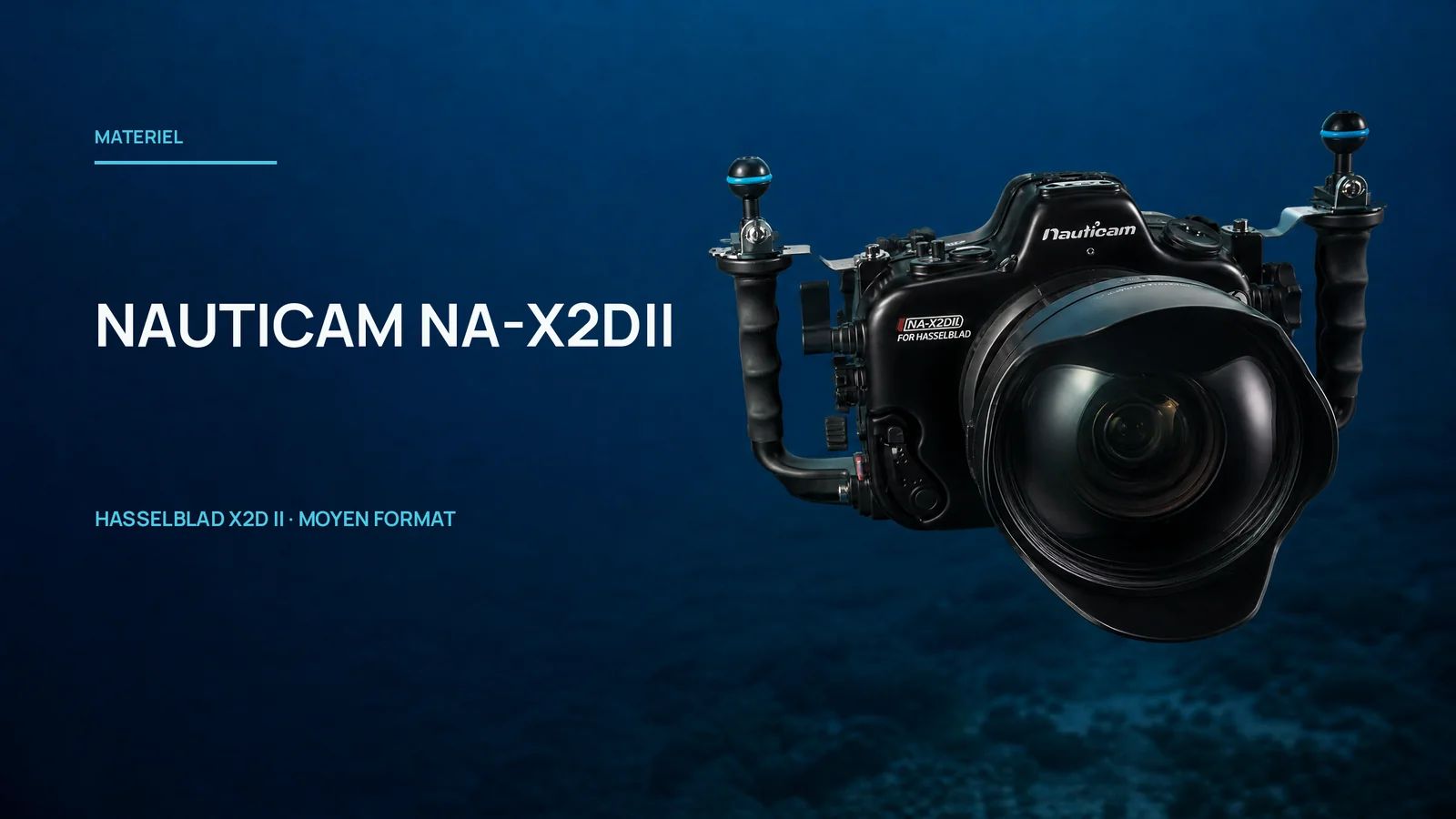
Nauticam NA-X2DII: A housing at €8,180 for underwater medium format photography.
In underwater photography, medium format is a niche that very few photographers explore, for a simple reason: until now, no one has offered a serious housing to make it possible. Nauticam has just changed that.
The NA-X2DII is the first housing announced for the Hasselblad X2D II 100C, and it opens a door that most underwater photographers had never even considered.
The X2D II 100C: What a medium format sensor brings.
The Hasselblad X2D II 100C features a 100-megapixel BSI CMOS sensor with 16 bits of color depth, boasting a claimed dynamic range of 15.3 stops. On paper, this is the kind of specification that can make any photographer accustomed to traditional full-frame cameras feel dizzy.
The most interesting aspect for underwater use isn't the raw resolution. It's the central leaf shutter integrated into the XCD lenses. Unlike a traditional focal plane shutter, this system allows for flash synchronization up to 1/4000s, depending on the lens used. In underwater photography, where you constantly balance ambient light and artificial light from flashes, this kind of flexibility really changes how you approach an image. You can cut out a significant portion of natural light without sacrificing a fast shutter speed, which is impossible on most full-frame mirrorless cameras limited to 1/200s or 1/250s in X sync mode.
The autofocus relies on subject detection using deep learning, 425 PDAF zones, and LiDAR assistance. The internal 5-axis stabilization claims to provide 10 stops of correction. On the other hand, the burst shooting is limited to 3 frames per second, which clearly places this device in a different category than fast hybrid cameras designed for wildlife photography.
What Nauticam includes in its housings.
The NA-X2DII is built around the N120 port system, already used on the brand's full-size housings. This provides access to the three most relevant XCD optics for underwater use: the standard zoom 35-100mm lens, the ultra-wide angle 20-35mm lens, and the 120mm macro lens.
The housing also maintains compatibility with Nauticam accessories such as the WACP-2, WACP-1B, MFO, SMC, and CMC lenses. For those who already own a Nauticam system for another camera body, part of the investment in optics can be directly transferred.
Two built-in cable pass-throughs allow for triggering flashes via fiber optics right out of the box. Electrical triggering remains possible through a Nikonos 5-pin cable pass-through installed on the M14 port. An optional vacuum valve can be connected to the M16 port, coupled with the leak detection system already pre-installed in the housing.
Price displayed: approximately €8,180 for the housing unit alone (converted from $9,400, official manufacturer's price), available from retailers such as Backscatter.
It's important to be honest about what this device is not. With only 3 frames per second, the NA-X2DII is not suitable for chasing schools of barracuda or capturing the fleeting passage of a manta ray. For that type of subject, a modern full-frame hybrid camera with 20 or 30 fps remains far superior.
The medium format truly shines when dealing with subjects that demand it. A shipwreck in controlled lighting, a large reef landscape composed with patience, a portrait of a turtle perfectly still. In this type of image, the dynamic range and resolution of the X2D II open up post-processing possibilities that no full-frame sensor can match today.
It's also important to say that this is an investment that goes far beyond just the learning equipment. Before spending €8,180 on a housing unit, the real question isn't about the enclosure itself. It's about whether you already have sufficient mastery of buoyancy, framing, and natural light reading to take advantage of what this level of equipment allows. A 100 MP sensor will never compensate for a poorly composed image.