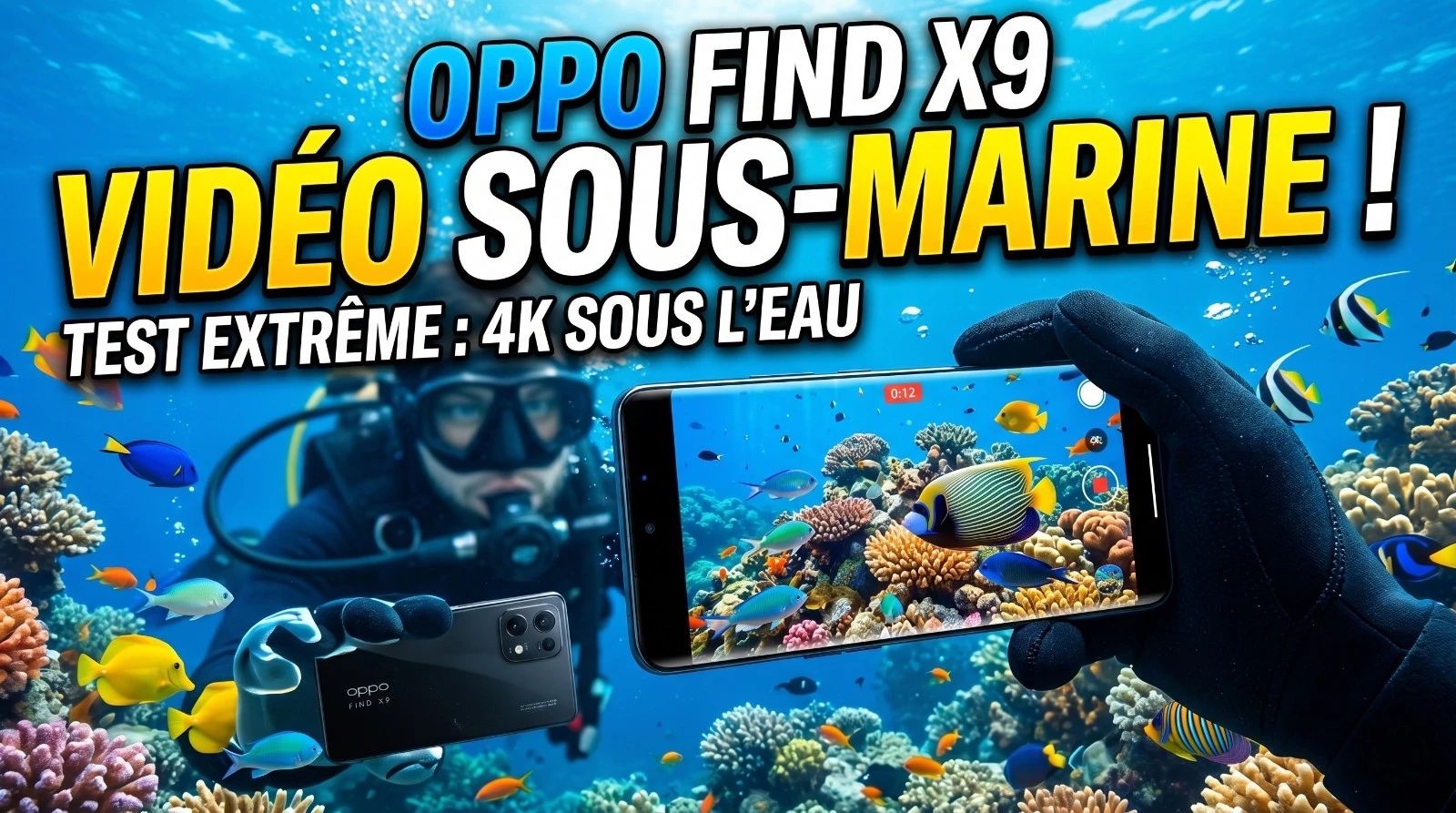
Yes. The OPPO Find X9 Pro and Ultra have an underwater mode accessible in the Camera app settings. This mode activates colour correction specific to the aquatic environment. To dive beyond its native water resistance (IP66/IP68/IP69), a dedicated housing like the DiveVolk SeaTouch is required.
What is the Hasselblad partnership on the OPPO Find X9?
Hasselblad is a Swedish professional camera brand renowned for colour accuracy since the 1940s. On the OPPO Find X9, this partnership translates into a secondary multi-spectral sensor that analyses scene light independently, then an algorithm derived from Hasselblad colour science fuses the two readings to reproduce the actual tones of the scene, including underwater.
Are the 200 megapixels of the OPPO Find X9 Pro really useful underwater?
The 200 megapixels refer to the periscope telephoto lens, not the main sensor. Underwater, it is mainly the F/1.5 aperture of the main sensor (50MP) that matters for capturing maximum light. The 200MP resolution is useful for cropping an image after the fact or photographing distant subjects with zoom.
OPPO Find X9 Pro or Olympus TG-7 for underwater photography?
It depends entirely on your use. The TG-7 is natively waterproof to 15m, has a unique microscope mode, and requires no housing for snorkeling or shallow diving. The OPPO Find X9 Pro surpasses the TG-7 in image quality in natural light and offers much more powerful zoom. Both have their place, just not the same use.
Where to learn underwater photography with a flagship smartphone?
The AquaExposure training covers underwater photography from smartphone to semi-professional equipment. Module 2 covers equipment selection and optimal settings for your gear.
OPPO Find X9 Pro and Ultra: complete underwater photography guide
Two numbers dominated the launch coverage: 200 megapixels and Hasselblad. Both deserve an honest explanation before you decide whether this phone has any business going underwater with you.
Hasselblad: what it actually changes
Founded in 1941 in Sweden, Hasselblad built its reputation on one thing above all others: colour accuracy. Their cameras went to the Moon. Their calibration process is what professional photographers reference when they talk about a colour that feels true.
On the OPPO Find X9, the partnership translates into something concrete. A secondary multi-spectral sensor sits alongside the main camera and analyses the light composition of the scene independently - including wavelengths invisible to the eye. An algorithm drawing on Hasselblad colour science then fuses the two readings.
The result is colour anchored in reality, not a statistical approximation of what the phone thinks the scene probably looks like. PetaPixel and Amateur Photographer both noted it: "the best colour science on any OPPO device", placed at the level of Samsung, Google and Apple in 2026.
Under water, where red and orange tones are absorbed as you descend, this matters. The correction happens from real data, not a guess.
The 200 megapixels: which lens, exactly?
The 200MP figure belongs to the periscope telephoto lens - a 1/1.4-inch sensor with 3x optical zoom, 13.2x lossless, and 120x digital on the Ultra. Impressive numbers, but not the lens you will use most underwater.
What matters most in low-light diving conditions is the main sensor: 50 megapixels, F/1.5 aperture. That F/1.5 opening is wide by any standard. It means maximum light intake in difficult conditions, and it is the reason the Find X9 can produce clean images at depths where other phones start to struggle.
The 200MP telephoto earns its place in a different situation: photographing a shark at a respectful distance, cropping tightly into an image in post-production, or reaching a subject you cannot approach without disturbing it. On the Ultra, the secondary telephoto doubles that reach to 10x optical - the equivalent of a 230mm lens.
Real conditions against competitors
Against the Galaxy S26 Ultra, the colour fidelity advantage goes to the OPPO thanks to the Hasselblad pipeline. Samsung answers with its Ocean Mode and a broader ecosystem of accessories in French-speaking Europe, where it remains more accessible in most phone shops.
Against the iPhone 17 Pro Max, the comparison is close on stills. OPPO sometimes produces more natural colour. iPhone wins on low-light video - DXOMark noted more visible noise on the OPPO in plain colour areas, a relevant factor when you are filming in open water with minimal contrast.
Against the Olympus TG-7, the two phones are simply different tools. The TG-7 is natively waterproof to 15 metres. It requires no housing for snorkelling or a shallow reef dive. Its microscope mode has no equivalent on any smartphone. The OPPO Find X9 Pro surpasses the TG-7 in image quality when natural light is good, and its zoom reach is in a different category. The right choice is not about which is objectively better - it depends entirely on how you dive.
Underwater mode and Native Film Modes
The underwater mode sits in the Camera app settings. Activating it triggers colour correction calibrated for the aquatic environment, compensating for the shift in colour balance that happens progressively with depth.
In April 2026, OPPO added Native Film Modes developed with Hasselblad - nine styles organised in four series. CC and NC cover warm classic rendering. RDP3 reproduces the positive film look suited to shallow, well-lit water. 800T Night Negative targets low light and depth. The distinction from ordinary filters is technical: these modes are integrated into the raw processing pipeline before final compression. They are not a layer applied on top of an already-processed image. The result is more natural, more stable, and it preserves dynamic range in a way that post-processing filters cannot.
With a housing: the complete system
IP66, IP68 and IP69 ratings place the Find X9 ahead of most smartphones in terms of water resistance. But IP69 refers to resistance against high-pressure jets, not dive depth. For anything beyond shallow snorkelling, a housing is necessary.
The DiveVolk SeaTouch 4 Max is rated to 60 metres and keeps the touchscreen functional underwater. All camera functions remain accessible - the underwater mode, the Native Film Modes, the 200MP telephoto for distant subjects. The housing turns the Find X9 into a system that works from the surface down to a serious recreational depth.
The honest answer is: the diver-photographer who already owns a Find X9, or who wants one versatile device that works as a serious underwater photography tool with a housing rather than carrying dedicated equipment.
The Hasselblad colour science adds real value when colour fidelity matters to you. The 200MP telephoto allows crops that most phones cannot match. For someone who wants only a dive camera, the TG-7 remains simpler, more solid in rough conditions, and cheaper. The Find X9 makes most sense if you want one device that moves from land to sea without compromise.
The sea has changed nothing about the fundamental rules of photography. Light remains light, composition remains composition, and the best tool is still the one you know best. What the OPPO Find X9 brings is that the technical barrier between your eye and the result is now very, very thin.
Yes. The OPPO Find X9 Pro and Ultra have an underwater mode accessible in the Camera app settings. This mode activates colour correction specific to the aquatic environment. To dive beyond its native water resistance (IP66/IP68/IP69), a dedicated housing like the DiveVolk SeaTouch is required.
What is the Hasselblad partnership on the OPPO Find X9?
Hasselblad is a Swedish professional camera brand renowned for colour accuracy since the 1940s. On the OPPO Find X9, this partnership translates into a secondary multi-spectral sensor that analyses scene light independently, then an algorithm derived from Hasselblad colour science fuses the two readings to reproduce the actual tones of the scene, including underwater.
Are the 200 megapixels of the OPPO Find X9 Pro really useful underwater?
The 200 megapixels refer to the periscope telephoto lens, not the main sensor. Underwater, it is mainly the F/1.5 aperture of the main sensor (50MP) that matters for capturing maximum light. The 200MP resolution is useful for cropping an image after the fact or photographing distant subjects with zoom.
OPPO Find X9 Pro or Olympus TG-7 for underwater photography?
It depends entirely on your use. The TG-7 is natively waterproof to 15m, has a unique microscope mode, and requires no housing for snorkeling or shallow diving. The OPPO Find X9 Pro surpasses the TG-7 in image quality in natural light and offers much more powerful zoom. Both have their place, just not the same use.
Where to learn underwater photography with a flagship smartphone?
The AquaExposure training covers underwater photography from smartphone to semi-professional equipment. Module 2 covers equipment selection and optimal settings for your gear.
OPPO Find X9 Pro and Ultra: complete underwater photography guide | AquaExposure