Table of Contents
How to approach and photograph an octopus underwater- understand its 3 behavioral states, choose the right angle, and respect the animal. Field guide by Benjamin Coste.
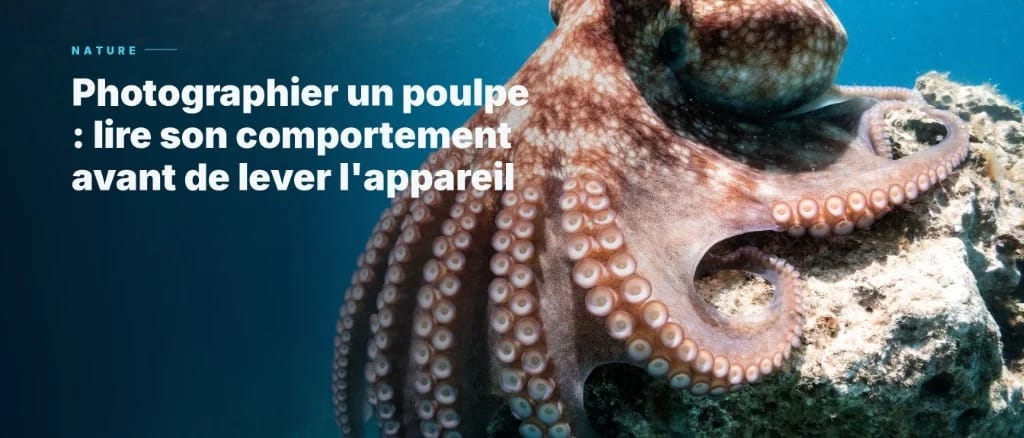
The octopus observes me from the bottom of its crevice, its two W-shaped eyes fixed on me, its rusty-colored mantle against a background of brown granite. It's a November morning in Cerbère, at a depth of 8 meters, with decent visibility despite the rains of the previous week. I haven't pressed the shutter yet. Three minutes have passed since I stopped at its level.
This is where octopus photography truly begins: before the first shot.
Photographing an octopus underwater is not something you can just do spontaneously. The animal is the most intelligent you'll encounter while diving, and probably the only one that studies you back with as much attention as you give it. Understanding what it's expressing before you raise your camera is the difference between an image that tells a story and a picture of brown granite with a vague tentacle on the right side.
The three behavioral states to recognize before taking a picture
An octopus is constantly communicating through the color and texture of its skin. These aren't just decorations, they are precise information about its internal state. By learning to read them, you know when to take a picture and when to back away.
The state of curiosity: it's now
Smooth or slightly granular mantle, uniform color in warm browns or oranges, arms partially extended with the suckers visible, slow movement directed towards you. The eye is fixed, the horizontal pupil in the shape of a W follows you without blinking.This is the state you're looking for. The animal isn't fleeing or on alert. It's assessing you. You typically have between one and five minutes, depending on the individual and the pressure you're exerting.
Alert State: Back Away Now
The color pales to a light gray or white. Irregular patches appear on the mantle. The arms contract gradually. The animal may release a short burst of water. The pupil constricts.
This is a sign that you've gotten too close, too quickly, or that you've blocked its path to shelter. Back away immediately and slowly. If you maintain the pressure at this stage, the octopus will disappear into a crevice or a cloud of ink. The dive is over for it.
Fleeing State: Too Late
Propulsion by siphon, the color turns almost completely white, arms extended backward. The animal is in an emergency situation. It won't return. This reaction can be triggered by a poorly aimed flash, a sudden fin movement, or a frontal approach without allowing for an adjustment period.
Decoding Skin Texture: Beyond Color
Color is only part of the message. Texture is equally important. An octopus can transition from smooth skin to skin covered in papillae – skin projections – in a matter of fractions of a second, completely changing the animal's appearance.Erected papillae usually indicate increased alertness or an attempt to camouflage with rough surfaces like coral or granite. On a smooth surface such as sand or bare rock, the mantle remains flat. These transitions are visually spectacular, but forcing them through an aggressive approach is not an option.
The AquaExposure rule on this point is simple: never intentionally trigger a change in color or texture for the photo. An animal's reaction to your overly intrusive presence is not a photographic effect – it's a stress response.
Body Position: It Changes Everything
You can transition from a state of curiosity to a state of alert without even realizing it, simply by the way you position yourself in the water.
What Scares Them Away:
Direct frontal approach, face to face with the animal. Body position that blocks access to a crevice or the bottom. Fins kicking above the octopus's head. Bubbles rising directly towards it.
What Allows You to Stay:
An angled approach, slightly to the side. A stationary body once at a reasonable distance (50-80 cm), allowing the animal to initiate the approach if it chooses. Stabilized fins, perfect neutral buoyancy. Slow and regular breathing to minimize bubbles.In Cerbère, I have refined this protocol through about thirty interactions since 2018. Approaching slightly below the animal's level – to avoid dominating it – significantly reduces the likelihood of it entering an alert state. This is based on practical experience, not formal science. But it works.
The Technique: Side Lighting, Settings, Patience
Side Lighting Reveals Texture
An octopus photographed with direct front lighting becomes a uniform brown surface. What reveals the texture of the skin, the suckers, and the color variations on the arms is side lighting or grazing light – the light that creates tiny shadows on every surface contour.
In practice: position yourself so that the main light source (the surface, a hole in the algae, a light-colored reflective surface) is on the side of the animal rather than behind you. This is often the opposite of natural instinct.
Settings for a Potentially Moving Octopus
Focusing on the eye is non-negotiable. The octopus's eye is the key focal point of the image. Use single-point autofocus rather than zone detection, and lock focus on the eye before reframing.Set the aperture between f/4 and f/8, depending on the depth and available light. In the Mediterranean, below 10 meters, f/5.6 at ISO 400 is a good starting point. The shutter speed should be fast enough to freeze any potential movement of the subject's arms- a minimum of 1/100, or 1/200 if the animal starts to move.
The 3- to 5-Minute Patience Rule
This is the most difficult rule to follow because it goes against the photographer's instinct. The natural inclination is to take the picture as soon as the animal is in the frame. However, an octopus that is initially curious becomes more interesting over time- its arms extend further, the animal moves forward, and exploratory behaviors emerge.
In Cerbère last November, for the first 90 seconds, the octopus was only partially out of its crevice. After 3 minutes, it had completely emerged, with two arms exploring the granite to the left of its shelter. It was this image that was truly valuable- not the initial shots where it was still wary.
AquaExposure's Perspective on Octopus Photography
The octopus is the animal that best embodies the fundamental ethical question of underwater photography: does the photograph you are trying to take significantly disturb the animal?The answer depends entirely on your behavior. An octopus observed with curiosity for five minutes, photographed from the side in natural light, without a flash, without contact, and without blocking its access to its shelter – this is an interaction with minimal impact on the animal.
The same octopus, startled twice by a powerful flash, chased when it tries to escape, and touched to provoke a color change – this is an aggression that costs the animal energy for defense. The photograph you obtain in this case is not worth the cost to the animal.
To learn more about ethical animal interaction in underwater photography, the guide to ethical underwater animal interactions covers all situations involving contact. The technique of "photographer removal" is detailed in staging and photographer removal. And if you are a beginner in macro photography, the article on macro photography beyond nudibranchs lays the foundation for spotting techniques that also apply to octopuses.
The AquaExposure underwater photography course covers the animal interaction module if you want to practice these techniques under guidance.
Share
/blog/poulpe-photographier-comportement-approche-sous-marine-en
Table of Contents
- 01The three behavioral states to recognize before taking a picture
- 02The state of curiosity: it's now
- 03Alert State: Back Away Now
- 04Fleeing State: Too Late
- 05Decoding Skin Texture: Beyond Color
- 06Body Position: It Changes Everything
- 07The Technique: Side Lighting, Settings, Patience
- 08Side Lighting Reveals Texture
- 09Settings for a Potentially Moving Octopus
- 10The 3- to 5-Minute Patience Rule
- 11AquaExposure's Perspective on Octopus Photography
Questions about the Journal
How can I approach an octopus without scaring it away?
Slowly descend to its level, avoid any sudden movements, and do not block its access to its shelter. A curious octopus will keep its arms partially extended and its pupil fixed on you. This is the only moment suitable for taking a photograph. As soon as the color fades or the arms retract, immediately move away.
What settings should I use to photograph an octopus in natural light?
Prioritize using the widest possible aperture on your lens (f/4 to f/8, depending on the depth), an ISO of 400 to 800, and a shutter speed of 1/100 to 1/200 to freeze any movement of the arms. Focusing on the eye is essential – it's the sharpest element in the image and helps to anchor the viewer's attention.
What is the difference between curiosity and a warning signal in an octopus?
Curiosity: Smooth skin, uniform brown or orange color, partially extended arms, slow movement towards you. Alert: Color fading to white or gray, irregular blotchy patterns, arm retraction, possible water expulsion. If you see the alert signs, the animal is stressed - back away.
Does a flash bother an octopus underwater?
Yes, it can be very important. A direct flash in the eyes of an octopus will consistently trigger a flight or defensive reaction. AquaExposure advises against using a flash on cephalopods, except in very low light conditions (night, cave), and only with an indirect angle and minimal power.
How can you identify a camouflaged octopus on the seabed?
Look for inconsistencies in texture- a slightly raised surface where the bottom should be flat, an area of color that is slightly too uniform, or conversely, a pattern of stripes that doesn't match the surrounding algae. "W" shaped eyes (horizontal pupils) are often the first visible sign.
Can I touch an octopus to encourage it to come out?
No, never. This is an AquaExposure rule with no exceptions. Touching an octopus to elicit a photographic reaction constitutes a deliberate disturbance of the animal. The resulting photograph is not worth the cost to the animal.
Is the common octopus dangerous to divers?
No, under normal diving conditions. The common octopus of the Mediterranean can bite if handled, but it does not attack divers. A safe distance is 30 to 50 cm. Larger Pacific octopuses require a bit more caution, but remain harmless when observed passively.