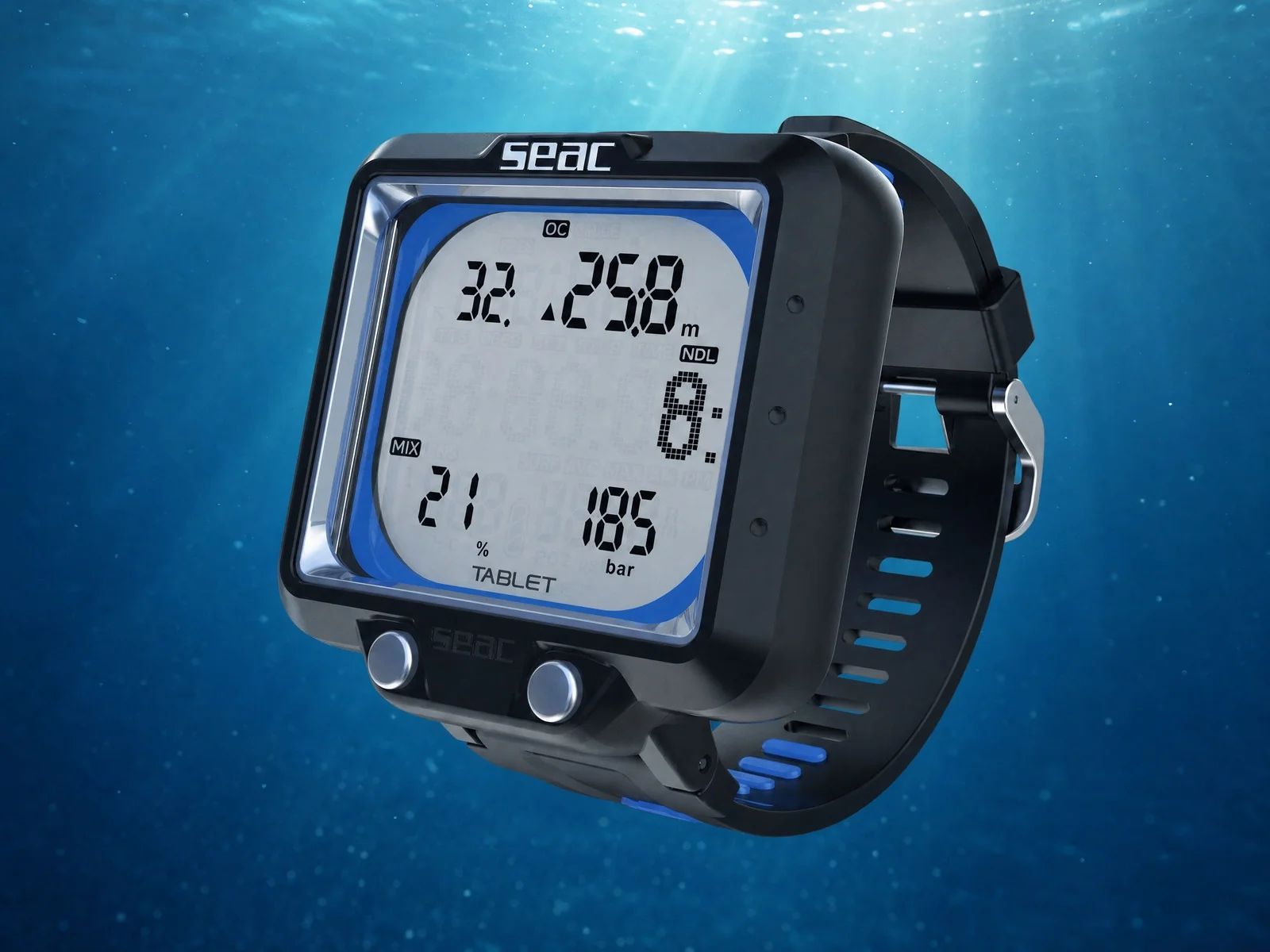
Yes, it manages up to 3 different mixtures (Air and Nitrox up to 99% O2), which is perfect for planning advanced accelerated decompression.
How does air integration work on the SEAC Tablet?
The Tablet can connect wirelessly to up to 3 transmitters to read your tank pressure in real-time. Note that this feature consumes battery faster and never replaces a backup mechanical pressure gauge.
How do I transfer my dives to my smartphone?
The SEAC Tablet features built-in Bluetooth, allowing rapid wireless sync of your dive log to the dedicated app. An optional USB cable remains available.
Is the SEAC Tablet suitable for freediving?
Yes. It has a dedicated FREE mode for freediving that records dive time, surface interval, and depth, as well as an OFF mode for static apnea.
There is something special about the moment when a diver realizes that their entry-level computer is starting to lack information.
It is not a failure, nor is it a design flaw. It is simply a sign that their diving has evolved, that decompression stops are starting to become part of their daily vocabulary, and that managing two different gases on the same dive is no longer a theoretical abstraction.
It is precisely at this stage that the SEAC Tablet deserves a close look. The Italian brand, whose reputation remains quieter than its Nordic competitors, has built a device that checks boxes not usually found at this price point: built-in Bluetooth, management of three gas mixtures, simultaneous connection to three wireless pressure transmitters, and an announced battery life of 600 dives on a simple user-replaceable CR2450 battery.
This test is based exclusively on the documented technical data from the AquaExposure source sheet, without direct field experience on this model. I provide my instructor analysis, with the nuances that implies.
3 Air/Nitrox gases up to 99% O2, without Trimix or CCR mode
O3 - Screen and ergonomics
3.6/5
47x40 mm hybrid LCD (segments and matrix), adjustable backlight, well-sized buttons
O4 - Battery life and cell
4.5/5
Replaceable CR2450 battery, ~600 dives announced over 2 years, integrated battery indicator
O5 - Connectivity and app
3.7/5
Native Bluetooth, optional USB cable, compatible OS/Windows dive manager
O6 - Compass and instruments
3.1/5
No electronic compass, SCUBA/GAUGE/FREE/OFF modes, 24h freediving logbook
O7 - Robustness and depth
3.5/5
Certified to 100 m, double silicone strap + bungee extension
O8 - Price and Support
3.6/5
This computer is made for: the advanced Nitrox diver (minimum Level 2 / Advanced Open Water) who wants to manage multiple decompression gases and synchronize their dives wirelessly.
This computer is not ideal for: Trimix divers or rebreather (CCR) users, as these modes are not supported.
Detailed Analysis
O1 - Algorithm and stops (3.9/5)
The SEAC Tablet integrates the Bühlmann ZHL-16C algorithm, an industry standard for its documented reliability and predictable behavior.
Instead of exposing you to the direct manipulation of Gradient Factors, which requires specific training and a true understanding of tissue saturation mechanisms, SEAC chose a preset approach: six conservatism levels numbered from 0 to 5. This allows you to adapt the decompression profile to your physical fitness of the day, dive conditions, or accumulated fatigue.
This is a coherent pedagogical decision for a device positioned in the evolving recreational segment. The logbook records 65 hours of diving in SCUBA mode, representing a comfortable memory for intensive recreational use.
The 3.9/5 score reflects the solidity of the algorithm and the clarity of the approach, with a slight reserve on the lack of freely adjustable Gradient Factors, which limits interest for a technical diver in advanced training.
O2 - Air and multi-gas (2.3/5)
This is where the Tablet clearly stands out from most computers at this price: it manages up to three gas mixtures simultaneously, Air and Nitrox up to 99% O2.
For a diver beginning to work with oxygen-rich stage bottles on their decompression stops, this capability fundamentally changes how you plan a dive. Two deco bottles at 50% and 80% O2, plus back gas, is exactly what this device can manage.
The 2.3/5 score might surprise you given this capability. It is explained by the AquaExposure scoring scale, which penalizes the lack of hypoxic Trimix and CCR mode, two features logically absent from this device by deliberate positioning choice. This score does not reflect a defect for the target audience: for the advanced recreational diver or confirmed Nitrox diver, three-gas management is very sufficient.
Note on air integration: The Tablet can connect to a maximum of three wireless transmitters to read tank pressure in real-time. This feature is documented here for information and does not enter the O2 score calculation. Two points remain non-negotiable: using these transmitters consumes the battery significantly faster than the onboard electronics alone, and having a backup mechanical pressure gauge remains an absolute rule, regardless of wireless system quality.
O3 - Screen and ergonomics (3.6/5)
The 47x40 mm LCD screen adopts a hybrid architecture that mixes segments and dot matrix, giving it graphic flexibility superior to purely segmented displays.
The two buttons are sufficiently spaced to be used with thick gloves, a detail that really counts when diving in drysuits in cold water. The backlight is adjustable in intensity, allowing readability to be adapted to ambient light conditions.
The 3.6/5 score translates into good execution on a classic format, without reaching the excellence of high-resolution color screens found on high-end models.
O4 - Battery life and cell (4.5/5)
This is the most unexpected strong point of this device, and one that deserves to be emphasized.
Despite the presence of Bluetooth and wireless transmitter management, SEAC announces a battery life reaching nearly 600 dives spread over two years on a simple CR2450 battery. This technical choice avoids the constraint of constant recharging, which is particularly valuable during a dive cruise where access to an electrical outlet is not always guaranteed.
The battery is user-replaceable without going through customer support. An integrated battery check system allows you to monitor the charge state before each immersion. The 4.5/5 score is the highest on the sheet, and it is well-deserved.
O5 - Connectivity and app (3.7/5)
This is the major evolution of this model compared to previous SEAC generations: profile transfers are done transparently via Bluetooth to your smartphone, without cables or complex manipulations.
An optional USB cable option remains possible for those who prefer this approach or work on desktops with the OS/Windows compatible dive manager software.
The 3.7/5 score reflects functional and well-thought-out connectivity, with a reserve on the quality and update frequency of the companion app, information that the source sheet does not document with enough precision to be verified.
O6 - Compass and instruments (3.1/5)
The device bypasses the electronic compass, representing a real limitation for divers navigating underwater without surface visual reference.
It distinguishes itself, however, by the versatility of its operating modes: SCUBA for classic diving, GAUGE for use as an independent depth gauge and stopwatch, FREE for pure freediving with a 24-hour logbook, and OFF to disable depth alarms during static apnea training in pools.
This last option is a thoughtful touch for freedivers training in calm water, where depth alarms would quickly become intrusive. The 3.1/5 score reflects the lack of a compass, partially compensated by the wealth of available modes.
O7 - Robustness and depth (3.5/5)
The casing is certified waterproof for dives down to 100 meters, a reassuring standard for regular recreational use in natural environments.
The device comes with a double silicone strap and a bungee extension, allowing it to be worn on the wrist or in bungee configuration on the forearm, a common preference for divers wearing thick suits. The 3.5/5 score reflects a solid construction suited to the target usage, without the additional resistance certifications found on tech-oriented models.
O8 - Price and Support (3.6/5)
MSRP at launch was around 379 euros, but the Tablet is regularly found between 259 and 299 euros on the current market. At this price, the feature-to-price ratio is objectively very favorable: Bluetooth, multi-gas, air integration up to three transmitters, and remarkable battery life, all under 300 euros.
On customer support, the situation deserves frankness. SEAC's reputation for after-sales service is average on specialized forums, with reports of unanswered emails from the Italian headquarters. If you buy a SEAC, make sure to go through a physical dealer capable of acting as an interface with the manufacturer. The dealer really acts as a buffer here. The 3.6/5 score reflects the excellent value balanced by this support reserve.
Who is this computer for?
The SEAC Tablet perfectly targets the advanced diver who has validated their Advanced Open Water or Level 2 certification and wants to start working seriously with oxygen-rich mixtures on decompression stops.
It is also the ideal device for divers practicing freediving alongside scuba diving, thanks to its dedicated modes and 24-hour freediving logbook.
On the other hand, if your ambition is to progress towards deep Trimix, hypoxic mixes, or rebreather use, this computer will not be able to follow you. You will then need to look towards more specialized models, such as the Shearwater Perdix 2 or Teric, whose algorithmic capabilities and multi-gas management cover these advanced uses.
Support and Service
SEAC is an Italian brand whose customer support relies heavily on its dealer network. Users on specialized forums report difficulties obtaining direct responses from headquarters, variable delays, and rigidity regarding warranty conditions.
The practical rule is simple: buy from a local dealer who knows the brand and is used to handling exchanges with the distributor. A dealer who stands by you in case of a problem is worth much more than saving a few euros online. On the manufacturer warranty, standard conditions apply. In case of failure linked to normal use, going through the dealer remains the most efficient path.
Power Supply
The SEAC Tablet runs on a user-replaceable CR2450 battery. This is a choice that deserves appreciation, especially when compared with rechargeable battery computers.
On a dive cruise, access to an electrical outlet is not always guaranteed. With a CR2450 battery, you simply pack two or three spare batteries in your kit, and you have enough to last several weeks of intensive diving without worrying about recharging.
The announced battery life of 600 dives over two years is remarkable. However, it assumes reasonable use of wireless transmitters, which consume the battery at a rate significantly higher than the onboard electronics alone. With three active transmitters, the actual battery life will be significantly reduced compared to the manufacturer's announcement.
If you are interested in the Tablet but looking for a more accessible entry point, the SEAC Screen is the brand's entry-level model, without Bluetooth or multi-gas, but with the same basic reliability on the Bühlmann algorithm. Read our SEAC Screen review.
For use focused on freediving and less on technical decompression, the SEAC Jack is a compact model dedicated to free diving. Read our SEAC Jack review.
Compare with other models
To compare this computer with other models from different brands, check out our dive computer comparator.
A dive computer is a decision aid, never a guarantee against decompression sickness. It does not replace proper training or diver judgment. Regardless of equipment quality, rigorous planning and respect for learned procedures remain the only true protections underwater.