Sharks Have Friends: What 2026 Science Changes About How You Photograph Them
A 2026 study on bull sharks in Fiji proves they have active social preferences. How to read a group for better photography and genuine respect for the animal.
Do all shark species have active social preferences?
The 2026 study focuses on bull sharks in Fiji, but earlier work has shown similar behaviour in schooling hammerhead sharks and in some reef shark species. The cautious rule is to assume that many species function within social networks, and that observation takes priority over the lone-predator stereotype.
How do you spot the "central" shark in a group?
It is the one the others watch. Its path is followed, its pause slows the group, its restart sets the group moving again. This is the shark you should photograph last, never first, because it holds the balance of the group.
Should we stop shark dives after these findings?
No. The 2026 science does not say that diving disturbs sharks. It says that sharks have a finer social life than we thought, and that our role is not to disrupt it. Respectful diving remains legitimate, and it is even a valuable source of observation for research.
Does light pollution on night dives actually affect sharks?
Yes. A study published in January 2026 in Science of the Total Environment showed that melatonin levels in several shark species change significantly under artificial light at night. This topic is covered in detail in the article on natural light for night diving.
What type of image truly tells this social story?
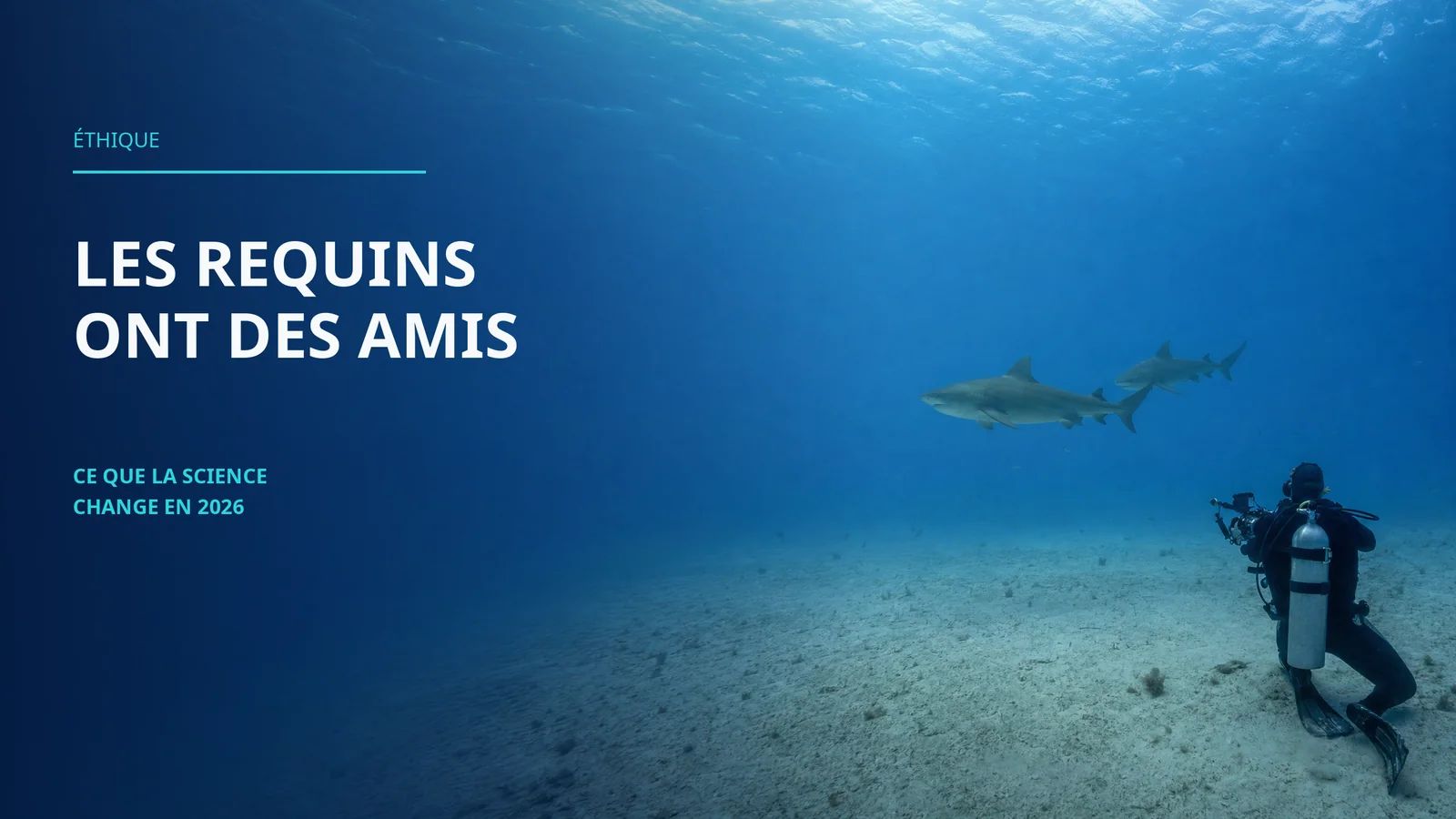
Group images with no visible human, two or three individuals in the frame and crossing trajectories. Not the isolated head-on portrait of a single shark. The isolated portrait removes precisely what science has just proven: that this shark exists within a network.
To learn how to get the most out of your gear underwater, discover the AquaExposure training.
Sharks Have Friends: What 2026 Science Changes About How You Photograph Them
A few weeks ago, a research team based at the Shark Reef Marine Reserve in Fiji published a study worth pausing for. Over several seasons of observing the bull sharks on the site, they proved something simple and powerful: sharks do not mix randomly. They have active social preferences. Certain individuals spend their time with specific other individuals, and avoid certain others, dive after dive.
For a diver, it is just another study. For an underwater photographer, it is a reframing of the practice.
Because if sharks have friends, then the group you are photographing is not a random cluster of interchangeable silhouettes. It is a society. With centres, peripheries, bonds, avoidances. And the way you position yourself, the way you press the shutter, the way you tell that moment: all of it changes.
That is the article I want to write with you.
What the Fiji Study Actually Showed
The work was conducted over multiple long seasons, with individual identification of each bull shark on the site (scar patterns and fin shapes allow that level of identification). The researchers recorded who swam with whom, at what time, and how often.
The result is unambiguous: the associations between individuals are not random. Some sharks consistently end up together. Others avoid each other. The structure resembles what we observe in marine mammals (dolphins, orcas) or in terrestrial chimpanzees: stable affinities, subgroups, dynamics.
What this challenges is the popular image of the lone shark, drifting between currents, crossing paths with its own kind without recognising them. That image is false for the bull sharks of Fiji. It is probably false for many other species, but we do not yet have the fine-grained observation to prove it.
For the underwater photographer, the useful information is not the study itself. It is what it changes in how you read a scene.
Reading a Shark Group as a Society, Not as Scenery
When you arrive on a reef shark site or in a bull shark cage, you first see a mass. Three or four silhouettes passing by, sometimes more. The photographic reflex is to aim at the one that passes closest, because it will be the sharpest.
The 2026 science invites a different gesture: observe for five minutes before pressing the shutter. And look for three things.
First, who follows whom. In a group, one individual often sets the pace. Its pause stops the collective movement. Its restart gets it going again. That shark is the centre. The others organise around it.
Second, who avoids whom. If two sharks systematically change course to avoid crossing paths, you are looking at a social dynamic. That detail does not show in an isolated photo. It shows in a sequence, and it tells a far richer story.
Third, who is watching what. A shark that turns its head toward a member of the group is information. A shark that turns its head toward you is also information (and it is usually the moment to back off by one fin kick).
This observation work is exactly the logic of the scenography of self-erasure that I describe for other species. The difference is that with sharks, self-erasure is not only ethical. It is tactical. A shark that saw you step back will be less inclined to dodge your frame.
Three Framing Mistakes That Erase the Social Dimension
I regularly see these three mistakes in the images students bring back from shark courses. None of them is serious on its own. All of them erase what 2026 science has just proven.
The isolated portrait mistake. You wait until the biggest shark passes alone in front of you, and you press the shutter. The image is visually powerful, but it removes the network. You have photographed an individual, not a society. It is valid for an identification shot or an artistic portrait. It is false as a representation of the animal.
The systematic backlight mistake. The shark silhouette against the blue surface has become an Instagram cliche. It is beautiful. It is also anonymous. All shark silhouettes look the same in backlight, which erases the individual markings that are precisely the substance of the social dimension.
The direct flash mistake. A powerful strobe on an approaching shark is technically useful for recovering colour. It is also an alarm signal for the animal and for its group. If you want to photograph a social dynamic, you cannot scare the group away with the first frame. The rule of natural light applies even more when the subject is sensitive.
No piece of equipment corrects these three mistakes. Only intention does.
The Parallel That Struck Me: The Tiger Sharks of Fuvahmulah
When I read the Fiji study, my first reflex was to cross-reference it with what I know from another iconic site: Fuvahmulah, in the southern Maldives. It is one of the rare places in the world where you can regularly observe tiger sharks in shallow water, just a few metres from shore, in a setting that feels more like an encounter than a photo chase.
At Fuvahmulah, local guides individually name several tiger sharks that return season after season. That one is the big female, she always comes first. The other one arrives twenty minutes later, more cautious. The third only approaches if the big one has already left. These observations are not anecdotal. They describe exactly the stable social structure that the Fiji study has just formalised for bull sharks: identifiable individuals, relational preferences, avoidance dynamics.
What the Fuvahmulah guides have known for years through observation, science has just confirmed methodologically for another species. It is this double foundation (expert field knowledge and published paper) that makes the position defensible and that will shape our approach in training.
For a photographer heading to Fuvahmulah, this changes the dive sequence. Instead of aiming at whichever tiger shark passes by, you listen to the local guide's briefing, you identify the central individual for that day's session, and you photograph the periphery first. You may get the big one. But she comes when she decides, not when you decide.
What This Concretely Changes in AquaExposure Training
These principles will be integrated into AquaExposure training in the next iteration of the marine animal photography modules. Specifically, two briefings that I have reworked since this study came out are already being adapted for course content.
The first briefing was about the approach. Before the study, I used to say: approach parallel, from the side, never head-on. That rule stays. But I now add: before approaching anyone, identify the centre of the group. That is the shark you will photograph last, not first. If you scare it off, you scare off the entire group with it.
The second briefing was about the image sequence. Before, I used to say: three images are worth more than a burst. Now I say: three images of three different individuals are worth more than nine images of the same individual. You are telling the story of a group, not a solo.
These two adjustments cost nothing in equipment. They changed the narrative quality of the images students bring back, and they reduced the visible stress on animals at course sites. They will find their official place in the animal ethics module of the training, alongside the existing work on turtles and reef species.
Ethics Is Not a Supplement. It Is the Subject.
I will end on something that took me a while to articulate.
For years, I talked about animal ethics as an extra layer of underwater photography. You photograph correctly, and on top of that you respect the animal. I now find that formulation incomplete.
The 2026 science tells us that the social dimension of sharks is not an accessory detail. It is part of the subject. If you ignore it, you are not photographing the real animal. You are photographing a fiction that looks like a silhouette. Observational ethics and photographic precision are the same thing. Seeing an animal well means respecting it well. Respecting it well is where you begin to see it well.