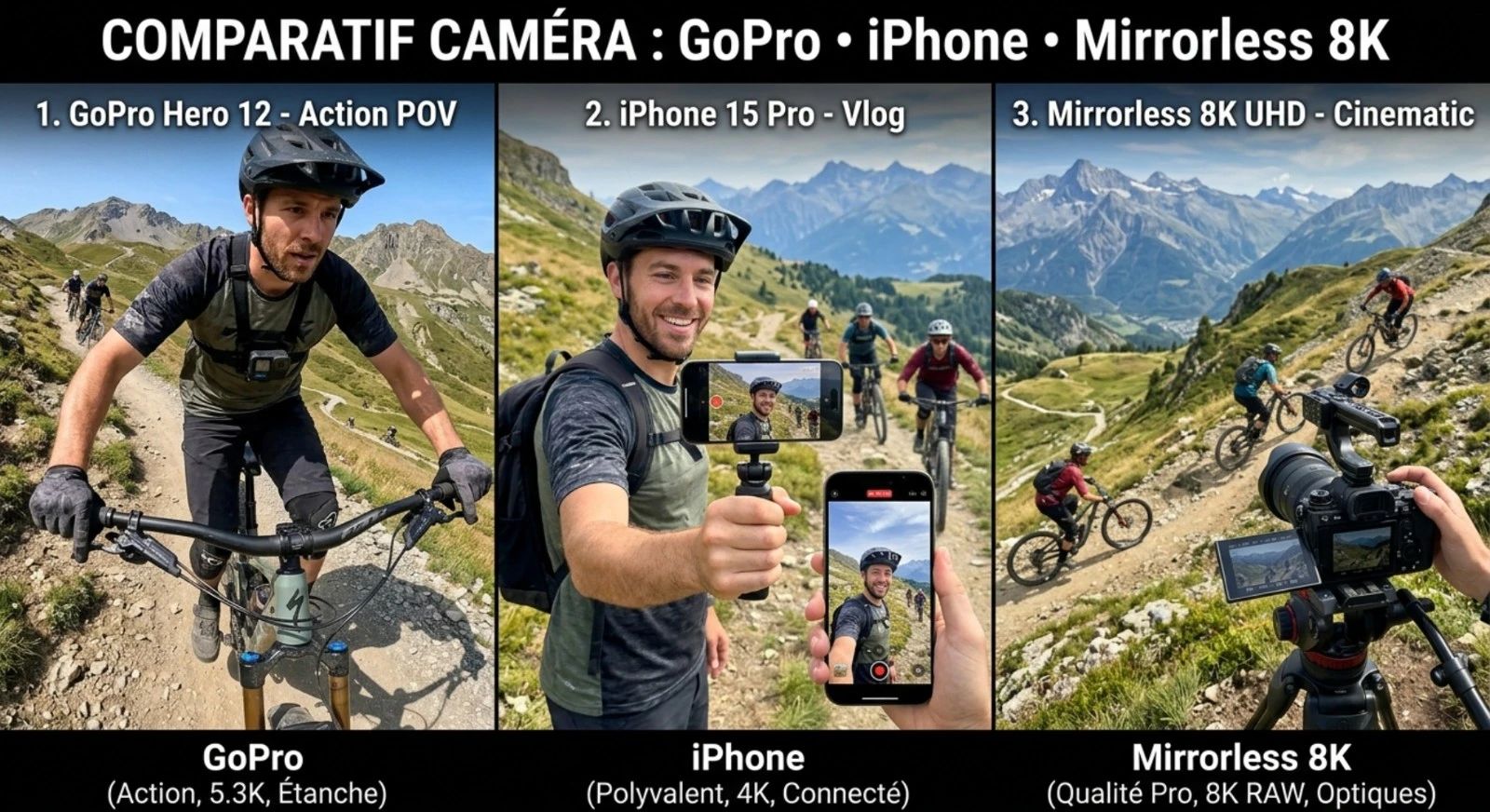
Smartphone, GoPro or compact: if I really have to pick one, which?
If you already own a recent smartphone (iPhone 13 Pro or later, equivalent Android), take the smartphone with a housing like the DiveVolk. It is the most rational option for the majority of divers in 2026. If you do not have a recent smartphone and mostly want to film, get a GoPro. If you are specifically passionate about macro and dive regularly, get the waterproof compact.
What is the real quality difference between a GoPro and an iPhone underwater?
In wide-angle action video, the GoPro remains very slightly superior for stabilisation and natural rendering. In photo and low-light video, a recent iPhone pulls ahead thanks to its larger sensor. For the majority of recreational diving situations, the two are qualitatively equivalent.
Is the DiveVolk housing really reliable down to 60 metres as stated?
Yes, but with precautions. The seal and gel pouch must be checked before every dive. Never dive with an empty DiveVolk housing (without a phone). Keep it in the shade on the surface to avoid overheating. With these precautions, over 1000 dives without incident in my experience.
Can you do serious macro with a smartphone?
Partially. Recent smartphones have macro modes, but they do not come close to the extreme macro level of the TG-7. For nudibranchs, cleaner shrimp, coral details, the waterproof compact remains superior. For macro of moderately close reef fish, the smartphone does the job very well.
Is a new waterproof compact really worth it in 2026?
For specialised macro, yes. For general use, no - a recent smartphone will do better for less money. The waterproof compact's relevance is now limited to specific cases: macro passion, cold-water diving with thick gloves, deep dives beyond 30 metres with a dedicated housing.
Should I buy new or second-hand?
For GoPro and waterproof compact, second-hand is very appealing - these products age slowly and lose value quickly on the resale market. For the smartphone, it depends on your other uses. For a smartphone housing, new is preferable - seals and gel pouches age and you need to know their history.
Android or iPhone: does it make a difference underwater?
Very little, provided both are recent high-end models. iPhone has a slight edge on video stabilisation and housing ecosystem (DiveVolk, Nauticam Smart Housing, Easydive are all compatible). High-end Samsung Galaxy and Pixel Pro phones are also very good. The choice comes down mainly to compatibility with your intended housing.
What is the realistic lifespan of each type of gear?
Smartphone: 3 to 5 years of primary use, plus 2 to 3 years as a second-life dedicated dive camera. GoPro: 3 to 5 years with regular use. Waterproof compact: 7 to 10 years, the most durable of the three if maintained. DiveVolk-type housing: 4 to 6 years before seals need full replacement.
Smartphone, GoPro, waterproof compact: which one to really choose and why the choice barely matters
Smartphone, GoPro or waterproof compact: all three now produce images that are good enough to photograph seriously underwater. The smartphone offers the best raw photo quality and the greatest versatility, the GoPro remains unbeatable for wide-angle video, and the waterproof compact keeps its edge for macro and manual controls. Choose the one you already own, or the cheapest if you are starting from scratch.
The choice between these three families matters far less than mastering whichever you pick. Here is why, and how to decide anyway if you insist.
The three families, what they actually do
Before the detailed comparison, let us honestly lay out what each brings to the table in 2026.
The smartphone in a housing
A recent iPhone (from the 13 Pro onwards), a high-end Samsung Galaxy or a Google Pixel Pro, slipped into a DiveVolk SeaTouch housing or a Nauticam smartphone housing, now produce images far beyond what anyone imagined possible five years ago.
The sensor in these phones has the same surface area as a premium waterproof compact. Their computational processing (HDR, RAW or ProRAW mode, software video stabilisation) compensates for the small lens. And you have in your hands a device you already use daily, so your learning curve is divided by five.
The GoPro Hero 12, 13 or equivalent Insta360 versions dominate underwater action video. Ultra-wide field of view, robustness, light weight, unbeatable price for what it delivers, easy editing.
For photos, it remains more limited (small sensor, poor low-light handling, little manual control). But for dive video and action footage (mantas, sharks, fish schools in motion, ambiance), it is often the best choice across all segments.
The Olympus TG-7 (formerly OM System TG-7), Sony RX0 II and a few Nikon or Ricoh models remain the references of a category that has evolved little in ten years. 1-inch or 1/2.3-inch sensor, waterproof to 15 metres without housing, spectacular macro mode on the TG-7, accessible manual controls.
The main advantage today: very close macro. The TG-7 does things that no smartphone and no GoPro can: photographing a nudibranch two centimetres from the lens with formidable sharpness. For those passionate about underwater macro, the waterproof compact remains relevant.
I compare the three families here on criteria that truly matter, not on spec sheets.
Photo image quality
Recent smartphone in RAW or ProRAW: excellent, with comfortable post-production latitude. At 5 metres, in natural light, an iPhone 15 Pro produces files comparable to an 800-euro compact.
GoPro: average for photos. Images often come out overly contrasty, hard to work with, and low light puts it in difficulty. It is the least photographic of the three for still shots.
Premium waterproof compact (TG-7): very good, especially for macro. Rendering is more neutral than a smartphone straight out of camera, but it also requires more editing to shine.
Advantage: smartphone, followed by compact, GoPro trailing.
Video image quality
GoPro: excellent, this is its specialty. Stabilised 4K, GP-Log or Flat profile for post-production, high bitrates. Hard to beat in its segment.
Recent smartphone: also excellent, sometimes outperforming the GoPro in low light thanks to the larger sensor. iPhone software stabilisation is remarkable. The drawback: less wide-angle, which changes how scenes read.
Waterproof compact: decent but trailing on stabilisation and 4K quality. No longer a relevant video format in 2026.
Advantage: GoPro and smartphone tied depending on context, compact trailing.
Mastery and learning curve
Smartphone: the fastest. You already know the interface. The housing adds a layer of handling, but the native app you use every day stays the same.
GoPro: medium. The touchscreen interface is simple, but you need to learn specific modes, colour profiles, bitrates. Allow two to three dives to feel comfortable.
Waterproof compact: the longest. Manual modes, dials, complex menus. Allow 10 to 20 dives to master a TG-7 or equivalent.
Advantage: smartphone, GoPro, compact last.
Versatility
Smartphone: maximum. Photo, video, communication, instant sharing, editing on the boat between dives, professional editing apps directly on the device. No other option comes close to this level of versatility.
GoPro: low outside the water. It is an action video tool, not a versatile device.
Waterproof compact: also low. You will not pull out a TG-7 to photograph your daily life. It is a dedicated tool.
Advantage: smartphone, by a wide margin.
Realistic total cost
Recent smartphone + DiveVolk SeaTouch 4 Max housing: 0 to 1500 euros if you already have the phone (otherwise 700 to 1500 for the phone) + 250 to 400 for the housing.
GoPro Hero 12 or 13 new: 350 to 500 euros. Second-hand: 200 to 350 euros. No additional housing needed (waterproof to 10-15 metres directly, deeper with optional housing).
Waterproof compact TG-7 new: 550 to 650 euros. Second-hand: 300 to 450 euros. Optional Olympus housing for depths beyond 15 metres: 350 to 500 euros extra.
The waterproof compact is the most expensive option in total if you add the deep housing. The GoPro is the cheapest. The smartphone depends on what you already own.
The practical decision table
Here is how to decide based on your profile. Use the criterion that best matches your situation.
You already own a recent iPhone or high-end Android smartphone: get a DiveVolk housing or equivalent (200-400 euros) and dive. The most rational decision 90% of the time.
You mainly want to shoot dynamic video (mantas, sharks, dive ambiance): second-hand GoPro Hero 12 or 13. Minimal investment, immediately professional video output.
You are passionate about underwater macro and dive regularly: waterproof compact TG-7. It is the only option that truly delivers this specialty.
You are starting from scratch and want to test before investing: the smartphone you already have + a basic waterproof pouch at 30-50 euros (Aquapac, Outdoor Element). You will test underwater photography for the price of a coffee and three dives before deciding.
You travel a lot and weight matters: smartphone + housing. The weight-to-result ratio is unbeatable. Fits in carry-on luggage without questions.
You dive in cold water with thick gloves: waterproof compact with large physical buttons. Smartphone and GoPro are both painful to use with 5-7mm gloves.
Why the choice matters far less than you think
This is where I step away from the standard comparison to say something more important.
Whichever camera you choose from these three families, the quality gap between your images will depend 80% on your skill and 20% on the gear. That is an enormous asymmetry, and it is good news: your time is better invested in practice than in equipment deliberation.
A trained photographer will produce beautiful images with a 250-euro GoPro. A beginner will bring back mediocre images with a 5000-euro setup. I have seen both scenarios a hundred times in the Maldives.
The real variable for progress is not the camera body, it is what you do between your dives. Land practice, dry handling of the housing, theoretical study, preparation. It is this accumulation that separates good underwater photographers from the rest, not the choice between iPhone and TG-7.
Marketing and some online comparisons maintain oppositions that do not really exist. A few deserve dismantling.
"Smartphone vs DSLR"
This opposition no longer makes sense in 2026 except in very specific cases (extreme underwater sports, professional photography for large-format prints, extreme macro). For 95% of underwater photo and video uses (online sharing, screen projection, A4 or A3 prints), a recent smartphone in a housing delivers exactly the same results as a DSLR in a housing, for a tenth of the price.
"GoPro vs professional underwater camera"
For recreational dive video, the GoPro is more than sufficient. So-called "professional" underwater video cameras bring real advantages (codec, latitude, audio quality) but at costs that make no sense for a non-professional diver. Unless you are shooting for Netflix, the GoPro is the relevant tool.
"Red filter vs no filter"
This discussion is outdated. On a modern smartphone, GoPro or compact, you shoot in RAW or flat mode (Flat, Log) and correct colour in post-production. The physical red filter is an old compromise that produces inferior results to well-done software correction, and becomes useless as soon as depth or turbidity changes.
"Rigid housing vs waterproof pouch"
A basic 30-euro waterproof pouch is perfectly adequate for first test dives (down to 5-10 metres depending on the model). It lets you discover underwater photography without investing 400 euros in a rigid housing. Once you have confirmed your interest, the rigid housing becomes the logical next step. But do not skip the pouch stage if it is relevant for your discovery season.
My gear history and what it taught me
I started underwater photography with a low-end waterproof compact at 200 euros. I believed my images were bad because of the camera. So I bought a premium waterproof compact at 600 euros. My images were still average, now just with a better sensor. I thought the problem was the dedicated housing, so I bought an Olympus housing at 400 euros more. Still the same. I then rented a semi-pro body with Nauticam housing for a week in the Maldives (total bill: 1800 euros for the rental alone). My images were barely better.
The breakthrough came from a dive where my semi-pro housing leaked. I pulled out my iPhone, slipped it into a basic 35-euro waterproof pouch, and dived with it. The images were clean, usable, and I no longer had the pressure of protecting an expensive investment. I started trying bolder compositions, getting closer to subjects, experimenting.
Those images were better than everything produced with my high-end gear. Not because of the 35-euro pouch, because of the freedom it gave me. The cost of the gear was unconsciously inhibiting my risk-taking. Modest gear was liberating it.
That experience is what finally convinced me. Today I dive with an iPhone 15 Pro and a DiveVolk SeaTouch 4 Max housing. For dynamic video, I sometimes add a second-hand GoPro Hero 12. Total setup cost: under 2000 euros, of which 1200 is for the phone I use every day. This setup produces images that easily match those from my former 6000 or 8000-euro configurations.