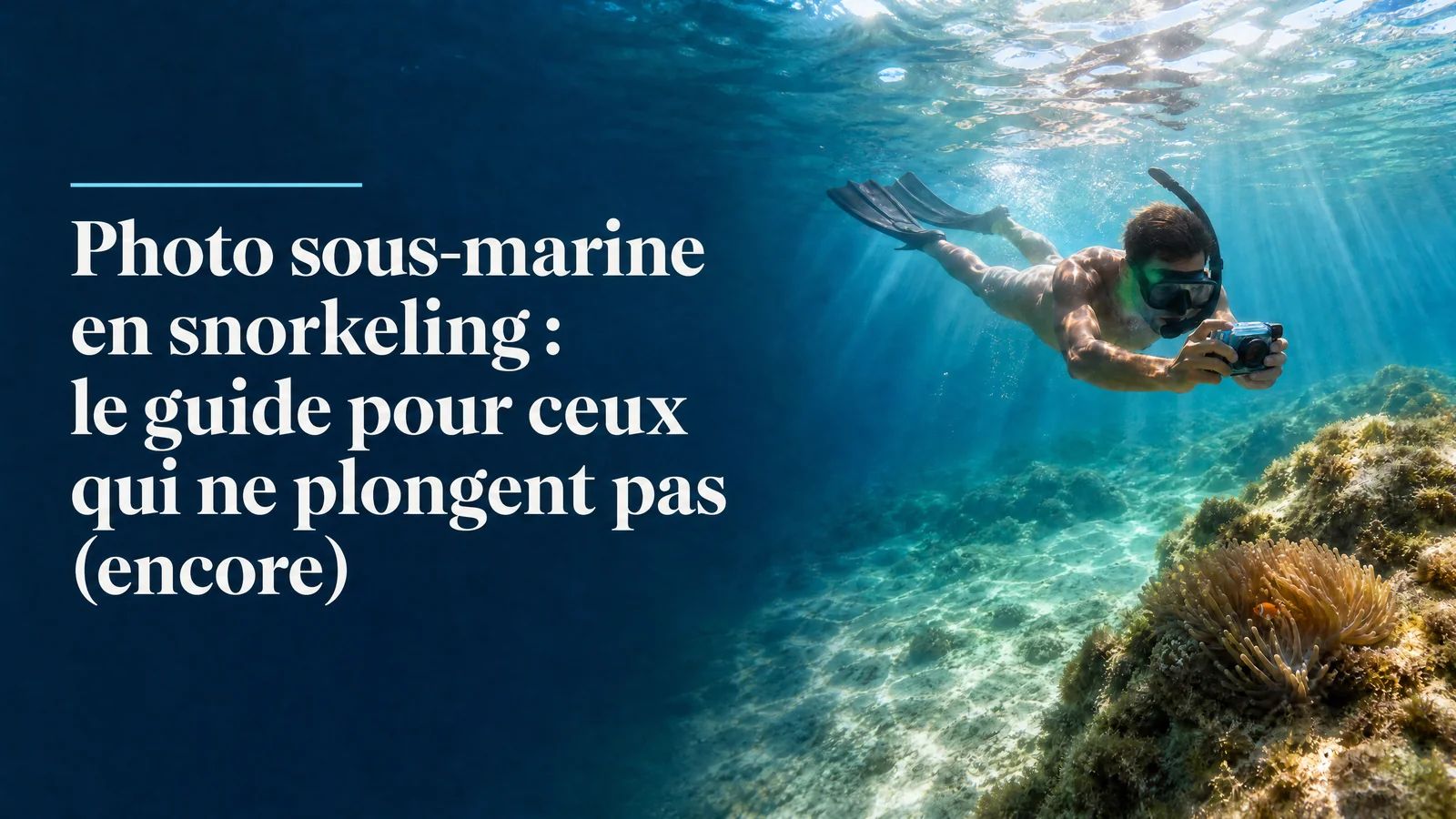
Can you take good underwater photos while snorkelling without diving?
Yes, between 0 and 3 metres natural light is at its maximum, subjects are plentiful, and colours remain intact. Some of the best underwater images are taken with just fins, mask, and snorkel.
What gear for underwater photography while snorkelling?
A recent smartphone in a Divevolk housing, a GoPro, or an Olympus TG-7 in snorkelling mode. No need for flash or complex accessories at shallow depth.
Why is the surface an advantage for underwater photography?
Sunbeams create dynamic light patterns on the bottom, backlighting occurs naturally, and the most photographed subjects (turtles, rays) often live at or near the surface.
To learn how to get the most out of your gear underwater, discover the AquaExposure training.
Snorkeling underwater photography is the best-lit discipline you will ever practice beneath the surface. Between 0 and 3 metres, natural light is at its peak, subjects are everywhere, and you have zero decompression constraints. Fins, mask, snorkel, and a waterproof camera: that is everything you need to bring back images worth the trip.
I see too many people waiting until they earn their dive certification before "really starting" underwater photography. That is a mistake. Some of my strongest shots come from snorkeling sessions at one metre depth, above a reef flooded with light.
Why snorkeling is an advantage for photography
The first thing to understand is that depth is not an asset in underwater photography. It is usually a drawback.
Every metre beneath the surface absorbs light. At 5m you already lose a significant portion of red. At 10m the oranges disappear. At 20m your images turn blue-green unless you intervene in post. Snorkeling at 0-3m means you work with the richest available light in the water.
The surface itself becomes a tool. Sunrays piercing the water through small waves create dynamic light patterns on the seafloor. Backlit shots are natural. Silhouettes form without effort. It is the ideal playground for natural light.
Add to that: the most photographed subjects in the world (turtles, rays, dolphins, tropical fish, reef sharks) often live near the surface or at shallow depth. Snorkelers have been photographing sea turtles for years before divers descend to find them at 15m.
Gear suited to snorkeling photography
Option 1: smartphone in a housing
This is the combination I recommend first for beginners. A recent iPhone or high-end Android inside a DiveVolk or Divevolk Sea Touch housing gives you a capable, versatile camera with a fully functional touchscreen underwater.
The advantages for snorkeling: the native wide angle of a smartphone is perfect for close-up surface work. Portrait mode isolates subjects. HDR handles the contrast between a bright surface and a darker seafloor. An app connection lets you control settings from inside the housing.
AquaExposure earns no affiliate commission on any equipment mentioned in this article.
Option 2: an action camera
The GoPro (Hero 12 or Mission 1) and the Insta360 X5 are natural choices for snorkeling. Native wide angle, built-in waterproofing without a housing, lightweight. They operate on automatic, which frees your attention for composition and swimming.
The downside: the very wide angle distorts close perspectives. Get really close to your subjects. At 50 cm from a turtle with a GoPro, the result is excellent. At 2 metres, the turtle becomes a dot in the blue.
Option 3: a dedicated waterproof compact
The Olympus TG-7 is waterproof to 15m natively, no housing needed. It offers a RAW mode, an impressive built-in macro, and accessible manual controls. For snorkeling, it is the choice that gives you the most control without adding complexity.
Its main advantage: the microscope mode, which captures macro images of tiny subjects a smartphone cannot get close to. In seagrass beds or shallow reefs, the variety of small subjects is endless.
Technique: how to swim for better photos
Passive buoyancy as your tripod
You have no tripod. You have no stabiliser. What you have is your body in the water.
The core technique: breathe in deeply, hold your breath for one second before shooting, then fire at the apnea. The chest movement from breathing is the number one cause of blur in snorkeling photography. Control that movement.
Hold the camera with both hands. Elbows slightly bent. Arms close to your body, not stretched out. The more your arms extend, the more they amplify micro-vibrations.
Approaching subjects
In snorkeling, you have an advantage over divers: you produce no bubbles above animals. Turtles, leopard rays, and surface barracudas are far less disturbed by a quiet snorkeler than by a diver exhaling.
The golden rule: never chase an animal. Position yourself on its path and wait. A turtle coming up to breathe follows the same route several times. Anticipate. Stay still. Let it come to you.
If you freedive down, descend slowly and diagonally, never straight down above the animal. Something dropping vertically from above looks like a predator. An oblique approach feels natural.
Using the surface as a light source
The surface is your biggest light source. Learn to use it.
Check where the sun is. Position yourself so the sun is behind you when you photograph a benthic subject (on the seafloor). The subject is lit from the front, the background is well exposed.
When you photograph a subject heading toward the surface (a turtle coming up to breathe, a whale shark at the surface), put the sun in front of you. The silhouette forms, light creates halos. That is where the strongest images come from.
For light-ray images, position yourself between the sun and the seafloor, looking slightly upward. The ripples create patterns that change second by second. Shoot in burst mode.
Settings that make the difference
Exposure
In snorkeling, light changes fast. A wave passes and the image is overexposed. Your angle shifts and you are in your own shadow.
Use a semi-automatic mode: shutter priority (Tv or S depending on your camera). Set a minimum of 1/250s to avoid motion blur and subject blur. If the sun is strong and the water clear, go to 1/500s.
If your camera runs on automatic (GoPro in Auto), that is fine for starting out. The automatic modes on modern action cameras handle surface/seafloor contrast well.
White balance
At 0-3m in clear tropical water, set white balance to "shallow water" or to 7000-8000K if you have a manual setting. This compensates for the blue cast without over-correcting.
If you shoot in RAW (smartphone or compact), you can leave white balance on automatic and correct in post. RAW gives you that freedom.
Focus
Subjects move. In snorkeling, you move too. Continuous autofocus (AF-C or tracking) is your ally. On GoPro and Insta360 it is handled automatically.
On a smartphone, keep the subject in the frame and let the camera track. If you have a few seconds of stillness (a turtle settling on the seafloor), use tap-to-focus on the area you want sharp.
Top snorkeling-first destinations for photography
Shallow tropical reefs
The Great Barrier Reef in Australia, the Maldives, the Togean Islands in Indonesia, and the Red Sea (Sharm el-Sheikh, Marsa Alam) offer reefs at 0-3m that rival any deep dive for diversity and light.
The Maldives in particular are paradoxical: the most spectacular snorkeling photos happen inside the lagoon, where divers walk past because they are looking for depth.
The French Mediterranean
The Calanques de Marseille, Port-Cros, and the Carry-le-Rouet marine reserve offer clear water (up to 20m visibility) and a unique Mediterranean light. The subjects are different (small fish, wrasse, octopus, grouper) but the quality of light in summer is unmatched.
Banyuls-sur-Mer, often cited as the birthplace of underwater photography, is excellent for snorkeling. The marine reserve protects abundant marine life just a few metres below the surface.
Belgian and Dutch spots
In Zeeland (the Netherlands, two hours from Brussels), the Oosterschelde offers unexpected macro subjects in shallow seagrass: cuttlefish in May-June, small crabs, anemones. The water is cold (a wetsuit is essential) but life is abundant.
From snorkeling photography to scuba: how to progress
Snorkeling photography is an excellent foundation. The techniques you develop, reading light, managing animal approaches, composition, handling a camera in the water, transfer directly to scuba diving.
If you want to move to scuba, here is what snorkeling photography will have taught you that diving courses alone do not: natural light intelligence, patience with animals, and the understanding that the best gear is useless without good approach technique.
The AquaExposure training includes snorkeling and beginner modules. If you want to progress with structure rather than trial and error, that is the most efficient path: Discover the training.
FAQ: Snorkeling underwater photography
Can you take truly good photos while snorkeling, or is it just for beginners? It is not just a beginner phase. Some photographers work exclusively in snorkeling for the light available at shallow depth. The UPY (Underwater Photographer of the Year) competition has a dedicated snorkeling category where images compete with the best shots from deep dives.
What is the best camera to start snorkeling photography? A recent smartphone in a DiveVolk housing or a GoPro Hero are the ideal starting points. The smartphone offers a touchscreen and advanced settings. The GoPro is simpler and more rugged. The Olympus TG-7 compact is an excellent step up if you want more control.
AquaExposure earns no affiliate commission on any equipment mentioned in this article.
Do you need to be a freediver to take good snorkeling photos? No. The best opportunities often happen at the surface, without going down at all. A turtle coming up to breathe is photographed from the surface. Silhouettes are created from the surface. Freediving is useful for approaching the seafloor, but it is not essential.
Is flash useful for snorkeling photography? No, with rare exceptions (very close-up macro at night). At the surface, natural light is more than enough and far more beautiful than any flash. Flash at 1 metre of distance creates backscatter and stresses animals. Avoid it.
How do I avoid blur in my snorkeling photos? Two main causes: water movement (swell) and breathing. Solution for swell: shoot at the moment you are rising slightly, not when you are dropping. Solution for breathing: hold your breath 1-2 seconds before firing. Use a minimum shutter speed of 1/250s.
Can you photograph while snorkeling with gloves? In cold water, thin gloves (1-2mm) do not prevent you from using a smartphone or GoPro. Thicker gloves make touchscreen controls difficult. In that case, a camera with physical buttons (Olympus TG-7, GoPro with thin gloves) is preferable.
Are there subjects impossible to photograph while snorkeling? Deep macro (small nudibranchs on walls at 15m) remains the territory of scuba diving. But large subjects (whales, whale sharks, rays, turtles), shallow reefs, coral formations, and the majority of tropical fish are perfectly accessible from snorkeling.
What wetsuit for snorkeling photography? In warm water (above 28°C), a 2mm shorty or even a lycra suit is enough. Thermal protection matters for long sessions (waiting is often longer in snorkeling than in diving). In the summer Mediterranean, 3mm for sessions over an hour. In Belgium or Zeeland, 5-7mm with a hood.
Snorkeling Underwater Photography: A Guide for Beginners | AquaExposure