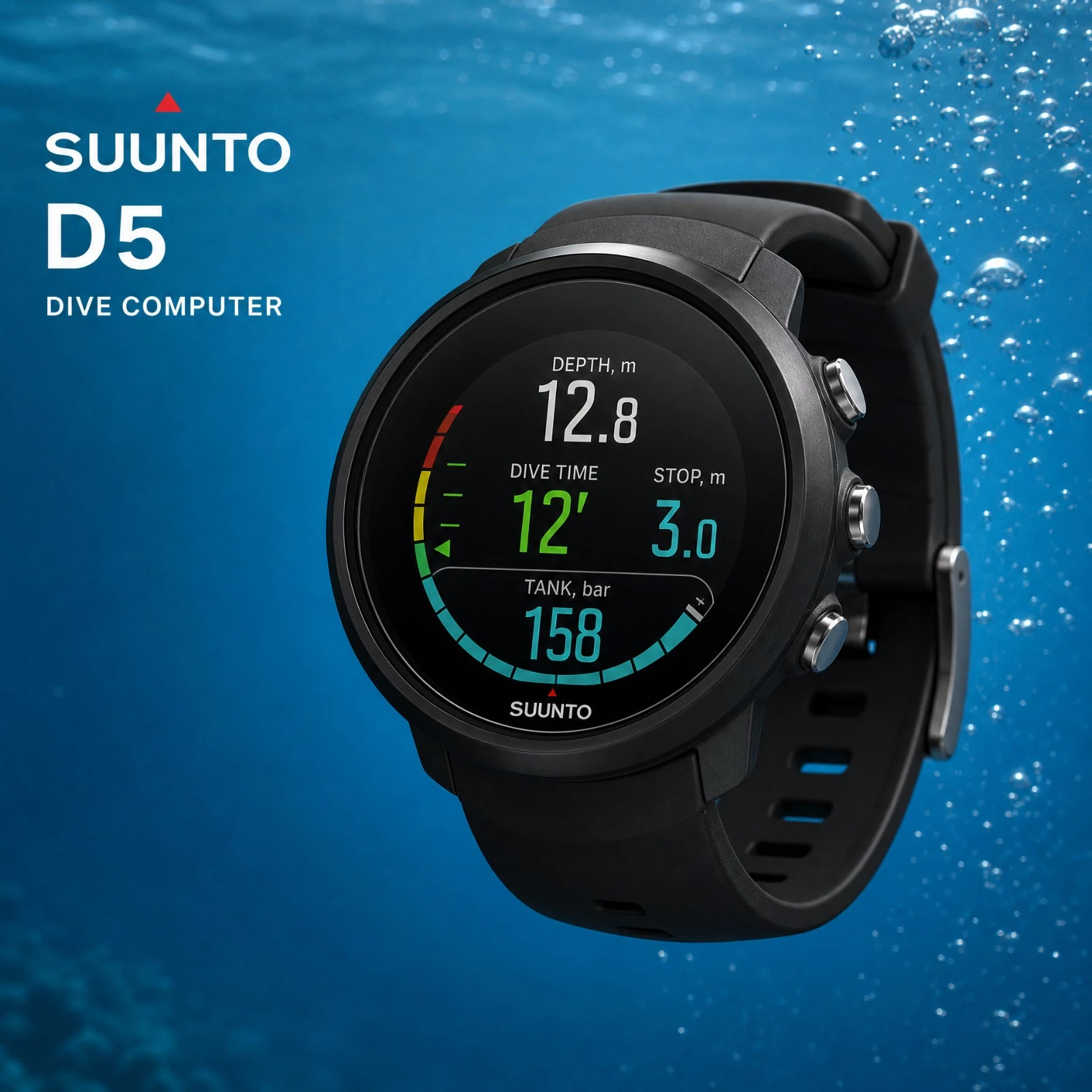
Complete review of the Suunto D5. Evaluation of the RGBM 2 algorithm, color screen readability, battery life, and air integration for recreational divers.
To learn how to get the most out of your gear underwater, discover the AquaExposure Training.
Introduction
In the world of scuba diving, where every detail matters for safety and the enjoyment of exploration, choosing your dive computer is a fundamental decision. It's not just a fashion accessory, but rather the instrument that safeguards our physical well-being during each dive, managing decompression parameters with surgical precision.
The Suunto D5, with its smartwatch-like appearance and color screen, has captured the attention of many divers. It promises an intuitive experience and seamless connectivity. But beyond the aesthetics and marketing claims, it is essential to understand what this device actually offers beneath the surface.
We will, through this analysis, thoroughly examine the Suunto D5 according to our rigorous rating system, in order to determine if it represents a worthwhile investment for the discerning diver. We will examine its algorithm, ergonomics, battery life, and durability, in order to provide you with a clear and objective perspective.
The Verdict in Summary
Overall score: 3.6/5
| Criterion | Score | What it means |
|---|---|---|
| Algorithm & settings | 4.1/5 | A proven RGBM 2 proprietary algorithm, with clear conservatism adjustments but no fine-tuning of Gradient Factors. |
| Air & multi-gas | 2.0/5 | It handles up to 3 Nitrox gases (up to 99%), which is more than enough for recreational diving and advanced decompression, but it lacks a Trimix mode. |
| Screen & ergonomics | 3.5/5 | A readable 1.2" MIP (Memory In Pixel) color screen, combined with a very intuitive 3-button navigation system. |
| Battery life | 3.5/5 | Rechargeable battery (USB). Its Achilles' heel: 6 to 12 hours in dive mode requires frequent recharges. |
| Connectivity & app | 4.6/5 | An excellent Suunto ecosystem: ultra-smooth Bluetooth and a top-notch companion app. |
| Compass & instruments | 5.0/5 | A highly effective 3D compass with tilt compensation, featuring a dedicated freediving mode. |
| Robustness & depth rating | 4.0/5 | Certified to 100 m, with a scratch-resistant mineral glass and reinforced casing. |
| Price & customer service | 4.1/5 | Its current market price (~350€, excluding transmitter) makes it an excellent value for money. The European customer service is solid. |
Detailed Analysis
Algorithm & tiers (4.1/5)
The Suunto D5 relies on the Suunto Fused™ RGBM 2, a proprietary bubble algorithm that has proven its effectiveness. While it doesn't offer the absolute transparency of a classic Haldanian model with free Gradient Factors, the computer allows for modulation of conservatism through personal settings (P-2 to P+2). During dives, the display is clear: the decompression ceiling and TTS (Time To Surface) are always readable, and ascent alarms are clear. This balanced approach offers appreciable safety without unnecessarily complicating the interface. It's an approach that combines the science of decompression with ease of use, which is essential for divers who focus on the present moment, as well as the marine fauna and flora.
Air & mixed gases (2.0/5)
This model is clearly designed for recreational diving and intermediate-level decompression. You can configure up to 3 gases (Air or Nitrox from 21% to 99%), which allows you to perform a bottom dive and then switch to an oxygen-enriched decompression tank at the designated depth. The lack of native Trimix support and CCR mode justifies this moderate rating in our overall assessment. However, this limitation will not hinder the vast majority of recreational divers, for whom these features are not essential.
Screen & Ergonomics (3.5/5)
The color matrix display, which uses MIP (Memory In Pixel) technology, utilizes ambient light to enhance contrast, making it particularly readable close to the surface. While the dial remains relatively small (1.2 inches), the color scheme chosen by Suunto greatly facilitates quick information acquisition. Navigation using the three physical buttons is remarkably efficient. It remains perfectly usable even with moderately thick gloves, a crucial point for comfort when submerged.
Battery Life & Power (3.5/5)
This is a major compromise for color smartwatches. Suunto announces between 6 and 12 hours of battery life in dive mode. If you are on a diving cruise with 3 dives per day, recharging overnight via the magnetic USB cable will be a necessary step. The performance in cold water with this type of Li-ion battery further reduces this margin, a factor to consider for dives in temperate or cold environments.
Connectivity & App (4.6/5)
The digital ecosystem is a major strength of Suunto. The Bluetooth synchronization to the mobile app on the surface is seamless and exceptionally smooth. The digital dive log is generated comprehensively, with high-quality graphical representations of the profiles, offering an enriching post-dive analysis. Firmware updates, although they require the SuuntoLink software on PC/Mac, are stable and contribute to the longevity of the device.
Compass & Instruments (5.0/5)
The integrated three-axis digital compass, compensated for tilt, is one of the best on the market in this segment. Whether your wrist is perfectly flat or tilted, the heading remains accurate, which is a definite advantage in underwater navigation, where orientation is crucial. It also includes a complete freediving mode, a welcome addition for divers who practice this discipline.
Robustness & Depth (4.0/5)
Designed for an operating depth of 100 meters (according to EN 13319 and ISO 6425 standards), the reinforced composite case and stainless steel bezel can withstand daily shocks. The treated mineral glass offers good scratch resistance, although it does not have the absolute hardness of sapphire crystal. This robust construction inspires confidence for regular use in demanding environments where equipment is subjected to harsh conditions from salt, sand, and currents.
Price & Customer Service (4.1/5)
Launched at over €500, the Suunto D5 is now regularly found for around €325 to €350. At this price, the value for money is excellent, especially considering the features offered. The Suunto customer service is decent, but it's crucial to emphasize the importance of the firmware. It is imperative to always update the device before any dive to ensure its proper functioning and your safety. Effective customer service provides peace of mind, the certainty that your equipment will faithfully accompany you on all your explorations.
Who is this computer for?
The Suunto D5 is a suitable choice for recreational divers who dive regularly or for technical divers doing light dives (confirmed Nitrox users) and are looking for a watch-style computer. Its readability, advanced connectivity, and design make it an ideal companion for those who appreciate integrating technology into their daily lives. It's aimed at those who don't mind the need to recharge the device regularly and who want a rich and detailed digital dive log.
On the other hand, this computer is not ideal for divers undertaking expeditions in remote locations far from any power source, where battery life becomes a crucial factor. It will also not be suitable for those considering an upgrade to technical deep diving (Trimix), as its multi-gas capabilities are limited to Air and Nitrox. Choosing your equipment is primarily about understanding your own needs and aspirations.
Customer Service and Support
The after-sales service of Suunto is generally considered to be adequate. However, one particular aspect deserves emphasis: the importance of firmware updates. It is highly recommended to systematically update your Suunto D5 before each dive. In case of a battery problem, it is necessary to return the device to Suunto's customer service, as the rechargeable lithium-ion battery cannot be replaced by the user. The support is accessible, but vigilance regarding updates is a shared responsibility between the manufacturer and the user, a constant dance between technology and human caution.
Nutrition
The Suunto D5 is equipped with a rechargeable lithium-ion battery that charges via a proprietary USB cable. While this feature offers the convenience of a connected watch in everyday use, it requires careful management of the charge. For a diving trip, it will be essential to bring the specific cable and plan for opportunities to recharge overnight, especially if you are making multiple dives per day. The absence of a user-replaceable battery also means that if the battery fails, the device will need to be sent in for repair. This is a point to consider for divers who prioritize simplicity and complete autonomy in isolated environments.
Links to other models from the same brand.
If the Suunto D5 has piqued your interest, the Finnish brand offers other models that might suit different diver profiles. For a more technically oriented approach, the Suunto EON Steel offers extended features. For tighter budgets or a simpler approach, the Suunto Zoop Novo remains a reliable and proven option. Each model meets specific expectations, and it is always rewarding to explore the range of possibilities.
CTA Comparator
To compare this computer with other models, see our diving computer comparison tool.
© 2026 AquaExposure. All rights reserved. Reproduction prohibited without authorization.
Diving is a school of life, a constant learning process in humility, technique, and respect for the environment. Each dive is a lesson, each ascent a moment for reflection. Continue to learn, question, and explore, because it is in this perpetual quest that the true essence of a diver resides. Dive well, dive safely, dive with awareness.
Share
Table of Contents
- 01Introduction
- 02The Verdict in Summary
- 03Detailed Analysis
- 04Algorithm & tiers (4.1/5)
- 05Air & mixed gases (2.0/5)
- 06Screen & Ergonomics (3.5/5)
- 07Battery Life & Power (3.5/5)
- 08Connectivity & App (4.6/5)
- 09Compass & Instruments (5.0/5)
- 10Robustness & Depth (4.0/5)
- 11Price & Customer Service (4.1/5)
- 12Who is this computer for?
- 13Customer Service and Support
- 14Nutrition
- 15Links to other models from the same brand.
- 16CTA Comparator
Questions about the Journal
Can I use the photographs from this journal?
All images are protected by copyright. For any commercial or editorial use, please contact us via our form.
How can I be notified of new articles?
Follow us on social media or join the Sentinels Circle to receive our immersion stories before anyone else.
Do you offer hands-on workshops?
Yes, we organize masterclasses and field expeditions for members of our school. Check the Training page for details.


