A Stanford-PNAS 2026 study reveals why molluscs survived the Great Dying 252 million years ago. What it changes when you dive with a camera.
The Great Dying is the name given to the mass extinction that occurred 252 million years ago, at the Permian-Triassic boundary. It eliminated roughly 96% of marine species and 70% of terrestrial species. For divers, it reshaped the seabeds we visit today: brachiopods, which had dominated the seafloor for 280 million years, nearly vanished, and the molluscs (mussels, oysters, snails) that survived became the dominant invertebrates in our modern oceans.
A study published in PNAS in July 2026 by Jose Andres Marquez and his Stanford team provides the most precise answer to date: molluscs had faster, more active metabolisms, allowing them to tolerate warm, oxygen-depleted water far better. Brachiopods, slow and sessile, could not adapt to rising temperatures and falling dissolved oxygen. This difference in physiological tolerance determined which animals would populate the oceans for the next 252 million years.
Erik Sperling, co-author of the study, states it plainly: during the Great Dying, temperatures rose by 8 to 12°C over several thousand years. Current worst-case projections point to 1.5 to 4°C over 100 to 200 years. The magnitude is smaller, but the speed is roughly a thousand times faster. The same mechanisms (warming and anoxia) are at work in our oceans today, at a pace evolution has never had to manage.
Brachiopods are marine invertebrates with two shells that look superficially like mussels, but share no evolutionary relationship with them. They dominated the seafloor for 280 million years before the Great Dying. Today, 300 to 400 living species remain, compared to tens of thousands of fossil species. They have become a relict group. Some can still be found on deep rocky substrates or in cold water, but they are rare and difficult to distinguish from bivalves for an untrained eye.
The Ink is a weekly series on recent marine discoveries. The ink of writing. The anchor of the deep. One episode, a handful of new findings, and what they change when you dive with a camera.
"What we essentially wanted to understand is why, when you go to the beach, you pick up mussel and snail shells rather than brachiopod shells." Jose Andres Marquez, Stanford University, PNAS, 2026
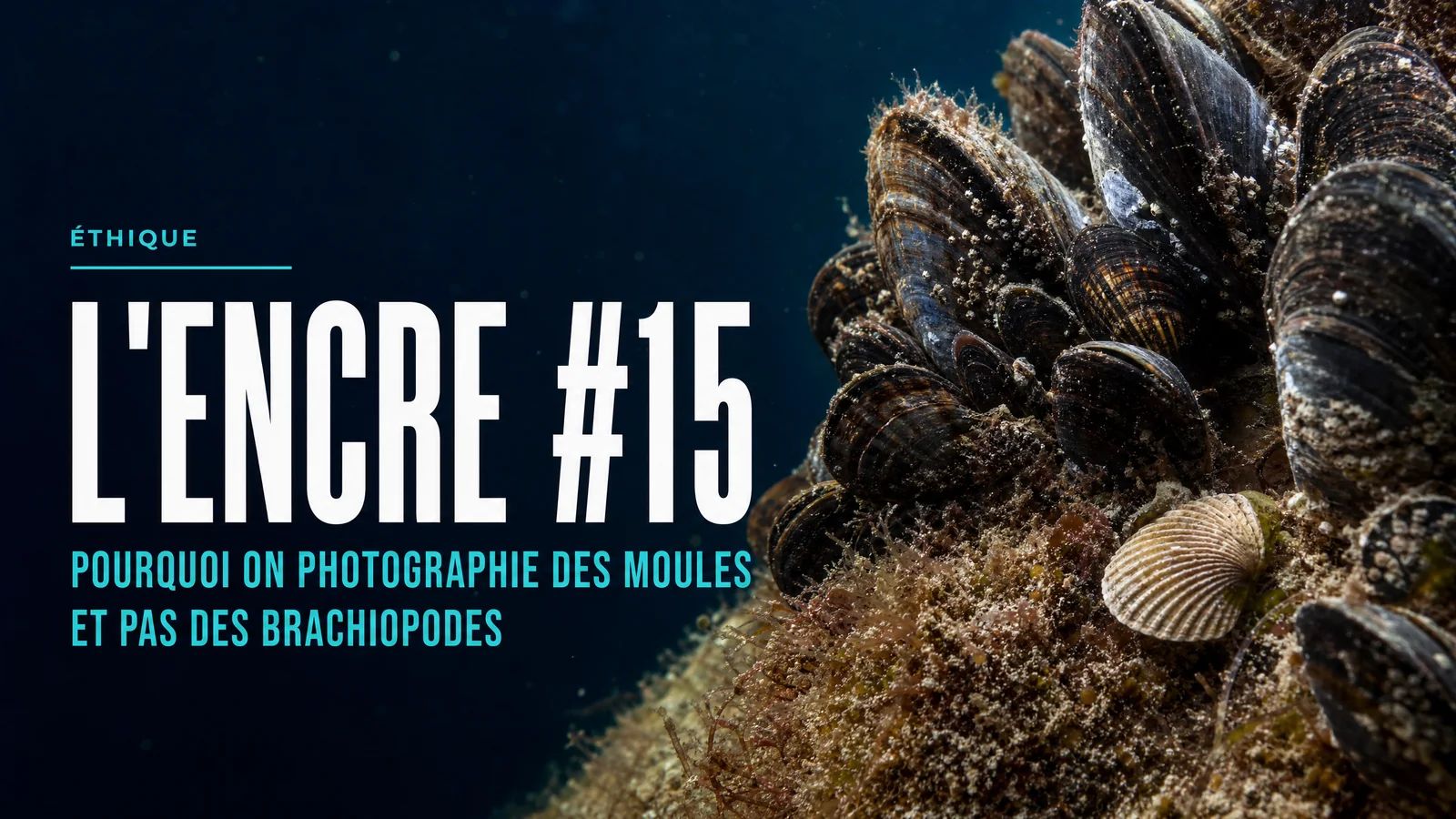
The last time I spent an hour underwater photographing mussels, I did not feel like I was documenting anything exceptional.
Mussels. On a rock. Their blue-black nacre, their way of simply being there without trying to impress.
It turns out I was photographing the winners.
A study published in early July 2026 in the Proceedings of the National Academy of Sciences has just answered a question that sounds obvious the moment you hear it, and that almost no one had thought to articulate clearly.
Jose Andres Marquez, a researcher at Stanford, and his colleagues analysed fossil databases from the Permian and Triassic, the two geological periods separated by the largest mass extinction the Earth has ever known.
Their starting question was simple: why, when you go to the beach today, do you pick up mussel and snail shells rather than brachiopod shells?
The answer, built on combined physiological and palaeontological data, is the most precise produced on the subject to date. And it speaks directly to anyone diving in coastal waters in 2026.
The Great Dying is the mass extinction that took place 252 million years ago, at the Permian-Triassic boundary.
In a relatively short time at geological scale, roughly 96% of marine species disappeared. Coral reefs ceased to exist for ten million years. The seafloors emptied.
The main cause: a series of colossal volcanic eruptions (the Siberian Traps) released a massive quantity of CO2, triggering global warming of 8 to 12°C over several thousand years, accompanied by a collapse in dissolved oxygen in the oceans.
Marquez and his colleagues' study places two groups of animals face to face, which perfectly illustrate what was at stake.
Brachiopods had dominated the seafloor for 280 million years before the Great Dying. They resemble two-shelled mussels, but share no evolutionary link with them. They are slow. They barely move. Their metabolism runs at low speed.
When bottom-water temperatures began to rise and dissolved oxygen fell, brachiopods lacked the physiological resources to compensate. Their tolerance for these conditions had narrow limits.
Nearly every species disappeared.
Molluscs (mussels, oysters, clams, marine snails) held a decisive advantage: a faster, more active metabolism. They could absorb far greater variability in environmental conditions. When the great crisis arrived, they held on.
Millions of species remain today. Of brachiopods, a few hundred.
The contribution of the Stanford team is not to have identified the winners and losers of this extinction (the fossils already showed that). It is to have formalised why, using comparative physiological data. The correlation is clear: groups with the narrowest tolerance for thermal stress and anoxia suffered the highest extinction rates.
This was not chance. It was selection.
Erik Sperling, co-author of the study and professor at Stanford, put this finding into perspective with a precision worth pausing over.
"We are on the trajectory of Permian-Triassic-level warming in the most pessimistic climate projections."
What he means: during the Great Dying, warming was 8 to 12°C over several thousand years. The most unfavourable current projections give 1.5 to 4°C over 100 to 200 years.
The magnitude is smaller. The speed is roughly a thousand times faster.
The same mechanisms (heat plus anoxia) are at work in our oceans today. What the Great Dying took millennia to accomplish, current climate change compresses into a timescale that, at an evolutionary scale, amounts to a snap of the fingers.
This is what I take away from this study, as an underwater photographer.
Every time you photograph a mussel, an oyster, a clam, a sea urchin, what you are documenting is not simply an animal. It is the result of a 252-million-year filter. These forms exist because their ancestors had the right physiological tolerances at the exact moment those tolerances were pushed to the extreme.
The accelerating disappearance of coral reefs follows precisely the same logic: current corals have narrow thermal tolerances, and what Marquez's study reveals is that this narrowness is not a biological footnote. It is a deferred death sentence.
Efforts to develop heat-resistant corals attempt to recreate artificially in a few decades what evolution took hundreds of millions of years to achieve. The problem, brought to light by the PNAS study, is that natural selection operates over thousands of generations.
The slowdown of the AMOC redistributes heat and oxygen throughout Atlantic ocean systems. What the Great Dying demonstrated is that these two variables combined can reshape the entire fabric of marine life. We are compressing that timeframe.
And seagrass meadows, whose ancestors among marine vascular plants also survived major extinctions, play a central role today in regulating dissolved oxygen in coastal zones. That is not a footnote in this context.
Those mussels on their rock, in two metres of water, are not there by chance. They are there because a common ancestor survived the hell of 252 million years ago, and came through the other side.
The next time you photograph them, you will know why they are there. And what it means that we are still here to photograph them.
To develop a genuine eye for what you are photographing underwater, not just how to frame it, the AquaExposure underwater photography course builds precisely this understanding. All resources are available on the AquaExposure course platform.
The Great Dying is the mass extinction that occurred 252 million years ago, at the Permian-Triassic boundary. It eliminated roughly 96% of marine species and 70% of terrestrial species. For divers, it reshaped the seabeds we visit today: brachiopods, which had dominated the seafloor for 280 million years, nearly vanished, and the molluscs (mussels, oysters, snails) that survived became the dominant invertebrates in our modern oceans.
A study published in PNAS in July 2026 by Jose Andres Marquez and his Stanford team provides the most precise answer to date: molluscs had faster, more active metabolisms, allowing them to tolerate warm, oxygen-depleted water far better. Brachiopods, slow and sessile, could not adapt. This difference in physiological tolerance determined which animals would populate the oceans for the next 252 million years.
Erik Sperling, co-author of the study, states it plainly: during the Great Dying, temperatures rose by 8 to 12°C over several thousand years. Current worst-case projections point to 1.5 to 4°C over 100 to 200 years. The magnitude is smaller, but the speed is roughly a thousand times faster. The same mechanisms (warming and anoxia) are at work in our oceans today, at a pace evolution has never had to manage.
Brachiopods are marine invertebrates with two shells that look superficially like mussels, but share no evolutionary relationship with them. They dominated the seafloor for 280 million years before the Great Dying. Today, 300 to 400 living species remain, compared to tens of thousands of fossil species. They have become a relict group. Some can still be found on deep rocky substrates or in cold water, but they are rare and difficult to distinguish from bivalves for an untrained eye.
Previous episodes of The Ink cover the Argentine taxonomy workshop, the Doldrums hydrothermal vents, the third Atlantic manta ray species and the image and the plastic that was already there.
252 million years ago, something decided which shells we would pick up on our beaches today. That something is starting up again. A little faster this time.