The Role of the Underwater Photographer in Ocean Protection: Witness, Not Hunter
The underwater photographer is a witness, not an image hunter. Invisible discipline, reading the living world, engaged storytelling. The 3 pillars of the modern role.
To learn how to get the most out of your gear underwater, discover the AquaExposure training.
One January morning in the Maldives, at dawn, I watched a group of divers descend on a manta ray that was feeding quietly at the surface. Eight people, eight cameras, eight pairs of fins beating the water in every direction. The manta disappeared in under thirty seconds.
Eight photographers. Zero usable photos. And an animal disturbed during its first meal of the day.
The modern role no longer chooses. Video offers increased safety and freedom of interaction, while high-definition extraction allows you to isolate the perfect moment for a still image.
How does AquaExposure guarantee an ethical approach?
By placing marine biology at the centre of every technical module. You don't learn to adjust a camera. You learn to blend into a living scene.
That day, I understood that the question wasn't "how to take better underwater photos", but "what kind of underwater photographer do I want to become".
The first pillar: invisible discipline
Underwater photographic technique, in its most accomplished form, is invisible. It becomes an embedded reflex, like the breathing of an experienced diver. You no longer think about your settings. You no longer search for the button. The camera becomes part of the body, and the body becomes part of the water.
This technical invisibility is the first pillar of the photographer-witness. As long as you're thinking about your shutter speed while facing a whale shark, you're not photographing. You're operating a tool.
The difference seems subtle. It's fundamental.
A musician who thinks about their fingers isn't playing music. A surgeon who thinks about their scalpel isn't operating. A photographer who thinks about their camera isn't photographing. They're taking photos, which is a radically different activity.
Invisible discipline is the moment when technique disappears in favour of attention. And attention, underwater, is everything. It's the ability to notice that the octopus has changed texture three seconds before moving. It's sensing that the turtle is about to rise for air before it begins its ascent. It's reading the current to know where the school of fusiliers will reform.
This discipline isn't acquired in a weekend. It's built dive after dive, image after image, mistake after mistake. But it builds much faster when someone shows you what to observe rather than what to adjust.
The second pillar: reading the living world
There's a reason the AquaExposure training starts with marine biology rather than camera settings. That reason is simple: you only photograph well what you understand.
A coral reef is not a backdrop. It's a network of predator-prey relationships, symbioses, territories, reproductive cycles, survival strategies that interweave on every square centimetre. The photographer who sees only a "pretty colourful fish" misses the essential.
The photographer who recognises a male clownfish ventilating its eggs understands why approaching is wrong. The one who identifies a reef shark in an alert posture (pectorals lowered, jerky swimming) knows it's time to back away. The one who spots the early signs of spawning in a nudibranch knows they have before them a scene that 99% of divers will never notice.
Biology transforms the photographer into an observer. And the observer captures images that the mere technician never will, because they know where to look, when to wait, and why this precise moment matters.
It's also biology that sets the natural ethical boundaries. When you understand the physiological stress your presence causes an animal, the question of flash, distance, and exposure time no longer presents itself in technical terms. It presents itself in terms of respect.
The third pillar: engaged storytelling
An underwater photo without context is a pretty image. An underwater photo with a story is testimony.
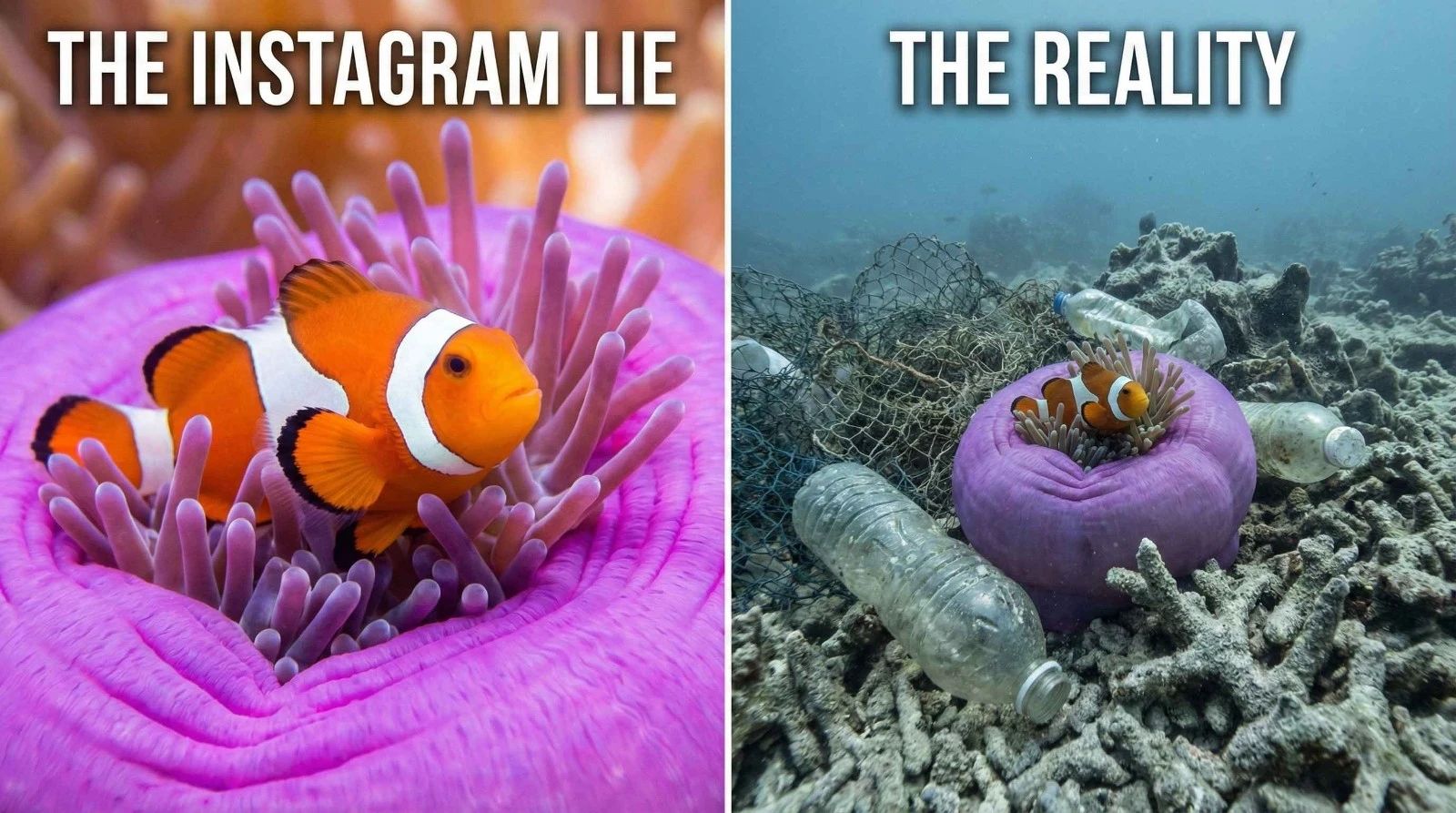
The difference between the two is narrative. Not the Instagram caption (though that matters too). The deep narrative: why this image exists, what it shows about the state of the marine world, what it implies for the person viewing it.
A bleached reef photographed with care is not a statement of failure. It's a document. A manta ray bearing the scars of a ghost fishing net is not a "sad" image. It's evidence. A school of barracuda forming a perfect vortex above a wall is not a "beautiful spectacle". It's proof that this ecosystem still functions.
The engaged underwater photographer doesn't seek beauty. They find it, inevitably, because the ocean is beautiful. But what they seek is the truth of a moment, a place, a species. And that truth, sometimes, is magnificent. Sometimes, it's unsettling. Often, it's both at once.
Engaged storytelling doesn't require becoming a militant. It requires accepting that every published image tells something about the state of the ocean, whether you intend it or not. Better that this something be intentional.
The ultimate power: knowing when to put the camera down
I saved this point for last because it is, by far, the most counterintuitive for a photographer.
The most powerful moment in your underwater practice is not the one where you press the shutter. It's the one where you choose not to.
When a dolphin approaches and you set the camera aside to simply watch. When an octopus camouflages itself before your eyes and you decide this spectacle belongs only to your gaze. When morning light pierces the surface in golden columns and you're there, suspended in the blue, doing nothing but existing in that moment.
This is the photographer-witness paradox: the best testimony is sometimes the one you don't bring back.
Not because you should be precious with your memories. But because the decision not to photograph proves you're there for the right reason. That the encounter takes priority over the capture. That the animal is the subject of your attention, not the subject of your portfolio.
The best underwater photographers I've met over fifteen years all share this trait. They have hard drives full of extraordinary images. And they have dozens of stories about moments they didn't photograph.
Those are the stories that shine brightest.
The choice that remains
Every dive is a choice. Every trigger press is a choice. Every publication is a choice.
The photographer-hunter accumulates images like trophies. The photographer-witness selects them like evidence. The difference isn't always visible in the final result. It's visible in the way you tell the story of the dive that evening, at the centre's bar, when someone asks what you saw.
If your answer starts with "I got an incredible photo of.", you're still a hunter. If it starts with "something magnificent happened.", you're on your way.
The ocean has enough hunters. It needs witnesses who know when to press the shutter, when to wait, and when to put the camera down and simply be there.