AquaExposure
Homepage
Pricing
Menu
Homepage
PricingShopArticles
AquaExposure

Underwater photography excellence, accessible to everyone.

Explore

  • Discover AquaExposure
  • Kai_App
  • Underwater Photo
  • AI Training with SAGE
  • Free Guide
  • All modules
  • Shop
  • Subscriptions
  • Articles
  • Manifest
  • About
  • PDC Simulator
  • Smartphone Housing Comparator
  • Partners
  • Frequently Asked Questions

Diving in Belgium

  • Training from Brussels
  • Training in Belgium
  • Photo in Zealand
  • Careers in Belgium

Stay in touch

Stay informed about our new courses and expeditions.

  • [email protected]
  • Contact
  • New items
  • Support the project
Legal Notices·CGV·Confidentiality·

© 2026 AquaExposure. Ethically preserving the depths.

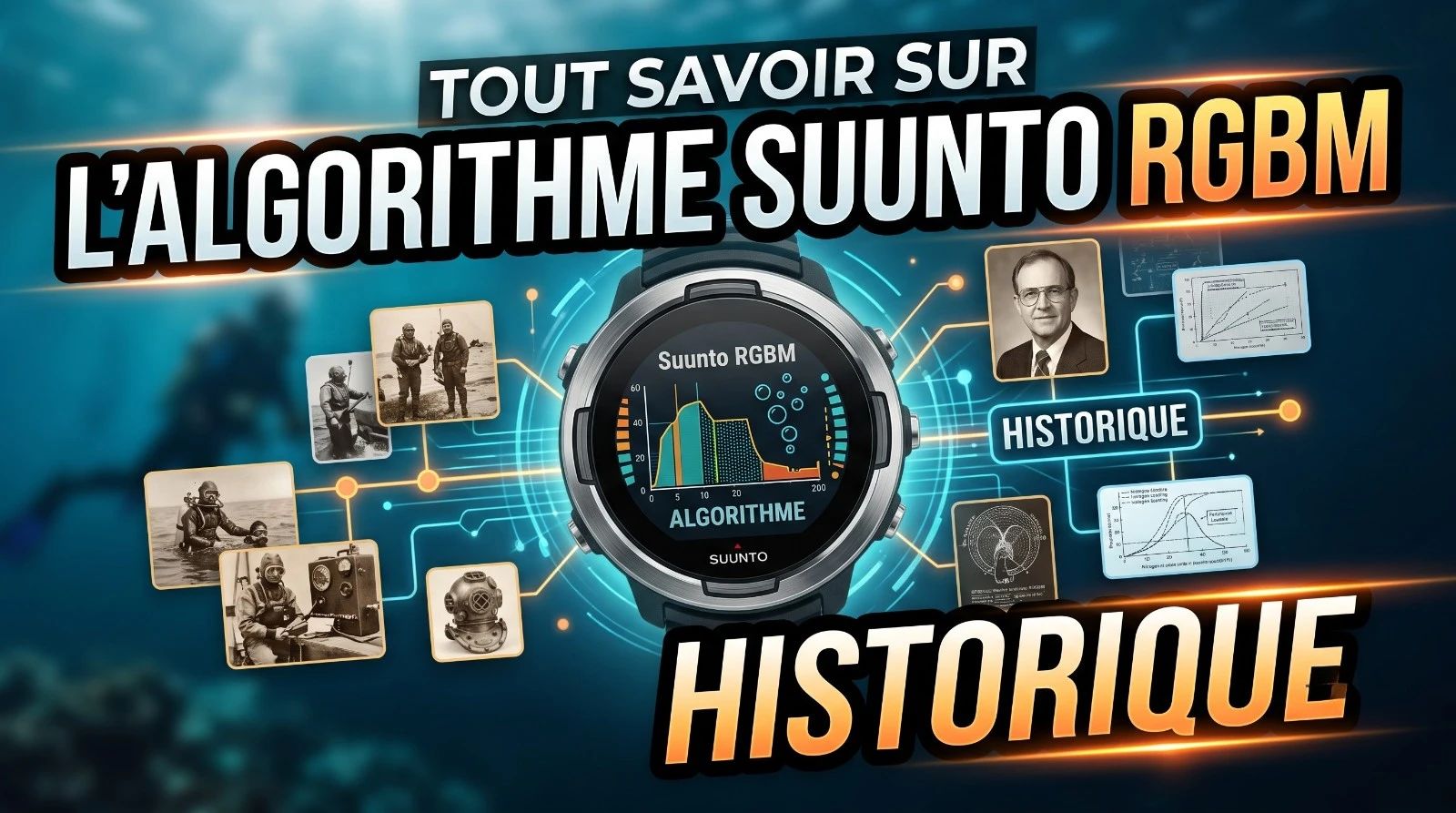
Everything you need to know about the historical Suunto RGBM algorithm- reviews, safety, and settings.
Table of Contents
  • 01Introduction
  • 02Algorithm ProfileThe standard Suunto RGBM algorithm is the result of close collaboration in the 1990s between Suunto engineers and Dr. Bruce Wienke, an American researcher renowned for his work on the bubble model (Reduced Gradient Bubble Model). Suunto adapted this theoretical model to create its own proprietary version, calibrated specifically for recreational divers.
  • 03Ease of Use and Conservative Settings
  • 04Real-time adaptation to diver safety
  • 05Medical Experience and DAN Data
  • 06Strengths and WeaknessesThe main strength is its undeniable passive safety features. It's the ultimate dive computer for divers who want to dive with peace of mind, confident that their device will calculate a decompression schedule with a very large safety margin.
  • 07Field Performance and Behavior in Groups
  • 08ConclusionThe classic Suunto RGBM algorithm remains a reliable safety standard for recreational diving- typically one or two dives per day. While it might be frustrating for intensive divers on liveaboards due to its conservative approach to successive dives, it's still an excellent choice for beginners and those who want to progress safely and confidently. It offers peace of mind.
OUTILS 5 minBenjamin Coste

Everything you need to know about the historical Suunto RGBM algorithm- reviews, safety, and settings.

Complete analysis of the standard Suunto RGBM algorithm- how it works, its conservative approach, "black box" aspects, and instructor reviews.

To learn how to get the most out of your underwater equipment, discover the AquaExposure training program.

Introduction

In the history of diving equipment, certain technologies leave a lasting impression due to their rigor. The historical Suunto RGBM algorithm, which equipped entire generations of Finnish dive computers, undoubtedly belongs to this category. Renowned for its inflexible conservatism and flawless protection, it has ensured the safety of millions of recreational divers while sometimes causing frustration during consecutive dives.

I remember my instructor dives in the cold waters of the North Sea with a student using a Suunto Zoop Novo running this historical Suunto RGBM algorithm. Although we meticulously followed our ascent rate, his computer severely tightened its safety stops after our second consecutive dive, forcing us to wait in the cold long after our fellow divers had surfaced. This dive reminded me of the protective but uncompromising nature of this historical algorithm, designed not to take any risks with the physiology of the diver.

Algorithm ProfileThe standard Suunto RGBM algorithm is the result of close collaboration in the 1990s between Suunto engineers and Dr. Bruce Wienke, an American researcher renowned for his work on the bubble model (Reduced Gradient Bubble Model). Suunto adapted this theoretical model to create its own proprietary version, calibrated specifically for recreational divers.

From a modeling perspective, it is a bubble model- or two-phase model. It simulates both the saturation of dissolved gases in nine theoretical tissue compartments and the physical behavior of circulating microbubbles. It's essentially a "black box" where the exact source code and penalty coefficients remain Suunto's exclusive intellectual property. This algorithm has been used in most of Suunto's classic dive computers, from the entry-level Zoop Novo and Vyper Novo series to the D series (D4i, D6i, D9, DX) and the early generations of EON.

Ease of Use and Conservative Settings

One of the strengths of this algorithm is its ease of use underwater. Suunto designed its menus to prevent divers from having to deal with complex concepts such as the Gradient Factors used in the Bühlmann algorithm.The conservatism settings are configured through very clear personal adjustments, often named P0, P1, and P2 (from standard to most conservative), along with altitude parameters A0, A1, and A2. Simply select your desired safety level in the menus before diving.

The algorithm handles Nitrox and recreational air very well. On models that support it, gas changes underwater during ascent are performed through intuitive button controls, with the processor instantly recalculating the total ascent time automatically.

Real-time adaptation to diver safety

The classic Suunto RGBM is a purely mathematical model that does not take into account direct biometric data in real time, such as the diver's heart rate or breathing effort. However, it closely monitors your diving behavior. If the computer detects a rapid ascent, "yo-yo" dives, or an excessively short surface interval between successive dives, the algorithm immediately applies severe penalties, reducing the no-decompression limit (NDL) or adding mandatory decompression stops.The model also incorporates deep stops- ranging from one to two minutes- at mid-depth, designed to limit the expansion of venous bubbles before the final ascent. On recent models equipped with this feature, divers have the option to disable these deep stops in the menus, retaining only the standard safety stop of three minutes at five meters.

Medical Experience and DAN Data

Statistical data from DAN confirms that computers equipped with the Suunto RGBM algorithm exhibit an extremely low rate of decompression accidents. This exceptional level of safety stems from the inherently conservative nature of the algorithm, which effectively protects recreational divers against profile errors or physical fatigue.

However, modern medical consensus has distanced itself from the philosophy of mandatory deep stops for decompression diving. Studies by the Navy Experimental Diving Unit (NEDU) have shown that stopping too deep continues to saturate slow tissues with nitrogen, increasing the overall risk of desaturation. Aware of these developments, Suunto gradually evolved its models towards the Fused RGBM 2 before adopting the Bühlmann model with Gradient Factors on its latest generation devices.

Strengths and WeaknessesThe main strength is its undeniable passive safety features. It's the ultimate dive computer for divers who want to dive with peace of mind, confident that their device will calculate a decompression schedule with a very large safety margin.

The major weakness is its excessive conservatism during successive or intensive dives, such as those on liveaboards. Doing three dives per day with this model can quickly become restrictive, as the device drastically reduces bottom times compared to divers using computers from other brands.

Field Performance and Behavior in Groups

In the field, a diver equipped with the standard Suunto RGBM will almost always be the "pace-setter" of the group. They will often be the first to start their ascent and perform the longest decompression stops, forcing their dive buddies who are using more permissive algorithms to follow their decompression profile.

To compare this classic Suunto model with newer technologies, we suggest using our AquaExposure dive computer comparison tool to evaluate the differences in scores and features.

ConclusionThe classic Suunto RGBM algorithm remains a reliable safety standard for recreational diving- typically one or two dives per day. While it might be frustrating for intensive divers on liveaboards due to its conservative approach to successive dives, it's still an excellent choice for beginners and those who want to progress safely and confidently. It offers peace of mind.

Share

/blog/understanding-suunto-rgbm-decompression-algorithm

Table of Contents

  • 01Introduction
  • 02Algorithm ProfileThe standard Suunto RGBM algorithm is the result of close collaboration in the 1990s between Suunto engineers and Dr. Bruce Wienke, an American researcher renowned for his work on the bubble model (Reduced Gradient Bubble Model). Suunto adapted this theoretical model to create its own proprietary version, calibrated specifically for recreational divers.
  • 03Ease of Use and Conservative Settings
  • 04Real-time adaptation to diver safety
  • 05Medical Experience and DAN Data
  • 06Strengths and WeaknessesThe main strength is its undeniable passive safety features. It's the ultimate dive computer for divers who want to dive with peace of mind, confident that their device will calculate a decompression schedule with a very large safety margin.
  • 07Field Performance and Behavior in Groups
  • 08ConclusionThe classic Suunto RGBM algorithm remains a reliable safety standard for recreational diving- typically one or two dives per day. While it might be frustrating for intensive divers on liveaboards due to its conservative approach to successive dives, it's still an excellent choice for beginners and those who want to progress safely and confidently. It offers peace of mind.

Questions about the Journal

What is the historical Suunto RGBM algorithm?

It is a proprietary and closed-source adaptation of Dr. Bruce Wienke's bubble model, specifically calibrated for older Suunto dive computers.

Why is this algorithm considered so restrictive?

Because it incorporates a significant memory of residual microbubbles. In cases of successive dives or slight variations in ascent rates, this can significantly increase the duration of safety stops and reduce bottom time without decompression obligations.

Can deep stops be disabled on the Suunto RGBM?

On most standard models that use this chip, deep stops can be disabled in the menu settings. This allows you to use a conventional safety stop at 3 meters instead.

Articles in the same category

Everything you need to know about the VPM-B algorithm: Reviews, safety, and settings.

Everything you need to know about the VPM-B algorithm: Reviews, safety, and settings.

Everything you need to know about the Pelagic Z+ algorithm- reviews, safety, and settings.

Everything you need to know about the Pelagic Z+ algorithm- reviews, safety, and settings.

Everything you need to know about the classic RGBM algorithm- reviews, safety, and settings.

Everything you need to know about the classic RGBM algorithm- reviews, safety, and settings.