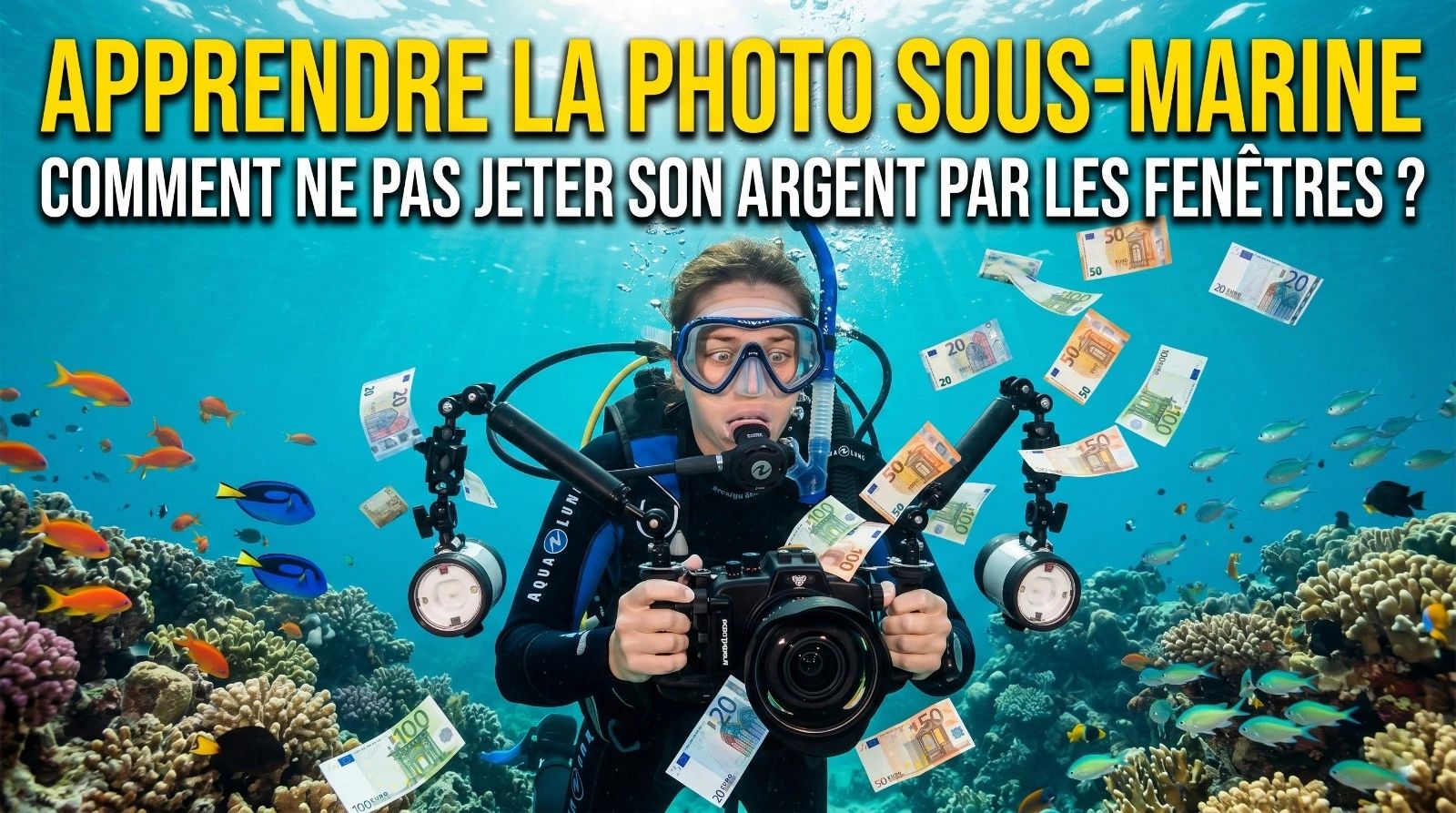
Underwater photography budget: How much does it really cost to get started
GoPro, Insta360, iPhone + Divevolk, Olympus TG-7: The realistic budget for starting underwater photography and video, from 500 to 1800 euros, without flash or unnecessary marketing.
Underwater photography budget: How much does it really cost to get started
Can you really take good images with a smartphone underwater?
Yes. The Underwater Photographer of the Year (UPY) 2026 competition awarded images taken with an iPhone in a Divevolk housing. The proof is in the results, not in the price of the equipment.
Should you buy underwater photography gear new or refurbished?
For action cameras (GoPro, Insta360), certified refurbished saves 30 to 40%. For the housing, prefer new to guarantee seal integrity and waterproofing. For the iPhone, Apple refurbished is perfectly reliable.
Why not recommend housings for DSLR or mirrorless cameras?
Because for 95% of amateur and intermediate divers, a light and simple setup produces better results than a heavy and complex one. Lightness improves stability, reduces air consumption, makes it easier to approach animals, and lets you focus on composition.
How to choose between the four recommended setups?
GoPro Hero 9 for simple and reliable video (505 euros). Insta360 Ace Pro 2 for dynamic video with AI assistance (780 euros). iPhone plus Divevolk for maximum versatility with RAW photo and ProRes video (1,810 euros). Olympus TG-6 or TG-7 for macro and detail photography (1,145 euros).
A few years ago, on a cruise ship in the Maldives, a diver showed me his brand new setup. A full-frame camera body, a Nauticam housing, two side strobes, and a carbon articulated arm. He had spent over 12,000 euros before his first photo dive.
That evening, he showed me his photos. They were blue, blurry, and the animals were never in the frame. Next to him, a diver with an iPhone in a 220-euro case had brought back manta ray footage with such stability and proximity that we were all speechless.
This is not a fable. This is the reality of this world.
What the forums don't tell you
Most of the budget guides you'll find online are written by people who sell equipment or are sponsored by brands. They start with "entry-level" equipment at 2,000 euros and end by telling you that images taken with equipment costing less than 8,000 euros will not be "serious".
That's not true. And it's a trap that discourages hundreds of divers every year.
The truth is that three-quarters of what makes a good underwater image has nothing to do with the price of the sensor. Light is understood, composition is learned, and the approach of an animal is practiced. These skills are worth infinitely more than a 5,000 euro camera held by someone who doesn't know how to use it.
The AquaExposure approach: between 500 and 1,800 euros
At AquaExposure, we don't recommend equipment that we haven't personally used in real-world conditions. And we also don't recommend inaccessible equipment.
We work with four types of configurations: action cameras such as the GoPro Hero 9, smart cameras such as the Insta360 Ace Pro 2, waterproof smartphones (iPhone + Divevolk), and specialized macro compacts such as the Olympus TG-7. Each has its strengths, its limitations, and a specific use case.
The common thread among these four approaches: they cost between 500 and 1,800 euros as a complete kit ready for diving, they are lightweight and easy to use, and they produce results that speak for themselves.
The details of each configuration (exact models, recommended kits, prices observed in Europe, field advice) are available free of charge in Module 2 of the AquaExposure training. This module is open to everyone, without any paid registration. If your main question is about equipment budget, you will find the most complete answers there.
The classic approach: 5,000 to 25,000 euros
To be transparent, here is what most online guides and specialized forums recommend.
A full-frame hybrid camera (Sony A7 IV, Canon R6 Mark II, Nikon Z6 III) between 2,200 and 3,000 euros. A Nauticam, Subal, or Aquatica underwater housing between 2,500 and 7,000 euros. Two to four lenses with ports between 600 and 5,000 euros. Underwater strobes between 800 and 2,000 euros. Total equipment: 6,000 to 17,000 euros, excluding training and dives.
This is high-quality equipment, and it has its place among professionals who deliver images for magazines or marketing campaigns. But for 95% of amateur and intermediate divers, it is a disproportionate investment compared to what they will actually get out of it.
A lightweight and simple setup produces better results than a heavy and complex setup when the person holding it does not yet have the skills to use it. Lightness improves stability, reduces air consumption, makes it easier to approach animals, and allows you to focus on composition rather than managing the equipment.
Our recommendations, whatever your budget
Whatever configuration you choose, here is what we recommend at AquaExposure.
Work in natural light. Underwater strobes, video lights, and snoots are not part of our recommendations for beginners and intermediate photographers. Poorly managed artificial light causes reflections, saturates colors, and above all stresses the animals. A diver arriving on a reef with two strobes blazing is the equivalent of a spotlight interrogation for every creature that passes in front of them. The resulting image is technically lit, but it tells no true story.
At AquaExposure, the hierarchy is clear: safety, ethics, aesthetics, technique. In this order, always. A safety dive light, yes, it is essential. A strobe for "getting more colors", no.
Avoid red or orange filters. They darken the image at depth, do not adapt to changes in light, interfere with autofocus, and often require additional editing. Manual white balance works better in all situations. It is one of the first techniques we teach in the training.
Dive between 10am and 2pm when the light is most vertical. Stay close to the subject (50 to 80 centimeters) to preserve natural colors. Make gentle corrections in post-production using LUTs or software like Lightroom or DaVinci Resolve.
There are situations where artificial lighting is justified (night diving, macro in caves, deep wrecks), but these are specific cases that will come later in your progression.
What the equipment doesn't cover
The equipment is the visible part of the budget. It is rarely the most important part.
Diving training first. An Open Water, an Advanced, a Nitrox: expect 800 to 1,500 euros in certifications. Without these skills, you won't dive in conditions where the images become interesting, and above all you won't dive safely.
Training dives next. You need at least a hundred dives to build the reflexes for stability, buoyancy, and framing that transform a correct image into a remarkable one. In a local club or quarry, expect 20 to 30 euros per dive.
Post-production software. Lightroom, DaVinci Resolve, GoPro Quik, or the Insta360 app depending on your setup. Some options are free, others cost 12 to 60 euros per month.
Equipment maintenance. O-rings to check before each dive, anti-fog inserts to replace, systematic rinsing with fresh water after every sea outing. This is not a major expense, but it is a discipline that protects everything else.
Where not to cut corners
The underwater housing, first. A housing that leaks at 20 meters means a lost device and irreplaceable lost images. Get the official manufacturer housing or a recognized brand. This is not the item to look for a bargain on.
Training, next. Not just diving training, but underwater photography training. I've met divers with equipment worth thousands of euros who had never learned how to frame underwater, how to manage their buoyancy with a camera in hand, or how to approach an animal without scaring it away. Their images showed it. Their behavior underwater showed it too.
Memory cards, finally. A card that fails during a dive is an entire dive lost. Get recognized brand cards and carry several rather than one large one.
What can wait
All the "advanced" equipment can wait until your practice justifies it. Articulated arms, additional macro lenses, color filters, stabilizing grips. The rule I apply with the photographers I work with: don't invest in the next level until you've used 80% of what the current level offers.
A diver who masters their GoPro in natural light will produce better images than a diver who just bought an 8,000 euro setup without knowing how to hold it steady at 15 meters.
FAQ
Can you really take good pictures with a smartphone underwater?
Yes. The Underwater Photographer of the Year (UPY) 2026 competition awarded images taken with a smartphone in a waterproof housing. The proof is in the results, not in the price of the equipment.
Should I buy new or refurbished?
For action cameras, certified refurbished is an excellent option that saves 30 to 40%. For the housing, I recommend buying new to guarantee the integrity of the seals and watertightness.
How to choose between the four types of configurations?
It depends on what you want to do: video, photo, macro, or versatility. AquaExposure training details each configuration with its use cases, strengths, and limitations. It is free and accessible to everyone.