What is the best device to start underwater videography?
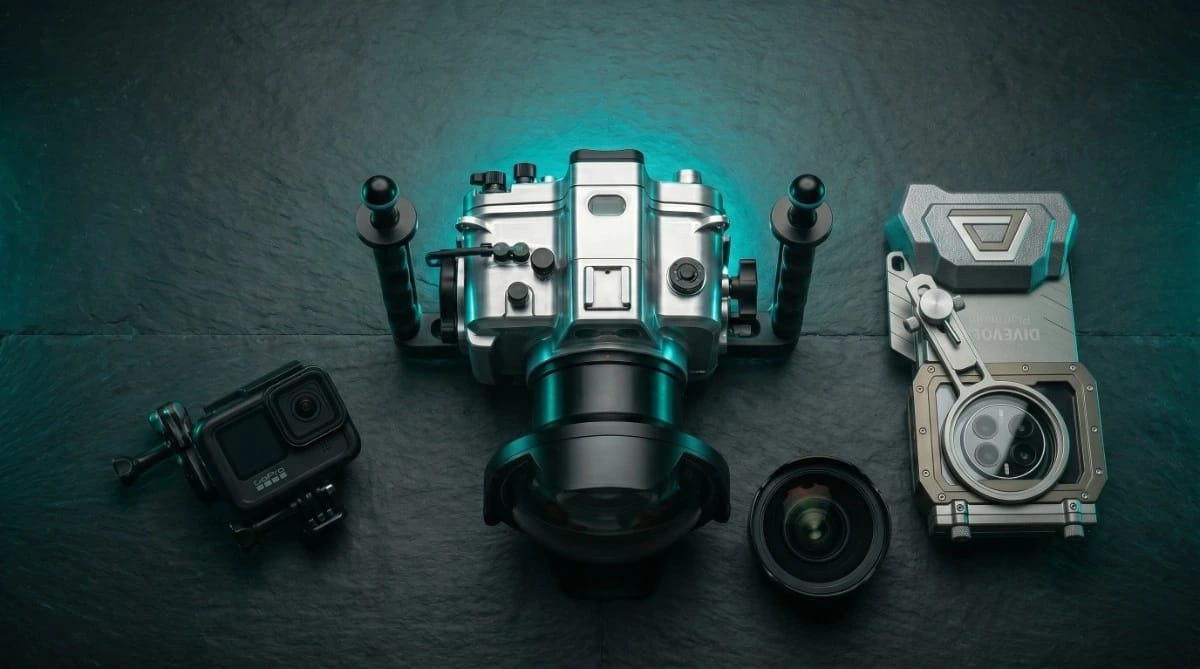
A recent smartphone in a Divevolk housing or a GoPro Hero are the two best entry points. They shoot in 4K, offer decent electronic stabilization, and weigh almost nothing in your bag. The choice between the two depends on what you already own.
Should I use a GoPro or a smartphone to film underwater?
The GoPro is more rugged and simpler to use underwater. The smartphone offers a larger screen for framing and more versatility above water. If you dive regularly, the GoPro is more practical. If you dive on vacation, the smartphone saves you an extra purchase.
When should I switch to a mirrorless camera in a housing for underwater video?
When you have mastered body stabilization, when you systematically shoot in a Flat profile, when you do color correction in post-production, and when your current camera limits your creativity. If any of these criteria is missing, the upgrade is premature.
Is the GoPro Mission 1 good for underwater video?
Yes. The GoPro Mission 1 is a real step forward for underwater video with its new sensor, GP-Log profile and improved stabilization. Its native wide angle is ideal for reef scenes and megafauna. It remains limited in macro and deep low-light conditions.
How much does an underwater video setup cost?
Level 1 (smartphone + housing or GoPro): 300 to 500 euros. Level 2 (advanced action cam like Insta360 X5 or DJI Action 6): 400 to 700 euros. Level 3 (mirrorless + housing): 2000 to 5000 euros. Level 1 is enough to produce quality content if your technique is solid.
Do I need video lighting underwater?
In natural light between 0 and 15 meters, no. A video torch becomes useful at depth, in macro or in dark conditions. Start without additional lighting and add it when you know exactly what you are missing. Buying a torch before mastering stabilization is putting the cart before the horse.
To learn how to get the most out of your gear underwater, discover the AquaExposure training.
The best underwater video setup is not the most expensive one, it is the one that matches your level of technical skill. A smartphone in a waterproof housing, in the hands of someone who controls their buoyancy and films in natural light, will produce better footage than a poorly stabilized full-frame mirrorless at 30 meters. This guide ranks gear by competence, not by budget.
The AquaExposure philosophy: light rather than bulky
Before talking about gear, let's recall the principle. In underwater video, just like in photography, the lightest and most compact equipment has a decisive advantage: it leaves you attention for everything else. Buoyancy, safety, animal approach, framing. Everything that makes the difference between a forgettable clip and a sequence that tells a story.
Every extra gram of equipment is one less gram of attention. This is not a metaphor. It is measurable task loading.
Level 1: smartphone in a housing or GoPro
Who this is for
You are starting out in underwater video. You may already have some experience in underwater photography and want to try video without a heavy investment. Or you are heading on a dive trip and want to bring back quality footage.
The smartphone in a housing
An iPhone 15 Pro or Samsung Galaxy S24 Ultra in a Divevolk housing shoots 4K at 60 fps with combined optical and electronic stabilization. The large screen makes framing easier, which is a real advantage when filming through a mask.
The ProRes video profile (iPhone) or Expert RAW video mode (Samsung) provide an acceptable color correction latitude. Not on the level of a true Log profile, but enough to recover colors between 0 and 15 meters.
The limitations: the sensor is small, which translates to digital noise at depth or in dark water. The lens is fixed (no macro, no true wide angle). And shooting duration is limited by battery life and phone overheating.
The GoPro
The GoPro Mission 1 was built for the water. Its GP-Log profile, HyperSmooth stabilization and native wide angle make it a formidable tool for underwater video. It slips into a BCD pocket and adds nothing to your buoyancy.
The wide angle is an advantage in video: it reduces the effect of micro-shakes and lets you capture wide scenes (reefs, schools of fish, megafauna passes) without the impossible step-back that water denies you.
The limitations: the small rear screen makes framing approximate. No artistic depth of field (everything is sharp from 30 cm to infinity). Macro is impossible without an add-on lens.
Estimated budget
Smartphone + Divevolk housing: 250 to 400 euros (you already own the phone). GoPro Mission 1 + protective filter: 400 to 500 euros.
AquaExposure does not receive any affiliate commission on gear recommendations.
Level 2: advanced action cam
Who this is for
You have been filming for a few months. You know how to stabilize your body during a 10-second shot. You are starting to color-correct in post-production. You want more creative flexibility without going semi-pro.
Insta360 X5
The 360 camera that changed underwater video. The Insta360 X5 films at 360 degrees, which means you choose the framing in post-production. Underwater, where framing is often a compromise, this freedom is a major change.
The "invisible selfie stick" mode removes the pole from the image, giving the impression that the camera floats on its own. Follow shots of turtles or rays with this technique are spectacular.
Limitations: the resolution per viewing angle is lower than a conventional camera (the sensor covers 360 degrees, so each portion is less detailed). The Log profile is decent without being exceptional. And the dedicated waterproof housing is mandatory beyond 10 meters.
DJI Osmo Action 6
The DJI Action 6 sits between the GoPro and the mirrorless. Its square sensor allows native 9:16 filming (vertical for Reels and TikTok) without resolution loss, which is a real advantage for social media content.
The D-Log M profile offers good correction latitude. RockSteady stabilization is effective. The front screen lets you film yourself for surface intros and outros.
Estimated budget
Insta360 X5 + dive housing: 600 to 800 euros. DJI Osmo Action 6 + housing: 400 to 600 euros.
Level 3: mirrorless in a housing
Who this is for
You film regularly. Your stabilization is impeccable. You work in a Log profile and systematically color-correct in DaVinci Resolve. You know exactly why your current camera limits you and what you will gain from a larger sensor.
This level is not a question of budget. It is a question of technical maturity. If you cannot explain why 10-bit 4:2:2 would be useful to you, you do not need it.
The options
Sony A6700: the versatile choice. APS-C sensor, S-Log3, 4K 120fps, excellent autofocus. The Nauticam or Ikelite housing gives access to essential video controls. This is the camera that covers the most situations in underwater video.
Olympus OM-5: compact and weather-sealed. The Micro 4/3 sensor is smaller but the dedicated lenses (8mm fisheye, 60mm macro) are excellent. The housing is more affordable than Full Frame systems. A good choice if you also shoot macro photography.
Canon R50: Canon's entry-level mirrorless with an APS-C sensor. Limited in framerate (no 4K 60fps) but Dual Pixel autofocus and the C-Log profile offer good value for starting out with a mirrorless underwater.
What changes
Total control. You choose your lens (wide angle or macro), your color profile, your aspect ratio, your bitrate. You shoot in 10-bit, which gives unmatched color correction latitude.
But also: a housing that adds 2 to 3 kg, a setup that requires 15 minutes of preparation, a risk of flooding if an O-ring fails, and a budget that starts at 2000 euros for the body alone (without housing, without lens, without port).
Estimated budget
Mirrorless + housing + port + one lens: 3000 to 6000 euros depending on brand and system.
The forgotten factor: body stabilization
Regardless of gear level, the limiting factor in underwater video is always the same: your body. A motorized stabilizer will never replace mastered buoyancy. The exercises for stabilization without a motorized stabilizer are the best investment you can make, and they are free.
Before upgrading, ask yourself: "Is my last clip shaky because my camera is not good enough, or because I am not stable enough?" The honest answer avoids many unnecessary purchases.
The summary table
Level 1 (smartphone/GoPro): you film for fun, for memories, for your first Reels. You are learning the fundamentals of underwater video. This is the level where 80% of divers should stay, and it is enough to produce content that impresses.
Level 2 (advanced action cam): you film regularly, you have a post-production workflow, you are developing a style. The Log profile and creative flexibility (360, native vertical format) open new possibilities.
Level 3 (mirrorless in a housing): you know exactly what you want and why your current gear cannot deliver it. You are ready to accept the logistical complexity and cost of a professional system.
The natural progression is to stay at each level long enough to truly master it. Not 2 dives. Not 10. Several dozen, to the point where settings become automatic and the gear disappears to let the subject take over.
The AquaExposure training supports you at every level, with exercises adapted to your setup, from GoPro to mirrorless housing.
Underwater video gear: which setup for which skill level | AquaExposure