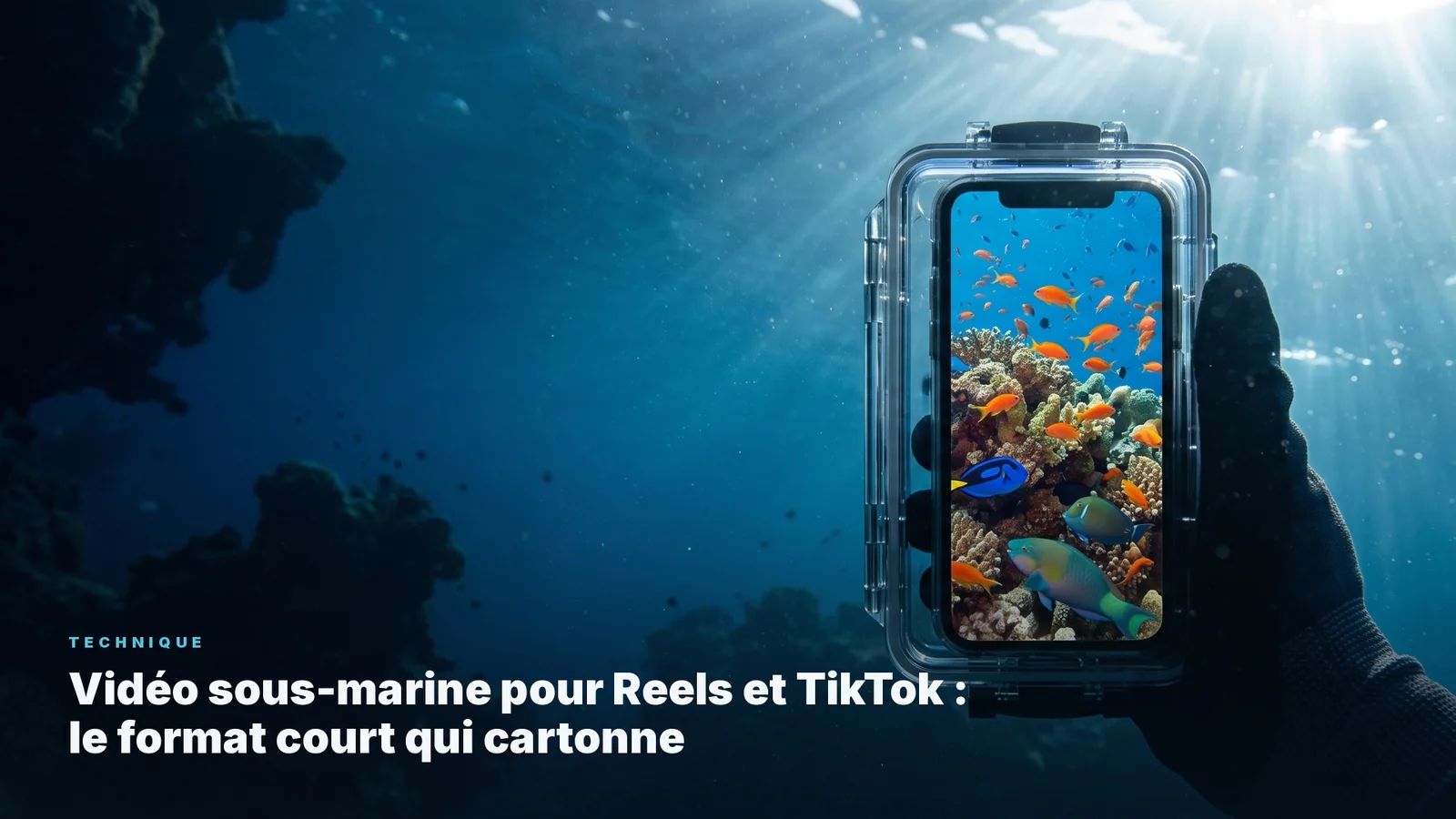
Do I need to shoot in vertical underwater for Reels?
Not necessarily. You can shoot in horizontal and crop in post-production, but you lose resolution. The best approach is to shoot directly in 9:16 if your camera supports it (DJI Action 6, Insta360) or to shoot in 4K horizontal and crop to 1080x1920, keeping the subject centered.
What is the ideal duration for a diving Reel?
Between 15 and 45 seconds for Instagram Reels, up to 60 seconds for TikTok. Algorithms favor videos watched all the way through. A 20-second Reel viewed in full outperforms a 90-second Reel abandoned halfway.
How do you hook the viewer in the first 3 seconds?
Open with your strongest visual shot. Not the water entry, not the descent, not the boat. The animal encounter, the beam of light, the spectacular movement. If your best shot is at second 15, put it at the opening.
Should you add text to diving videos?
Yes, almost always. 85% of Instagram users watch videos with the sound off. Text overlay replaces narration and adds context the image alone cannot provide (species name, depth, location, anecdote). Keep the text short and readable within 2 seconds.
Which format should you choose between Reels and TikTok for diving?
Both work. Instagram Reels reaches a broader and more international audience across age groups. TikTok reaches a younger audience and favors discovery. The best strategy is to publish the same content on both platforms, adapting the hashtags and description.
Does music matter on diving Reels?
It is critical. The music choice accounts for 50% of the emotional impact. Use trending sounds from the platform for discoverability, or ambient music for emotion. Avoid copyrighted music that will get your content blocked or demonetized.
How do you create transitions underwater for Reels?
The most effective underwater transitions are natural ones. Pass your hand in front of the lens, dive toward the bottom and cut to black, follow a fish leaving the frame and cut to a new shot. Avoid artificial transitions that break the immersion.
To learn how to get the most out of your gear underwater, discover the AquaExposure training.
Vertical short-form content dominates social media, and diving is one of the most engaging subjects on Instagram Reels and TikTok. But shooting in 9:16 underwater changes everything: vertical framing reverses the habits of the diver-videographer, the first 3 seconds decide it all, and editing follows different rules than classic documentary. This guide covers the specific techniques for creating short-form diving content that captures attention.
Vertical format underwater: shifting your perspective
Underwater, we naturally frame in horizontal. The reef stretches from left to right, schools of fish move laterally, light comes from above and spreads across the full width. The 16:9 horizontal format is the diver's natural instinct.
The 9:16 vertical format flips everything. And that is exactly what makes it powerful.
Vertical highlights what horizontal flattens: depth. A wall filmed in vertical shows its full verticality. A descent toward the bottom gains dramatic impact. A diver ascending toward the surface and the light creates a natural composition that works perfectly in vertical.
Vertical underwater subjects are more numerous than you might think: the water column itself, sea fans reaching toward the light, wreck anchors, column corals, rays seen from below rising toward the surface, diver silhouettes in sunbeams.
How to frame in 9:16 underwater
If your camera shoots natively in vertical (/blog/DJI Action 6 with its square sensor, or Insta360 in reframe mode), use that mode directly. You keep full resolution.
If you shoot with a GoPro or a smartphone in horizontal, shoot in 4K and crop to 1080x1920 in post-production. You lose resolution but keep the flexibility to choose your framing afterward. The condition: keep your subject centered in the horizontal frame so you can crop without cutting it off.
The third option: shooting with the camera held vertically. Simple, effective, but less stable (the grip changes) and you lose the ability to use the same footage in horizontal for YouTube.
The first 3 seconds: everything is decided there
The Instagram and TikTok algorithm measures "watch time," how long the viewer stays on your video before scrolling. If you lose the viewer in the first 3 seconds, the rest does not exist.
The visual hook
Open with your strongest shot. Not the water entry. Not the descent along the mooring line. Not the dive guide briefing. Those shots are interesting to you, not to a stranger scrolling at 2 AM.
The hook is the moment when the viewer thinks "wait, what is that?":
The turtle looking straight into the lens. The shark emerging from the blue. Sunbeams piercing the surface like a cathedral. A fluorescent nudibranch in close-up. A swirling school of barracudas.
If your best shot is at minute 3 of your dive, put it at second 1 of your Reel. The chronology of the dive does not matter in short-form content. Only impact matters.
The text hook
Add text from the very first second. Not a descriptive title ("My dive in Komodo"). Text that creates curiosity or emotion:
"This shark followed me for 3 minutes" "The weirdest thing I saw at 30 meters" "Why this shrimp cleans inside the grouper's mouth" "20 meters deep. No more red. Watch what color correction can do"
Text gives a reason to stay. The image gives the desire to watch. Together they are stronger than either one alone.
The structure of an effective diving Reel
15-30 second format (highest performing)
Seconds 1-3: Visual hook + text hook. Your strongest shot. Seconds 4-10: Development. 2-3 shots that build the story or show the context. Seconds 11-20: The payoff. The full animal behavior, the reveal, the color correction before/after, the emotional moment. Seconds 21-30: The conclusion. A wide shot for context, a CTA text ("Follow for more diving"), or a loop back to the opening shot.
30-60 second format (mini-story)
This format allows real storytelling. The classic structure works:
Hook (3s): the highlight moment as a preview. Setup (10s): where, when, what. Text overlay for context. Tension (15s): the approach, the wait, the search. Climax (10s): the encounter, the behavior, the reveal. Resolution (10s): pulling back, the emotion, the message.
Text overlay: replacing narration
85% of users watch Reels without sound. Text overlay is not optional, it is your voice.
What works
Short informative text: "Nurse shark, 12 meters, Maldives." Gives the context the image does not provide.
Narrative text: "It looked at me for 10 seconds. I didn't move." Creates emotion and connection.
Educational text: "This shrimp cleans the grouper's parasites. A symbiotic exchange millions of years old." Turns a clip into valuable content that gets saved and shared.
What does not work
Text blocks that are too long. If the viewer cannot read it in 2 seconds, it is too much.
Text that describes what is already visible. "A fish swims" over a shot of a fish swimming adds nothing.
Text in a font too small or poorly contrasted. Underwater, the background is often a uniform blue. White text with a drop shadow works almost every time.
Natural transitions underwater
Artificial transitions (wipe, zoom, glitch) break the immersion of a dive clip. The best transitions are the ones the water provides naturally.
Hand over the lens. Pass your hand in front of the camera, cut when the image is fully covered. Follow with a shot where the hand pulls away. Invisible, natural transition.
The fade to blue. A shot that pulls away from the subject into the blue of the water column. Cut on the uniform blue. Follow with a shot that emerges from the blue toward a new subject. The blue acts as a fade.
The subject leaving the frame. A fish exits screen right. Cut. A new subject enters from the left. The movement creates continuity.
The diver passing by. Your buddy passes in front of the camera. Cut at the moment they block the image. New shot from the other side.
Audio: music and trending sounds
Sound accounts for 50% of a Reel's impact. Your camera's microphone inside a housing captures unusable noise (bubbles, plastic vibrations, boat engine). The soundtrack will always be added in post-production.
Trending sounds
Instagram and TikTok favor videos that use "trending" sounds. Using a popular sound increases your content's discoverability. The downside: the sound may feel out of place for your clip's atmosphere.
Ambient music
For higher-quality, timeless content, choose royalty-free music that serves the emotion. Platforms like Artlist and Epidemic Sound offer subscriptions with social media licensing included.
Strategic silence
Do not underestimate silence. A strong shot without music, just with underwater ambient sound (bubbles, snapping shrimp clicks), creates a powerful contrast after a musical sequence.
Mistakes that kill engagement
Black bars. A horizontal clip posted in vertical with black bars at the top and bottom is the visual signal of "content not optimized." The algorithm penalizes it and the viewer scrolls.
The slow start. "Hello, welcome to my diving video in Egypt, today we're going to." The viewer is gone since "hello." Short-form content has no introduction.
Too many cuts, too fast. Frantic editing (0.5-second shots) tires the viewer and prevents immersion. Water demands slowness. Shots of 2-4 seconds let the viewer "enter" the scene.
Copyrighted music. Using the latest hit without a license gets your video blocked or muted. Invisible to you, catastrophic for engagement.
Forgetting the CTA. A Reel without a call-to-action is a missed opportunity. "Follow for more diving," "Save this technique," "What's your favorite marine animal?" as final text or in the description.
The production workflow
During the dive
Shoot with short-form content in mind. That means:
Looking for highlight moments rather than ambient shots. Short-form lives on moments, not contemplation.
Varying angles on the same subject. A wide shot, a close-up, a moving shot. Three 5-second clips of the same subject make a complete Reel.
Filming details. A fish's eyes, the tentacles of an anemone, bubbles rising. Close-up details are spectacular in vertical format.
In the edit
The tool does not need to be sophisticated. CapCut (free, mobile) handles 90% of the work for Reels: trimming, text, transitions, music, 9:16 export.
For a more advanced workflow, DaVinci Resolve lets you color correct and then export in 9:16. The vertical timeline in Resolve requires initial setup but then offers full control.
Export
Instagram Reels: 1080x1920, H.264, 30 fps, 10-15 Mbps bitrate. The optimized export for each platform is covered in detail in a dedicated article.
TikTok: same specs, but TikTok compresses more aggressively. Upload the highest quality possible to compensate.
Next step
Short-form is a muscle. The more you produce, the better you get at spotting "Reel-worthy" moments during your dives. Start with one Reel per dive. Then one per travel day. The rhythm builds naturally.
The AquaExposure training includes a dedicated module on underwater social media content, with editing exercises and personalized feedback on your Reels.
Underwater Video for Reels and TikTok: Short-Form Content That Performs | AquaExposure