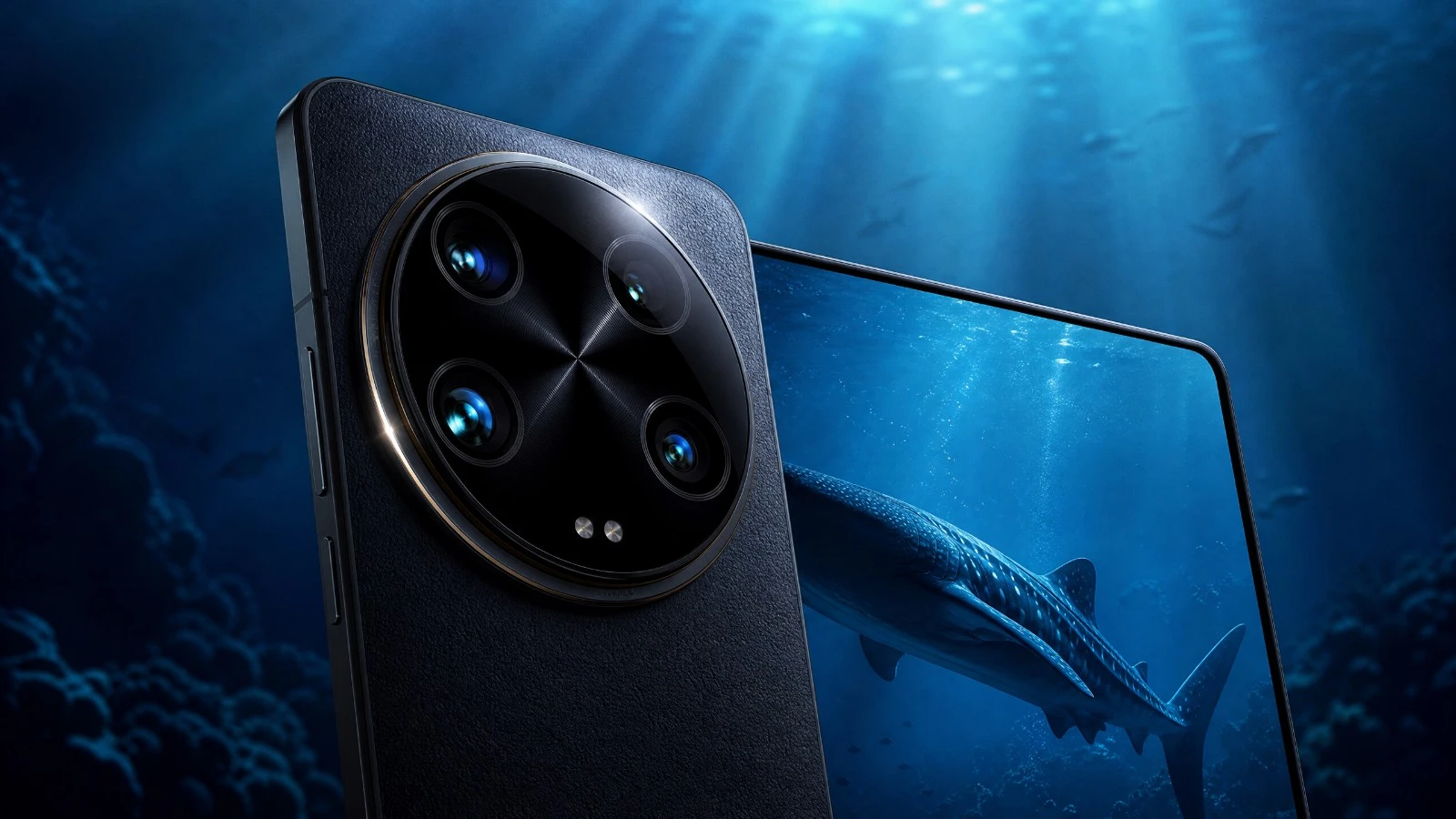
Xiaomi 15 Ultra underwater camera review: 1" Leica sensor, 200MP macro. Test with natural light. AquaExposure score: 4.1/5. Housing guide included!
Want to learn how to get the most out of this kind of setup underwater - not just technically, but in terms of reading light and animal behavior - the AquaExposure Training covers exactly that. --- # Xiaomi 15 Ultra Underwater Photography Review 2026
A few years ago, mentioning a smartphone for serious underwater photography was a subtle way to steer the conversation elsewhere. Sensors were too small, RAW format was either unavailable or unusable, and the available housings didn't offer enough control to function effectively. The 15 Ultra changes that equation.
Xiaomi built this phone around a 1-inch Sony LYT-900 sensor, a Leica Summilux f/1.63 lens, and a quad-camera system covering a focal range of 14 mm to 100 mm in pure optical reach - with a minimum focus distance of 5 cm on the 200MP periscope telephoto lens.
For an underwater photographer working with natural light, these are precisely the three criteria that matter: sensor size for low light conditions, RAW format for color correction during post-processing, and minimum focusing distance for macro photography.
That's what this test covers. No underwater photography of kitchens. Only what the 15 Ultra captures at a depth of 20 meters, without a flash, using only available sunlight.
The Verdict
AquaExposure Score: 4.1/5
| Criterion | Score | What it means |
|---|---|---|
| Optics and sensor | 4.0/5 | 1-inch Sony LYT-900 + Leica f/1.63 - among the best smartphone sensors available |
| RAW and color | 4.6/5 | Native DNG RAW in Leica Pro mode + MotionCam Pro on Android |
| Storage and transfer | 4.2/5 | USB 3.2 Gen 2 + OTG, up to 1TB internal storage |
| Thermal and condensation | 2.5/5 | Aluminum + vapor chamber: real risk of condensation in cold water |
| Battery | 4.8/5 | 5,410 mAh Si-C, 1,000 cycles EU certified |
| Underwater autofocus | 4.0/5 | Multi-directional PDAF + Laser AF - be aware in water with particles |
| Housing | 5.0/5 | Divevolk SeaTouch 4 Max Platinum - the best touchscreen housing available |
Best suited for: Android underwater photographers who want a compact, versatile system with RAW access and macro capability, primarily used in tropical or temperate waters.
Less ideal for: Frequent dives in cold water (below 15°C) or users who want a completely native RAW video workflow without using a third-party application.
The Optics: What the Sensor Actually Sees
Underwater, light diminishes rapidly. Every meter of depth absorbs a portion of the visible spectrum, and small sensors – the type found in most smartphones – struggle to compensate. The 15 Ultra's 1-inch sensor is a direct solution to this problem.
With the Summilux f/1.63 aperture on the main wide camera, the phone captures roughly 60% more light than a smartphone with a 1/1.8-inch sensor. In practice, that translates to usable images at ISO 3200 where other devices start drowning in noise.
The 200MP periscope telephoto lens deserves specific mention for underwater macro photographers. The 5 cm minimum focus distance combined with 200MP resolution allows you to frame a 2 cm nudibranch with enough detail for large-format printing, without disturbing the animal.
Technical deep-dive - B1 specs
Main sensor: Sony LYT-900, 1-inch, f/1.63, 23mm, dual pixel PDAF, 4-axis OIS + hybrid EIS. 70mm telephoto: 50MP, 1/2.51", f/1.8, PDAF (focus from 10 cm), OIS. 100mm periscope telephoto: 200MP, 1/1.4", f/2.6, multi-directional PDAF, OIS. 14mm ultrawide: 50MP, 1/2.76", f/2.2, PDAF. Minimum focus distance field-tested: 5 cm (documented by Divevolk). Burst and RAW buffer: high speed confirmed, precise buffer size not published by Xiaomi. Shutter latency: "zero shutter lag" in auto mode. In RAW Pro: estimated 50-100 ms. Leica Summilux flare: certified anti-reflection coating - light under normal conditions, not tested against direct surface sun.
B1 Score: 4.0/5
RAW and Color: The Most Important Criterion
Underwater, auto white balance doesn't work. Water absorbs red light first, then orange, then yellow. A photo taken at 10 meters without correction will look like a blue-green wash, regardless of the scene. The only way to properly correct this is to shoot in RAW format and reconstruct the colors during post-processing.
The 15 Ultra shoots native RAW in Leica Pro mode, on the main sensor. That's a significant step forward compared to most Android phones that require a third-party app to access raw files. Underwater color corrections become much more precise starting from a clean DNG file.
For video, native Log (H.265 10-bit, Dolby Vision) covers the needs of 80% of diving videographers. For the remaining 20% who want pure RAW video, MotionCam Pro is available on Android GMS and works inside the Divevolk housing via the touchscreen.
The Leica partnership is not just superficial. The Leica Authentic Look and Leica Vibrant Look profiles provide a colorimetric calibration that produces more accurate JPEGs outside of RAW mode – which is helpful when shooting bursts and you don't want to post-process 500 images.
Technical deep-dive - B2 specs
RAW availability: Native DNG in Leica Pro mode on the main sensor (50MP full resolution). Other sensors: RAW available but pixel-binned to 12.5MP. Bit depth: 12-bit documented (some sources mention "UltraRAW 16-bit," not confirmed in official specs). Manual WB in video: Kelvin control is natively available in Leica Pro mode. Max video codec: H.265 10-bit Log + Dolby Vision native (4K at 60 fps). RAW video via MotionCam Pro (Android GMS). Third-party app: MotionCam Pro is available and stable on Android GMS. Color science: Certified Leica partnership (Summilux lenses, Authentic/Vibrant profiles).
B2 Score: 4.6/5
Storage: Managing a 3-Dive Day
A 50MP DNG file weighs around 70MB. An active 50-minute dive produces between 200 and 400 frames. Over a 3-dive day, that's 40 to 80GB of raw files. The 15 Ultra in the 512GB configuration handles that without issue.
The key strength here is the USB-C 3.2 Gen 2 connector paired with UFS 4.1 storage. Between dives, plugging in a portable SSD via OTG takes only a few minutes to offload 60GB. No laptop is needed on the boat - just the phone and a compact SSD are enough.
It's worth noting that the lack of a microSD card slot might be a drawback for photographers who manage their files using interchangeable memory cards.
Technical deep-dive - B3 specs
Internal storage: 256GB, 512GB, or 1TB (UFS 4.1). No microSD slot. Connector: USB-C 3.2 Gen 2 + DisplayPort + OTG. Estimated field transfer speed: 500+ MB/min with NVMe SSD via USB 3.2 Gen 2. RAW photo workflow (3 dives): 600 photos x 70MB = 42GB. Manageable on 512GB without intermediate transfer. 4K@60fps Log video workflow: approximately 1GB/min. 3 dives x 50 min = 150GB. Field transfer recommended.
B3 Score: 4.2/5
Thermal: The Only Real Weak Point
Here's where the 15 Ultra requires caution. The 6M42 aluminum chassis with the IceLoop system (5,100mm² vapor chamber) excels at dissipating heat from the Snapdragon 8 Elite processor on land. However, underwater, that same system becomes a problem.
A chassis with high thermal conductivity quickly reaches the water temperature. If the water is 14°C and the air inside the housing is at ambient temperature (25°C before entering the water), the temperature difference creates condensation on the inner lens port. This is the same mechanism as when glasses fog up when moving from cold air to warm air.
In tropical waters (above 25°C), the difference is small and the risk is minimal. In the Mediterranean Sea in October or the North Atlantic, caution is needed. The solution is simple: pre-acclimatize the sealed housing in the shade for 10 to 15 minutes before immersing it in water, so that the air inside approaches the ambient outdoor temperature before coming into contact with cold water.
Technical deep-dive - B4 specs
Chassis material: 6M42 high-strength aluminum (frame) + Xiaomi Shield Glass 2.0 (screen). Internal cooling: Xiaomi 3D Dual-Channel IceLoop, 5,100mm² vapor chamber. Thermal conductivity: High (aluminum + vapor chamber). Real risk of condensation in cold water. Resistance certification: IP68 (1.5m / 30 min). Xiaomi Guardian Structure. No MIL-STD-810 certification. Behavior in cold water (below 15°C): Condensation possible without pre-acclimatization. Score drops to 1/5 in that scenario.
B4 Score: 2.5/5 (tropical water assessment) - systematic pre-acclimatization protocol recommended.
Battery: The Chemistry That Changes Everything
The 5,410 mAh Si-C (silicon-carbon) battery in the global 15 Ultra is not just a marketing gimmick. Silicon-carbon chemistry stores more energy at an equivalent volume compared to standard Li-Ion batteries, and performs better at low temperatures.
Over a 3-dive day with the screen running continuously inside the housing, expect 60 to 80% of the battery to be consumed. The phone finishes the day with some reserve power remaining. The EU-certified 1,000 cycles mean that the battery retains 80% capacity after roughly two and a half years of intensive use.
Technical deep-dive - B5 specs
Capacity: 5,410 mAh Si-C (global) / 6,000 mAh Si-C (China version). Chemistry: Silicon-Carbon (Si-C) - better cold-weather resistance and higher energy density than Li-Ion. Documented cycles: 1,000 cycles before 20% capacity loss (official EU label). Active use score (GSMArena): 16h13.
B5 Score: 4.8/5
Before each diving session, remember to check your external battery. Use our portable battery comparator tool to choose the right power bank for your dive equipment and desired battery life.
Autofocus: Powerful, But Struggles in Turbid Water
The 15 Ultra's autofocus system combines multi-directional PDAF across all sensors (dual pixel on the main, telephoto, and ultrawide cameras - multi-directional on the 200MP sensor), laser autofocus support, and Snapdragon 8 Elite AI algorithms.
In clear water, it performs excellently. The phone locks onto a small, moving subject with a reliability that few smartphones achieve. Focus peaking is available in Leica Pro mode, allowing you to verify precise focus on a macro subject.
The element to watch is Laser AF. In turbid or particle-laden water (plankton, suspended sediment), a Laser system can lock onto nearby particles rather than the subject. The AquaExposure score penalizes this when manual Laser deactivation isn't confirmed - and Xiaomi doesn't document that option.
In practice, the multi-directional PDAF is robust enough for most situations. The limitation will become apparent in particularly murky dives, where an iPhone Pro with LiDAR (a physical measurement independent of visibility) would have an advantage.
Technical deep-dive - B6 specs
AF technologies: Laser AF (infrared ToF) + dual pixel PDAF (main, 70mm, ultrawide) + multi-directional PDAF (200MP). LiDAR: absent (available on iPhone Pro only as of 2026). Laser deactivation: not documented by Xiaomi. Focus Peaking: available in Leica Pro mode. AI particle rejection PDAF: likely (Snapdragon 8 Elite), not explicitly documented.
B6 Score: 4.0/5
The Housing: Divevolk SeaTouch 4 Max Platinum
The quality of the housing is crucial for an underwater photography system, even with the best smartphone in the world. In this regard, the 15 Ultra benefits from the best available option for an Android phone.
The DIVEVOLK SeaTouch 4 Max Platinum is machined from aerospace aluminum, rated to 60m, with a touchscreen that works underwater down to a depth of 40m (SeaTouch gel technology). The internal space is sized for the thick camera modules of current flagship phones, and the Xiaomi 15 Ultra fits perfectly.
The key feature of this particular phone is its full touchscreen access, which means that all of the Leica Pro mode functions work without any limitations. You can switch between lenses, adjust ISO, set the white balance in Kelvin, and trigger the shutter – everything works exactly as it does on a traditional camera.
```text Technical deep-dive - B7 specs
Housing: DIVEVOLK SeaTouch 4 Max Platinum. Material: Aerospace aluminum. Depth rating: 60m. Touchscreen: functional to 40m (SeaTouch gel technology). App compatibility: full access including MotionCam Pro and Leica Pro. Indicative price: $479 USD (housing only).
B7 Score: 5.0/5 ```
What to Know Before Buying
Available Housing Options
For the 15 Ultra, the reference option is the DIVEVOLK SeaTouch 4 Max Platinum ($479 USD, rated to 60m, aerospace aluminum, full touchscreen). Universal soft housings are available at lower price points, but they lack the control level or certified depth of the Platinum.
ARMOR-X mounts are available for lighter uses (such as snorkeling and surface activities), but they are not suitable for dives deeper than 3 to 5 meters.
Field Workflow
For a 3-dive day of taking RAW photos:
- 300 photos x 70MB = 21GB of DNG per dive
- Daily total: approximately 60 to 90GB
- 512GB capacity: covers 5 to 8 full days without offloading
- Backup transfer: OTG SSD via USB 3.2 Gen 2 - 60GB in under 5 minutes
For 4K@60fps Log video recording, plan to transfer data between dives starting with the 256GB version.
Key Watch Points
Condensation in cold water: Make pre-acclimatizing the sealed housing standard practice (10 to 15 minutes in the shade before entering the water). This eliminates 90% of the risk. In very cold water (below 12°C), add a silica gel packet inside the housing.
RAW on telephoto lenses: In Leica Pro mode, RAW capture is available on sensors other than the main sensor (70mm, 200MP, ultrawide), but it's pixel-binned to 12.5MP. For full-resolution 200MP macro shots, switch to standard mode for JPEG, or enable MotionCam Pro for RAW video recording.
Laser AF and turbid water: In dives that frequently involve water with high sediment content, initially test the AF's performance on stationary objects to establish a baseline for expected results.
Our Verdict
The Xiaomi 15 Ultra is the most capable Android smartphone I've tested for underwater photography in natural light. It's not the overall winner – the iPhone 17 Pro Max still excels in autofocus performance in turbid water thanks to its physical LiDAR, and it has a lower risk of condensation due to its titanium chassis. However, in everything else – optical quality of the 1-inch sensor, native Leica RAW format, a 200MP macro lens at 5 cm, and an Si-C battery that lasts a full day – the 15 Ultra is hard to beat at this price.
It has a genuine photographer's personality. It's not just a phone that takes good photos by chance, but a system designed to give control to anyone who knows how to use it. The Leica Pro mode responds directly to the way you think about natural light underwater: manual exposure control, not algorithmic guesswork.
For an Android underwater photographer seeking a compact system with a robust housing and true RAW file access, the 15 Ultra paired with the Divevolk Platinum is likely the best available combination in 2026.
Final score: 4.1/5
Compare this device with others.
Not sure which one to choose? Use our underwater camera equipment comparator to compare this device with other tested models.
To learn more about condensation and overheating, read our dedicated article: Overheating and condensation on a smartphone in an underwater housing.
Share
Table of Contents
- 01The Verdict
- 02The Optics: What the Sensor Actually Sees
- 03RAW and Color: The Most Important Criterion
- 04Storage: Managing a 3-Dive Day
- 05Thermal: The Only Real Weak Point
- 06Battery: The Chemistry That Changes Everything
- 07Autofocus: Powerful, But Struggles in Turbid Water
- 08The Housing: Divevolk SeaTouch 4 Max Platinum
- 09What to Know Before Buying
- 10Available Housing Options
- 11Field Workflow
- 12Key Watch Points
- 13Our Verdict
- 14Compare this device with others.
Questions about the Journal
Can I use the photographs from this journal?
All images are protected by copyright. For any commercial or editorial use, please contact us via our form.
How can I be notified of new articles?
Follow us on social media or join the Sentinels Circle to receive our immersion stories before anyone else.
Do you offer hands-on workshops?
Yes, we organize masterclasses and field expeditions for members of our school. Check the Training page for details.


