Is AI completely banned in underwater photography competitions?
No, not completely. The UPY 2026 allows AI noise reduction, backscatter removal and cleaning of parasitic elements. What is banned is using generative AI to create entire images or generate parts of an image that did not exist at the moment of capture.
What is the penalty for AI cheating in a competition?
The UPY 2026 applies a lifetime ban for anyone caught submitting AI-generated images. RAW files from all finalists are specifically checked to detect artificially generated content.
Where is the line between allowed editing and banned AI?
The rule is clear: if the element existed in the scene at the moment you pressed the shutter, you can modify, remove or adjust it. If the element didn't exist, you cannot generate it. Cleaning backscatter is allowed. Replacing a sky or adding an animal is not.
Do these rules apply to all photo competitions?
Each competition defines its own rules. The UPY is among the strictest. Other competitions like Ocean Art or the Russia Underwater Photo Awards have their own policies. The Lumethic database lists the AI rules of over 100 photo competitions worldwide.
AI and Underwater Photography Competitions: The UPY 2026 Rules
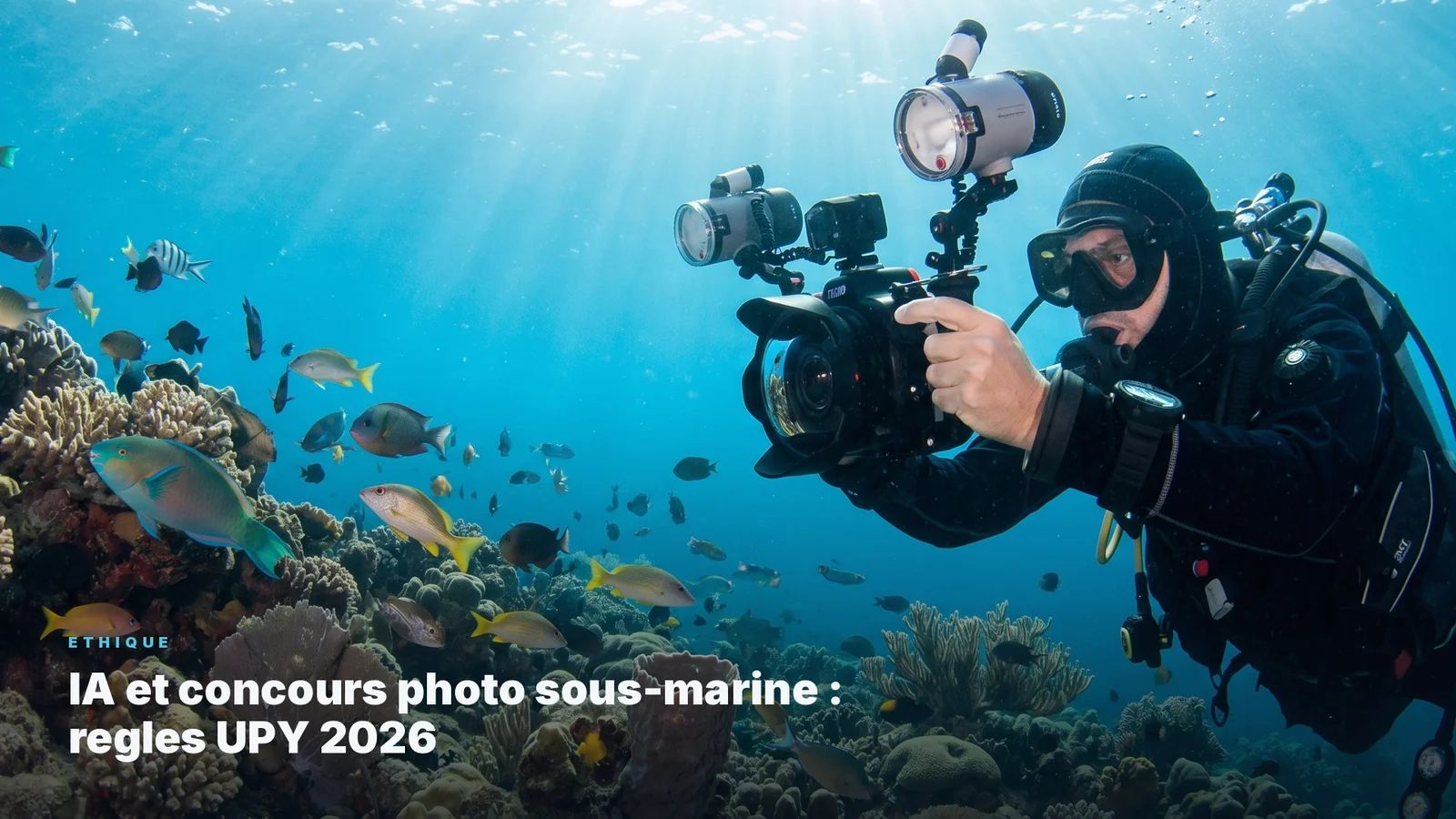
There are debates that cut across all of photography, from the terrestrial studio to the most remote depths. The role of artificial intelligence in image creation is one of them, and it's far from new. But in underwater photography, where every image carries within it the proof of a real encounter with a living creature, the question takes on a particular dimension. The Underwater Photographer of the Year 2026 has chosen to respond with rare clarity.
What the UPY 2026 allows
The competition does not ban all digital processing. Far from it. Lightroom, Photoshop, DaVinci Resolve - all these tools remain perfectly accepted for developing and correcting your images. AI noise reduction (such as Topaz DeNoise or the functions built into Lightroom) is allowed. Removing backscatter, those suspended particles that pollute the foreground, remains permitted. Removing UFOs (Unwanted Floating Objects, those bits of fin or snorkel that invite themselves into the frame) is also fine. Cropping, colour correction, exposure adjustment, contrast: all of this falls within standard digital manipulation, accepted and encouraged.
The principle is simple. If the element was present in the scene at the moment you pressed the shutter, you can adjust it, correct it, refine it.
What the UPY 2026 bans (and the penalty)
Generative AI is formally banned. No nuance, no grey area. Entirely AI-generated images are excluded. AI-generated parts of images too, whether it's a sky replacement, a modified background, or an added element that didn't exist in the original capture.
AI sky replacement is specifically cited. Adding a subject that wasn't there, creating a more aesthetic background, generating a reef where there was only sand: all of this is forbidden.
And the penalty leaves no room for ambiguity. RAW files are requested for all shortlisted images. Each file is examined specifically to detect the presence of AI-generated content. And if a photographer is caught submitting images generated by artificial intelligence, the penalty is a lifetime ban from the competition.
Lifetime. Not a one-year suspension. Not a warning. A permanent ban.
Where the line sits
That's the question everyone asks, and the UPY's answer has the merit of being crystal clear. The line sits at the moment of capture.
If the element existed in the scene when you pressed the shutter, you can work on it. Reduce noise, correct white balance, adjust highlights, remove a distracting particle - all these operations reveal what was already there. They create nothing.
If the element didn't exist at the moment of capture, you cannot add it. A more dramatic sky, an extra fish, a more colourful coral in a corner of the frame. Even if the result is convincing, even if nobody would spot it with the naked eye, even if "it doesn't change the meaning of the image": that's creation, not processing.
Post-processing reveals beauty. It doesn't create it. That's the dividing line, and it holds up.
Why this matters for the whole community
The UPY isn't the only competition asking these questions. Databases like Lumethic catalogue the AI policies of photo competitions worldwide, proof that the topic has become central to the entire profession. Every competition must now pick its side, and most are converging in the same direction.
In underwater photography, the stakes go beyond a simple competition rule. Our images carry testimony. When a photographer shares the image of a whale shark encountered at 15 metres in the Maldives, the viewer enters an implicit pact of trust: this encounter happened. This moment existed. This animal was swimming there, in that spot, at that instant.
If generative artificial intelligence enters this pact, if doubt creeps in about the reality of what's shown, the entire power of underwater photography collapses. Without trust in the image, our photos lose their power of testimony, wonder and mobilisation for ocean protection.
Competitions that protect the real image protect the entire community. The UPY understood this, and their position is the right one.
And the smartphone that won the UPY
One last point worth highlighting. The UPY 2026 created for the first time a dedicated smartphone photography category. It was won by Jack Ho with a shot taken using a DiveVolk housing.
That's a strong signal. On one side, the competition protects image integrity against generative AI. On the other, it opens its doors to the most accessible technology that exists. The message is consistent: it's not the sophistication of the tool that matters, it's the authenticity of the encounter. A smartphone in a housing costing a few hundred euros can produce a prize-winning image in the most prestigious competition in the world, as long as that image is real.
The encounter is sacred. Processing reveals it. It doesn't replace it.
Our underwater photography training addresses these questions in depth in Module 3 (ethics and approaching marine life) and Module 6 (post-production). Because knowing where processing ends and creation begins is a skill that's built over time.
FAQ
Is AI completely banned in underwater photography competitions?
No, not completely. The UPY 2026 draws a clear distinction between generative AI (banned) and processing AI (allowed). Noise reduction tools like Topaz DeNoise or AI functions built into Lightroom remain accepted. What is banned is using AI to create or modify elements that didn't exist in the original scene.
What do you risk if you submit an AI-generated image to the UPY?
A lifetime ban. The organisers request RAW files from all shortlisted images and analyse them specifically to detect content generated by artificial intelligence. The penalty is definitive, with no possibility of re-registration. Other competitions are adopting similar policies, though penalty severity varies.
How do judges detect generative AI use?
RAW file analysis is the first line of defence. A RAW file contains the sensor's raw data and EXIF metadata. Generative AI modifications leave detectable traces, especially when comparing the original RAW to the submitted image. Detection tools are also improving rapidly, making cheating increasingly risky.
Where can I find the AI rules for all photo competitions?
The Lumethic database catalogues the AI policies of most photo competitions worldwide, including underwater photography competitions. It's a valuable resource for checking the specific rules of each competition before submitting your images.
Is traditional post-processing threatened by these rules?
Not at all. Colour correction, cropping, exposure adjustment, noise reduction, removing suspended particles: all of this remains perfectly allowed. These rules don't target traditional post-processing. They target the creation of content that didn't exist at the moment of capture. Developing and refining your RAW files remains not only allowed but encouraged.