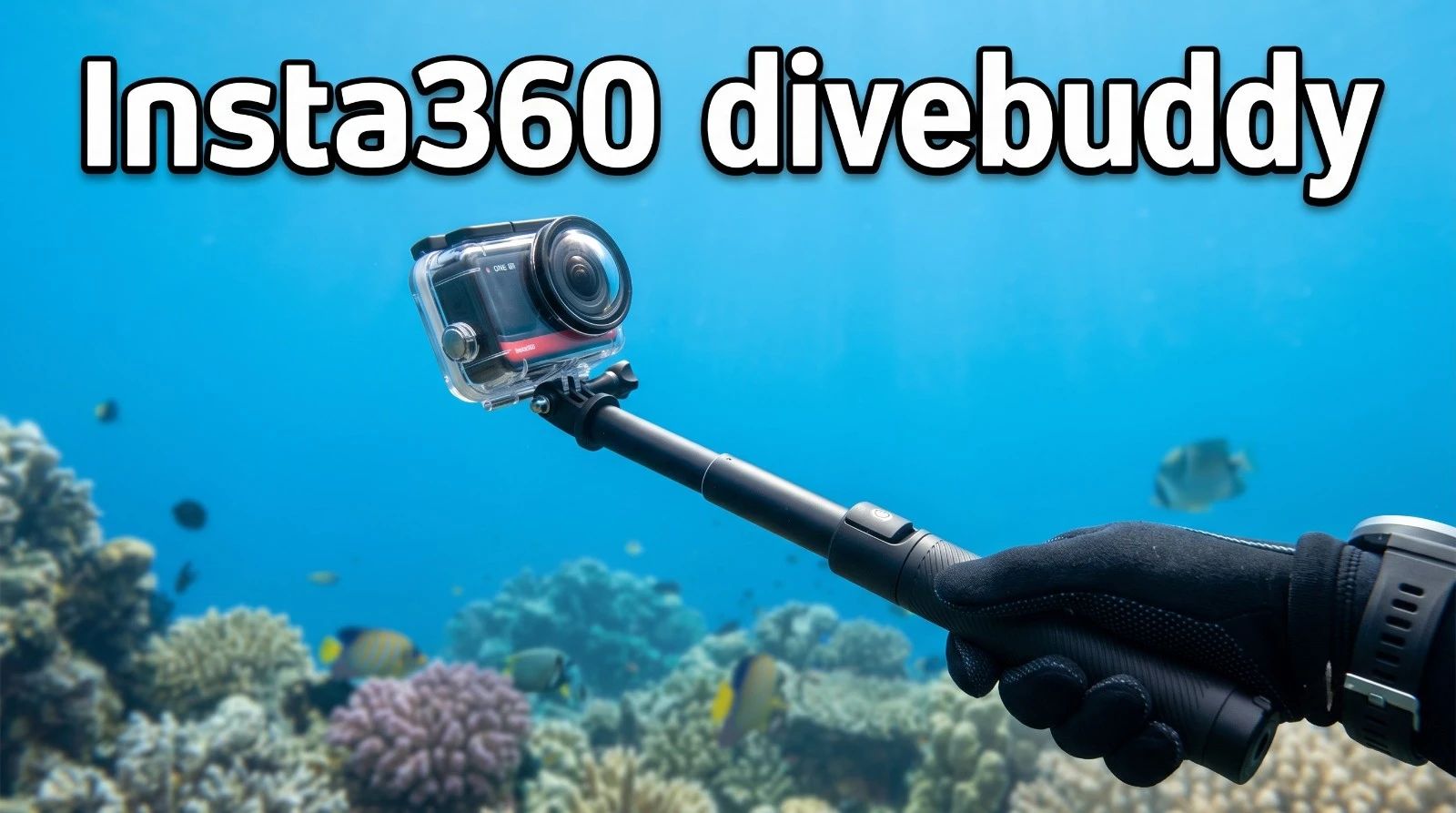
Insta360 Dive Buddy: filming underwater without disturbing marine life
The Insta360 Dive Buddy automates the core principle of underwater photography: place your camera, step back, let life come to you. What it actually changes underwater.
Insta360 Dive Buddy: filming underwater without disturbing marine life
The Dive Buddy is a motorised arm that automatically tracks your subject using the AI tracking built into the Insta360 X5. It adjusts to the subject's movements without you touching the camera, reducing water disturbance and letting marine animals approach more naturally.
Is the Dive Buddy compatible with traditional DSLR or mirrorless housings?
No. The Dive Buddy is designed specifically for Insta360 cameras (primarily the X5). It is not compatible with housings for DSLR or mirrorless cameras. For those configurations, other stabilisation and fixed mounting solutions exist.
Why is placing your camera a fundamental principle in underwater photography?
When you hold a camera, your body moves, your breathing creates bubbles, and your limbs disturb the surrounding water. Marine animals sense these micro-vibrations and move away. Placing the camera on a fixed support removes these disturbances and lets marine life return naturally toward the subject you are filming.
Does the Dive Buddy replace underwater photography training?
No. Automatic tracking does not replace an understanding of animal behaviour, buoyancy control, or compositional instinct. It is a tool that supports a technique the photographer-diver must first have internalised. Module 3 of the AquaExposure training covers precisely this approach and its practical exercises.
A few years ago, during a dive on a Mediterranean reef, I watched something I have not forgotten. A photographer with a full lighting rig and a stabiliser arm outstretched was approaching a school of damselfish. The fish parted with each movement, re-forming their circular dance two metres away, out of frame. The photographer moved forward. The school retreated. This went on for twenty minutes. No usable footage. The water around him was one long conversation between his approach and the animals fleeing, and he was not hearing that conversation.
In module 3 of the underwater photo and video training, I come back consistently to a principle that took me years to properly internalise: the best underwater images are not captured by chasing your subject - they are prepared by erasing yourself. Place your camera. Kneel on the sand, away from the coral. Wait. Let life come toward you rather than forcing it.
This posture runs against the instinct that kicks in when you are underwater with expensive gear and a pressure to make the dive worthwhile. Insta360's July 2026 release of the Dive Buddy interested me precisely because this accessory starts from the same observation.
What the Dive Buddy actually does
The Dive Buddy is a motorised arm designed to work with the Insta360 X5 underwater. Its principle fits in one sentence: once mounted and activated, it tracks your subject automatically using the camera's AI tracking, without you touching the device. You lock onto your subject via the included waterproof remote, and the camera pans on its own.
This is not just another stabiliser on an extension arm. The difference lies in the system's autonomy: your position in the water can remain completely static while the camera does its work. Your hands are free. Your body generates no parasitic movement toward the subject.
The X5's spherical field of view already changes how you approach a subject underwater. The Dive Buddy adds a temporal dimension to that equation: you no longer need to be active at the moment of capture.
Why this principle works
The behaviour of marine animals toward an equipped diver follows a few rules that instructors end up knowing by heart.
The most fundamental rule, covered in detail in the guide to ethical underwater animal interactions, fits in one sentence: animals do not flee what they do not perceive as a threat. What triggers flight is a direct approach, bubbles rising toward them, sudden unpredictable movements - not necessarily your presence itself.
A diver who stays at a respectful distance, who controls their buoyancy, who produces no movement directed at the subject, gradually becomes part of the scenery. I have seen moray eels come out of their holes within fifty centimetres of divers who had simply stopped moving. I have seen curious amberjacks make close passes toward someone waiting motionless on a sandy bottom.
For seahorses - one of the most requested macro subjects in the training - the passive approach is the only one that genuinely works. These animals freeze or move away at the slightest disturbance. A camera placed at a good distance and left to work on its own produces images you will never get by chasing them.
What the Dive Buddy changes in this context
The Dive Buddy's value lies in a specific gap that a fixed tripod technique does not resolve: actively tracking a moving subject without human intervention. Placing a camera on a tripod to film a seahorse on its gorgonian is an approach that has always worked. But to film a school of fish circling, a ray passing through, or a turtle ascending toward the surface, a fixed support cannot follow.
The Dive Buddy fills that gap. You position yourself at a good distance, trigger tracking from the remote, and let the camera pivot toward the moving subject on its own. Your body stays outside the animal's alert zone. The sequence builds without any intervention from you.
This is not a revolution in the sense that the tool brings nothing that experience and patience do not already bring. What the Dive Buddy offers is concrete mechanical assistance with a gesture that remains demanding to sustain - especially for divers who have not yet automated buoyancy control and presence management underwater.
The limits to know before diving
It would be dishonest to present this system without its real constraints.
The Dive Buddy remains dependent on the Insta360 technology chain. It works with the X5, requires configuration before entering the water, and adds volume and weight to an already present setup. In technical diving, strong current, or confined spaces like a wreck, managing an additional motorised arm raises practical questions that every diver should think through in advance.
AI tracking works well in conditions with decent visibility and sufficient contrast between the subject and background. In low-visibility water, low light, or with a subject that blends into its surroundings, performance can disappoint.
There is also a question that touches on ethical underwater photography and citizen science: does an active tracking system encourage spending more time on a subject than is reasonable? Does it facilitate approaches that are too close because the machine is "handling" what the photographer would have managed themselves? These questions remain open. A tool does not replace a doctrine. It can support it or bypass it, depending on the intention of the person using it.
The AquaExposure position
In module 3 of the training, we work on posture before equipment. Every exercise turns on a single question: does your presence in the water serve the subject you are filming, or does it prevent that subject from existing?
The Dive Buddy strikes me as a tool aligned with that direction, in the right context of use. Not a substitute for compositional instinct, not a guarantee of results, but concrete mechanical help for specific situations where passive capture is the best option.
An automated gesture is not the same as understanding that gesture. But if the automation helps a diver respect the rule when they would otherwise break it, it earns its place in the bag.
Some images only exist because the photographer chose not to be there.
Insta360 Dive Buddy: filming underwater without disturbing marine life | AquaExposure