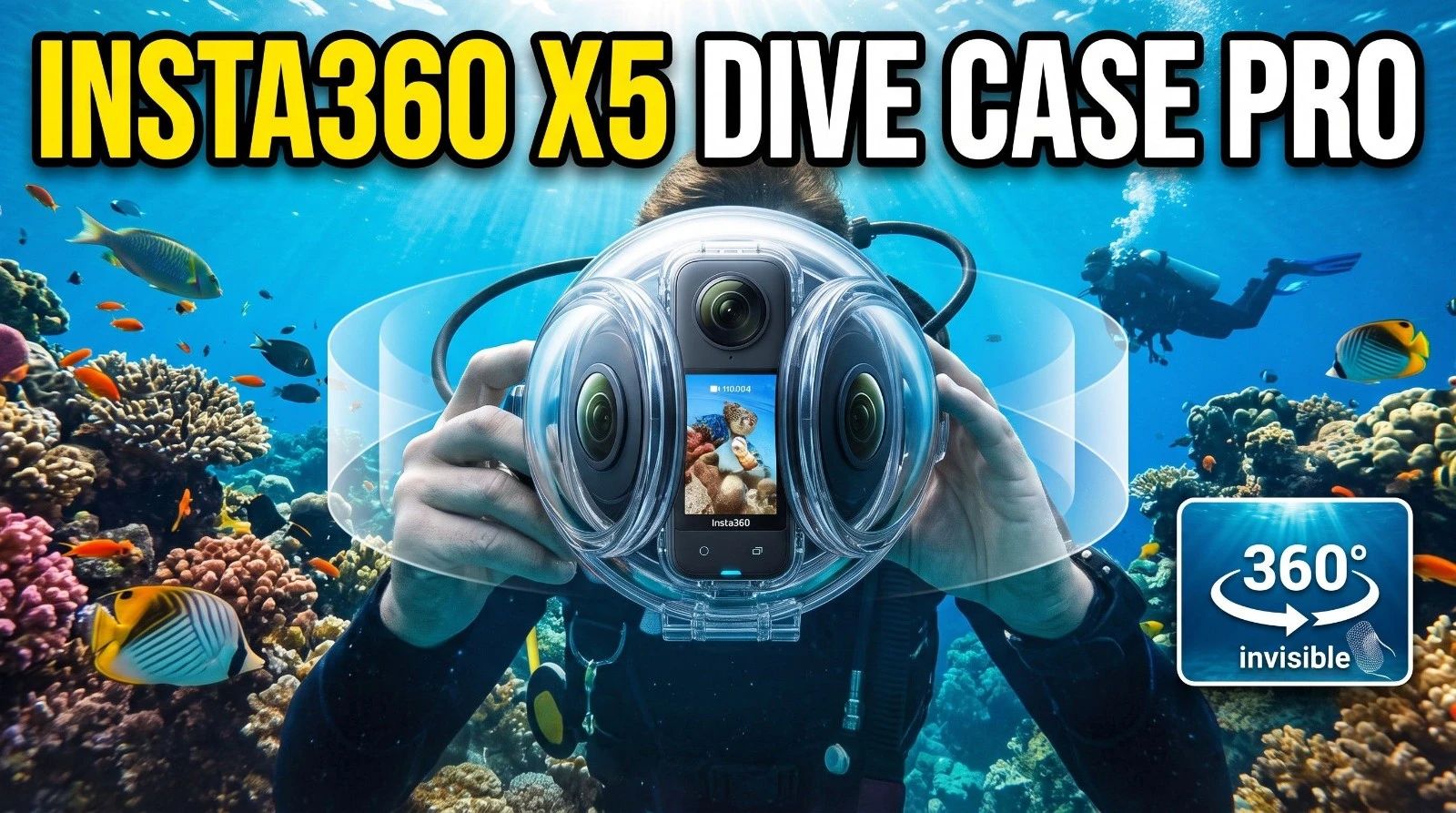
Insta360 X5 Invisible Dive Case Pro: why you should not replace it with a generic housing
The X5 Invisible Dive Case Pro is not just a waterproof shell. Corrected optics, extreme mechanical resistance: why going generic is a false economy that shows up in every image.
Insta360 X5 Invisible Dive Case Pro: why you should not replace it with a generic housing
Generic housings do not correct the optical refraction specific to the X5 sensor. The result is sharpness loss at the edges of the frame, distortion of straight lines, and degraded 360-degree image stitching. The Dive Case Pro is calibrated for the X5 lenses specifically, not for a hypothetical universal sensor.
What depth is the Dive Case Pro rated for?
The Invisible Dive Case Pro is rated to 60 metres by Insta360, which covers recreational diving and a large part of technical diving. The rating is product-specific and does not extend to third-party accessories mounted on it.
Does the housing affect the image quality of the Insta360 X5?
When properly maintained (seals checked, lenses clean, no scratches on the dome), the Dive Case Pro does not degrade image quality. It is precisely because it is designed for the X5 lenses that the optical corrections remain effective. A generic housing introduces artefacts that neither firmware nor post-processing can fully remove.
How do you maintain the Dive Case Pro between dives?
Rinse with fresh water after every dive, dry completely before closing, inspect the O-ring at each outing with a light greasing if needed, and store away from direct heat. The O-ring is the most critical component: a single hair or grain of sand caught in it is enough to cause a flood.
The first reflex when you start diving with a camera is to want to save money on the housing. The logic sounds reasonable: a waterproof-certified case sold for thirty euros on a parallel market does the same job as the manufacturer's housing at ten times the price, right? The camera is protected. Water does not get in. What are you really losing?
A few hours of diving is enough to understand what you are actually losing. And with the release of the X5 Invisible Dive Case Pro by Insta360, this question comes back with particular sharpness, because this housing does things a generic cannot.
What "Invisible" means in practice
The "Invisible" name refers to the optical design of the housing, not a camouflage effect. The lenses of the Dive Case Pro are calculated to compensate for the specific refraction of the Insta360 X5 lenses when they work behind a water/glass/air interface.
This is the fundamental problem of underwater photography that every housing must solve: water refracts light differently from air, producing angle distortion, sharpness loss at image edges, and chromatic aberrations on wide-angle sensors. Housings with a spherical dome correct this phenomenon - but only when the dome is calculated for the precise optical characteristics of the specific sensor it covers.
A universal generic housing does not make that calculation. It protects the camera from water, and that is all. The optical aberrations remain in the image, and for a 360-degree camera whose quality depends on precision stitching between lenses, this is particularly damaging.
The question of mechanical resistance
Beyond optics, the Dive Case Pro is built to mechanical tolerances significantly above those of the generic housings circulating on parallel markets.
Within the community of divers using the X5, field reports describe unusual mechanical resistance - drops on rock, rubbing against coral walls, and some severe contacts with marine life in demanding dive conditions. These are field observations, not laboratory tests or commercial promises from Insta360. But they converge toward the same finding: the rigidity and material quality of the Dive Case Pro exceed what you would expect from an action camera housing.
The difference versus a generic housing is not just a brand argument. It lies in the seals, the latches, the thickness and quality of materials used. A housing that fails at 30 metres is a lost camera and an interrupted dive. That possibility is worth the price comparison.
The false economy
Put the real numbers on the table. The Dive Case Pro costs noticeably more than a compatible generic housing. The price difference, invested in extra dive sessions or training time, represents a measurable gain in your images.
What you lose with a generic housing: degraded 360-degree stitching you cannot fix in post, blurry edges on wide shots, and mechanical fragility that becomes a permanent risk factor. What you gain with the Dive Case Pro: usable images straight from the dive, reliability that lets you focus on the subject rather than the gear.
If you are working with the Insta360 Dive Buddy for passive shots, the optical quality of the housing becomes even more critical: you no longer have live control over framing, and the aberrations from a generic housing show up in every image.
Specialised housing brands like AOI follow the same logic: their domes are calculated for the sensors they cover. This is not a marketing argument - it is optics.
What actually matters at purchase time
Two non-negotiable checks before any housing purchase.
First: verify that the housing version matches exactly the firmware version of your X5. Insta360 pushes regular updates, and some minor mechanical changes between generations can affect compatibility.
Second: inspect the O-ring before every dive, apply a light coat of silicone grease if needed, and never close the housing with any doubt about the seal's condition. An O-ring with a single hair caught in it means a flooded camera. Not at 40 metres, necessarily. Maybe at 3 metres, on a night dive, far from the boat.
The underwater photo and video training includes a gear section covering housing maintenance and pre-dive checks. These steps take less than two minutes, but they determine the reliability of everything else.
What you are actually buying
A housing is the only component between your camera and the water. It is also the component that determines whether your images are usable or merely documentary.
The X5 Invisible Dive Case Pro is not perfect - no housing is, and user feedback on seal maintenance and lens scratch sensitivity deserves attention. But in the balance between what it delivers in optical quality and what it protects in mechanical reliability, it is hard to build a serious argument for choosing an uncalibrated off-brand alternative.
The economy you think you are making with a generic housing, you pay back in lost images and anxiety at every depth change.
Some compromises cost more than they save.
Insta360 X5 Invisible Dive Case Pro: why you should not replace it with a generic housing | AquaExposure