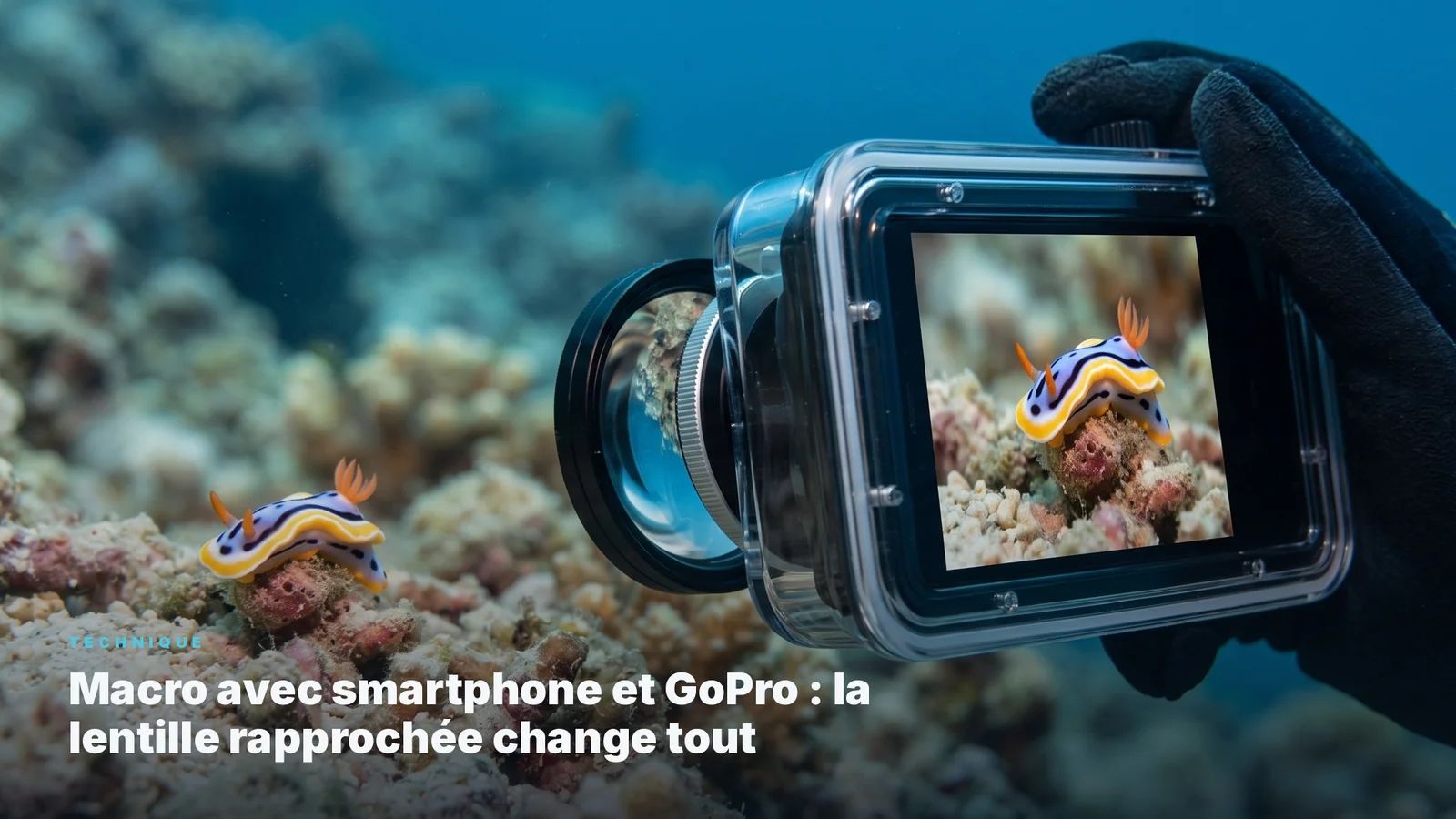
Macro With a Smartphone and a GoPro: the Wet Lens Changes Everything
Shoot underwater macro without a 3000-euro mirrorless: how close-up wet lenses turn a smartphone or a GoPro into a macro tool, and where their real limits sit.
Can you really shoot underwater macro with a smartphone?
Yes. With a close-up wet lens fitted in front of the housing, a smartphone photographs subjects a few millimetres across with very respectable sharpness. The limit is not the sensor, it is the focus distance and your stability.
What is a wet lens?
It is an add-on optic that mounts in front of the housing port and reduces the minimum focus distance. It lets you fill the frame with a tiny subject. It is also called a macro wet lens or a close-up lens.
What lens power should I choose to start macro?
A lens around +10 to +12 dioptres is a good compromise for beginners. Stronger lenses increase magnification but shrink depth of field and the sharp zone, which makes the work harder.
Is the GoPro suited to underwater macro?
With a dedicated close-up lens, yes, for static or slow-moving subjects. Without one, the GoPro stays wide-angle and does no real macro. It is the accessory that changes everything, not the body itself.
What are the limits of macro with a smartphone or GoPro?
The focus distance is fixed and very short, depth of field is shallow, and a fast-moving subject becomes hard to track. For sessile life and patient subjects, these limits are easy to work around.
Do I need lighting for smartphone macro?
In daylight and shallow water, natural light is often enough. Deeper or in a dark area, a small continuous video light helps focus and reveals colour without aggressing the subject.
How much does a macro lens for smartphone or GoPro cost?
Depending on brand and optical quality, expect roughly forty to two hundred euros. It is nothing next to the price of a macro mirrorless and housing kit, for very usable results.
To learn how to get the most out of your gear underwater, discover the AquaExposure training. Underwater macro does not require a 3000-euro mirrorless. A close-up wet lens, fitted in front of a smartphone housing or a GoPro, is enough to fill the frame with a subject a few millimetres across. This guide explains which lenses to choose, how to mount them, and above all where their real limits sit.
In the Maldives, I spent a long time watching divers unpack camera bodies worth several thousand euros to photograph the same gobies as me. Meanwhile, with my smartphone in a housing and a simple close-up lens screwed in front, I was producing perfectly publishable images of commensal shrimps. The truth is that macro rewards technique and patience long before budget. That is the case I make at every course.
Why the body is not the problem
Macro rests on a simple optical principle: reduce the distance at which the camera focuses, so the subject fills the whole frame. A modern smartphone or a recent GoPro already has a sensor capable of very good results in open water. What they lack is not image quality, it is the ability to focus two centimetres from a tiny subject.
That is exactly what a close-up wet lens corrects. And once that lock is lifted, the gap with a mirrorless kit narrows far more than people think, especially for static subjects. I described my full switch to smartphone in the article on the Divevolk housing for iPhone in underwater photo and video, where the macro logic is central.
Close-up wet lenses
How they work
A wet lens mounts in front of the housing port, underwater, hence the name. It adds dioptres, meaning magnifying power. The higher the number, the larger the subject appears, but the narrower the sharp zone becomes.
Which power to choose
To start, a lens around +10 to +12 dioptres offers the best compromise between magnification and ease. Stronger lenses, like +15 and beyond, give spectacular magnification but demand near-perfect stability, because the slightest sway pushes the subject out of the sharp zone. Start reasonable and move up in power as your technique follows.
Thread or quick mount
Two systems coexist. The thread screws the lens directly onto the housing, which is cheap but slow to handle underwater. The bayonet, or flip mount, lets you swing the lens in front of the port with one move, and pull it away to frame wide between subjects. For macro, the flip mount saves precious time.
The GoPro case
The GoPro is built for wide-angle. Without an accessory it does no macro, because its fixed optic cannot focus close enough. With a dedicated close-up lens, however, it becomes a real machine for textures and small subjects, as long as you target slow-moving prey. The latest generations also gained stabilisation and colour accuracy, as I explain in the article on the GoPro Mission 1 in underwater photography. For sessile life, sponges, fan worms, it is a formidably effective option.
The limits you have to accept
Let me be honest, because that is what I owe my students. Macro with a smartphone and a GoPro imposes three limits. The focus distance is short and roughly fixed, which forces you to get physically close to the subject, sometimes too close for a shy animal. Depth of field is shallow, so part of the subject will be soft if you do not place the plane of focus in the right spot. Finally, a fast subject, like a swimming flatworm, becomes hard to track.
These limits are not deal-breakers. They simply steer your choice of subjects toward sessile life and patient animals, which happen to be the most accessible. The full list of those subjects is in the article on hidden macro subjects beyond nudibranchs.
The settings that make the difference
Lock focus on the eye or the point of strongest contrast, and move your whole body forward or back rather than relying on autofocus. Look for natural light first, between five and fifteen metres, or add a small continuous video light if the subject sits in shadow. Work your buoyancy until you can hold still without a hand down, because in macro, stability beats all the megapixels in the world.
What these cameras really deliver
Let us be concrete about results, because theory is not enough. With a smartphone in a housing and a +10 lens, a three-centimetre nudibranch fills the frame with sharpness perfectly usable for the web, medium-format printing and social media. On sessile life, sponges and fan worms, the gap with a mirrorless shrinks to almost nothing, because the subject does not move and you have all the time you need to nail focus.
Where the gap widens is on fast subjects and very low light, where a dedicated body keeps the edge. But for ninety percent of the situations a photographer meets in recreational diving, an equipped smartphone and GoPro hold their own. That accessibility is what lets you progress right now, without waiting for a budget that never arrives.
"The best camera is the one that's with you." Chase Jarvis
Going further
Accessible macro is probably the best argument for not waiting on the perfect gear before you progress. If you want to learn to set up your smartphone or GoPro for macro in natural light, the AquaExposure underwater photography course walks you from lens choice to framing.
AquaExposure earns no affiliate commission on the gear mentioned in this article. Our recommendations stay independent and based purely on field experience.