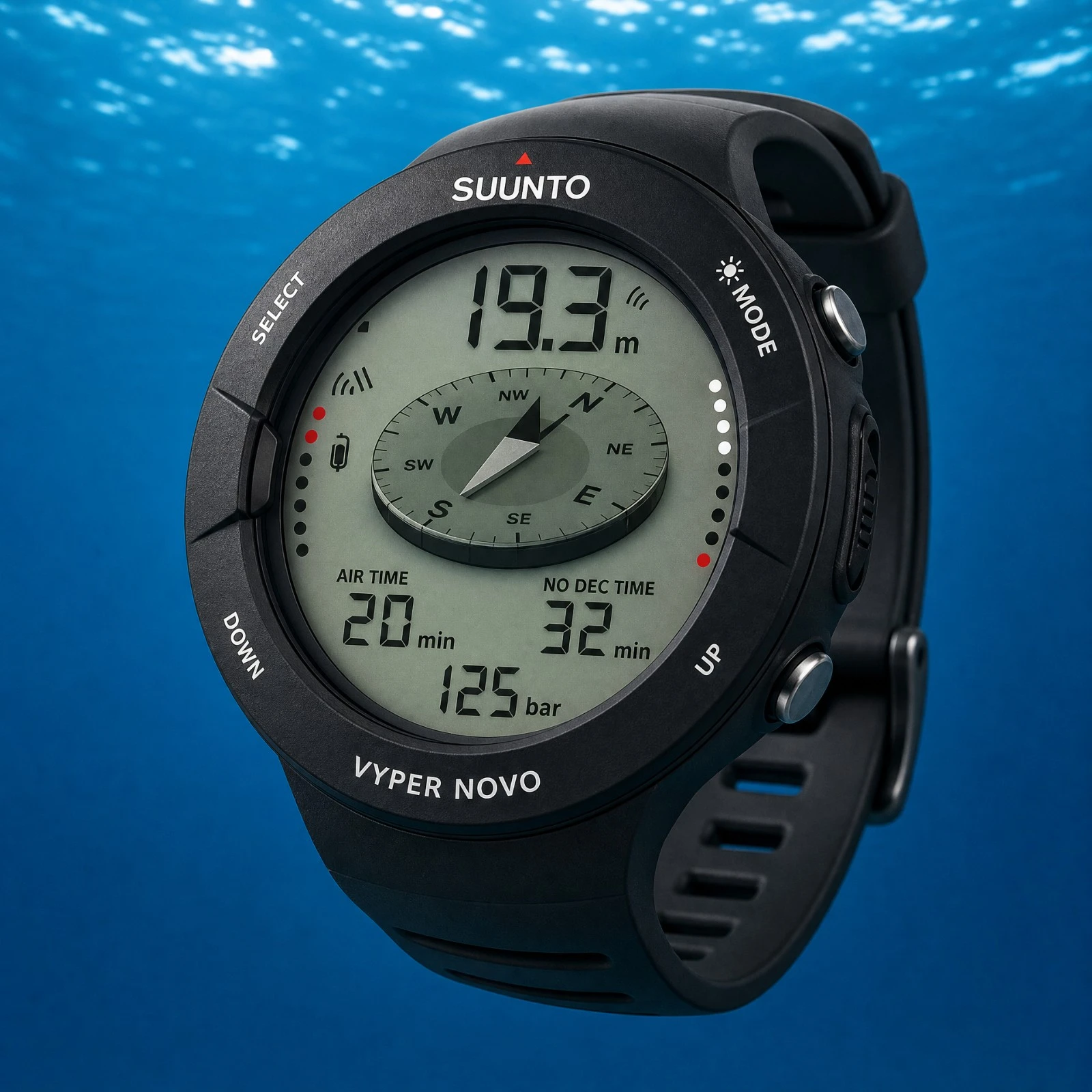
Comprehensive review of the Suunto Vyper Novo. Analysis of its RGBM algorithm, 3D compass, multi-gas management, and integrated air system.
To learn how to get the most out of your gear underwater, discover the AquaExposure Training.
Introduction
In the world of scuba diving, the development of skills often leads to a natural desire for more suitable and high-performance equipment, capable of meeting the increasing demands of exploration. When a Level 1 or Open Water diver begins to accumulate experience, the limitations of their basic first computer often become apparent. The need to manage multiple gases for decompression, to navigate with increased precision, or to read the pressure of their tank directly on their wrist becomes a necessity, a legitimate aspiration.
The Suunto Vyper Novo was designed specifically to fill this gap, to accompany this progression. It retains the robust and proven casing of a classic model from the brand, but incorporates the software core of its higher-end counterparts, offering a gateway to more advanced diving experiences. However, a dive computer is not just an assembly of priced options, it's the tool that manages the diver's decompression safety with each dive, a crucial piece of our equipment. Faced with recent rechargeable color computers, do the LCD matrix display and USB cable of the Vyper Novo still hold up? This rigorous and factual test compares this device to the technical specifications of AquaExposure to evaluate its relevance in the current market, to guide you in your choice.
The Verdict in Summary
Overall score: 3.3/5
| Criterion | Score | What it means |
|---|---|---|
| Algorithm & decompression models | 4.0/5 | Continuous Suunto RGBM model. Conservative but very readable. |
| Air & multi-gas | 2.3/5 | Supports up to 3 gases (Nitrox up to 99%). Perfect for mild decompression, no Trimix. |
| Screen & ergonomics | 2.5/5 | Central matrix LCD screen. Good contrast but the navigation remains outdated. |
| Battery life | 4.2/5 | Huge battery life (up to 1.5 years) with a simple replaceable CR2450 battery. |
| Connectivity & app | 2.5/5 | Wired synchronization via USB cable only. No Bluetooth. |
| Compass & instruments | 5.0/5 | Excellent 3D compass, complete freediving and depth gauge modes. |
| Robustness & depth rating | 2.6/5 | Certified to 80m (EN 13319). The acrylic glass requires protection. |
| Price & customer service | 3.8/5 | Interesting price-quality ratio for accessing multi-gas and the 3D compass. Customer service is readily available. |
Detailed Analysis
Algorithm & tiers (4.0/5)
The Vyper Novo uses the continuous Suunto RGBM algorithm. It does not offer adjustment of the Gradient Factors, a feature found on more advanced models, but it allows for personal adjustments on three levels of conservatism (0, 1, 2). The display during dives is very reassuring: the device clearly displays the decompression ceiling, the total ascent time (TTS), and triggers clear audible and visual alarms in case of a rapid ascent. This readability is a major advantage, providing valuable peace of mind underwater.
Air & mixed gases (2.3/5)
This is a significant upgrade compared to the entry-level models, a feature that opens up new possibilities. The device can manage up to 3 switchable gases underwater (Air and Nitrox, with an oxygen setting adjustable from 21% to 99%). It calculates the maximum partial pressure of O2 (pO2), which is adjustable between 1.2 and 1.6. This is more than sufficient to follow all Nitrox certified diver training programs and explore new horizons. Trimix and CCR modes are logically absent, clearly positioning it in the advanced recreational diving segment.
Screen & Ergonomics (2.5/5)
The LCD display matrix (49x22 pixels), combined with the classic segments, ensures excellent readability even in bright sunlight, a crucial factor for safety. An electroluminescent backlight (adjustable from 5 to 60 seconds) takes over at night, ensuring constant visibility. While Suunto has evolved the interface to use 4 buttons, navigating the menu settings is much less intuitive than on a modern touchscreen or color display. This is a compromise, something you need to get used to, but it doesn't detract from the device's primary function.
Battery Life & Power (4.2/5)
The longevity of this case relies on its energy efficiency, a very appreciable feature for the traveling diver. Powered by a standard CR2450 button cell battery that you can replace yourself, it can withstand up to 150 dives (or a year and a half) before needing replacement. The low battery indicator is basic, but the computer won't let you down in the middle of a dive trip, which provides reassuring reliability.
Connectivity & App (2.5/5)
Its Achilles' heel in 2026, it must be admitted. The device lacks a Bluetooth chip, which distinguishes it from newer models. Transferring its logbook (which stores approximately 140 hours of data with a sampling rate of 20 seconds) is mandatory via a Suunto USB cable. This cable is sometimes sold as an optional accessory, which you need to factor into your total budget, representing an additional expense to anticipate.
Compass & Instruments (5.0/5)
An excellent feature of the Vyper Novo is a functionality that makes all the difference. It integrates a 3D digital compass compensated for inclination (up to 45 degrees). This is very helpful for navigation and allows you to maintain your heading with confidence. The computer also offers a highly readable depth gauge mode and an apnea (freedive) mode with ultra-fast sampling every 2 seconds, valuable tools for various activities.
Robustness & Depth (2.6/5)
The composite case is rated for a maximum operating depth of 80 meters, adhering to the strict EN 13319 standard, guaranteeing its robustness. The main drawback concerns its transparent acrylic glass. This plastic is susceptible to scratches, so using the protective shield (display shield) included in the box is absolutely essential to protect it, maintain its readability, and ensure its durability.
Price & Customer Service (3.8/5)
Historically priced in the €300 range, its three-gas switching capabilities and 3D compass made it an undeniable choice, a worthwhile investment. Today, although it has aged in terms of connectivity, the assurance of finding after-sales service worldwide still makes this device attractive. Suunto's customer support is decent, but the firmware is critical. It is imperative to consistently update the firmware before every dive to ensure optimal and safe operation.
Who is this computer for?
The Suunto Vyper Novo is the ideal computer for recreational divers who are progressing, those who have moved beyond the Open Water level and aspire to greater autonomy and more technical capabilities. It is specifically designed for Level 2 divers or confirmed Nitrox divers who seek multi-gas management, an integrated compass for precise navigation, and a user-replaceable battery, all without breaking the bank. It's a practical choice, a logical evolution for those who want to expand their underwater abilities without spending a fortune.
On the other hand, this computer is not ideal for tech enthusiasts or those seeking the latest innovations in color display technology or instant Bluetooth synchronization with smartphones as soon as they emerge from the water. It will also not be suitable for those who practice advanced technical diving (Trimix, CCR), which requires specific features not present on this model. It is a reliable and effective tool for its segment, but it has its limitations, which are important to know.
Customer Service and Support
The after-sales service of Suunto is generally considered to be good, which is an important factor for the longevity of your investment. However, a crucial aspect to highlight concerns the device's firmware. It is imperative to systematically update the firmware of your Vyper Novo before every dive. This precaution not only ensures the proper functioning of the computer, but also applies the latest software corrections and improvements, ensuring maximum safety. Up-to-date firmware is a prerequisite for the smooth and reliable use of your equipment.
Nutrition
The Suunto Vyper Novo is powered by a CR2450 button battery, a choice that offers great flexibility. This battery can be easily replaced by the user, a highly appreciated feature, especially during diving trips where access to a service center may be limited. This battery life, which can reach up to 150 dives or a year and a half, is a major advantage. It allows you to dive with peace of mind, without the constraint of having to recharge your device daily. It's a practical and reliable solution for divers who prioritize simplicity and energy independence.
To find out which battery to buy for this computer, check out our complete guide on batteries for dive computers. To learn how to replace the battery yourself step by step without risking damage, read our complete tutorial on how to change your own battery.
Links to other models from the same brand.
For those who wish to explore other options from the Suunto brand, or compare features with more advanced models, we invite you to consult our detailed reviews. For example, discover the Suunto Zoop Novo, its little brother, or the Suunto D5, a model that is more focused on technology and the color screen. Each computer has its own specific features and target audience, and it is essential to understand these differences in order to make the most informed choice.
CTA Comparator
To compare this computer with other models, see our diving computer comparison tool.
© 2026 AquaExposure. All rights reserved. Reproduction prohibited without authorization.
Share
Table of Contents
- 01Introduction
- 02The Verdict in Summary
- 03Detailed Analysis
- 04Algorithm & tiers (4.0/5)
- 05Air & mixed gases (2.3/5)
- 06Screen & Ergonomics (2.5/5)
- 07Battery Life & Power (4.2/5)
- 08Connectivity & App (2.5/5)
- 09Compass & Instruments (5.0/5)
- 10Robustness & Depth (2.6/5)
- 11Price & Customer Service (3.8/5)
- 12Who is this computer for?
- 13Customer Service and Support
- 14Nutrition
- 15Links to other models from the same brand.
- 16CTA Comparator
Questions about the Journal
Can I use the photographs from this journal?
All images are protected by copyright. For any commercial or editorial use, please contact us via our form.
How can I be notified of new articles?
Follow us on social media or join the Sentinels Circle to receive our immersion stories before anyone else.
Do you offer hands-on workshops?
Yes, we organize masterclasses and field expeditions for members of our school. Check the Training page for details.


