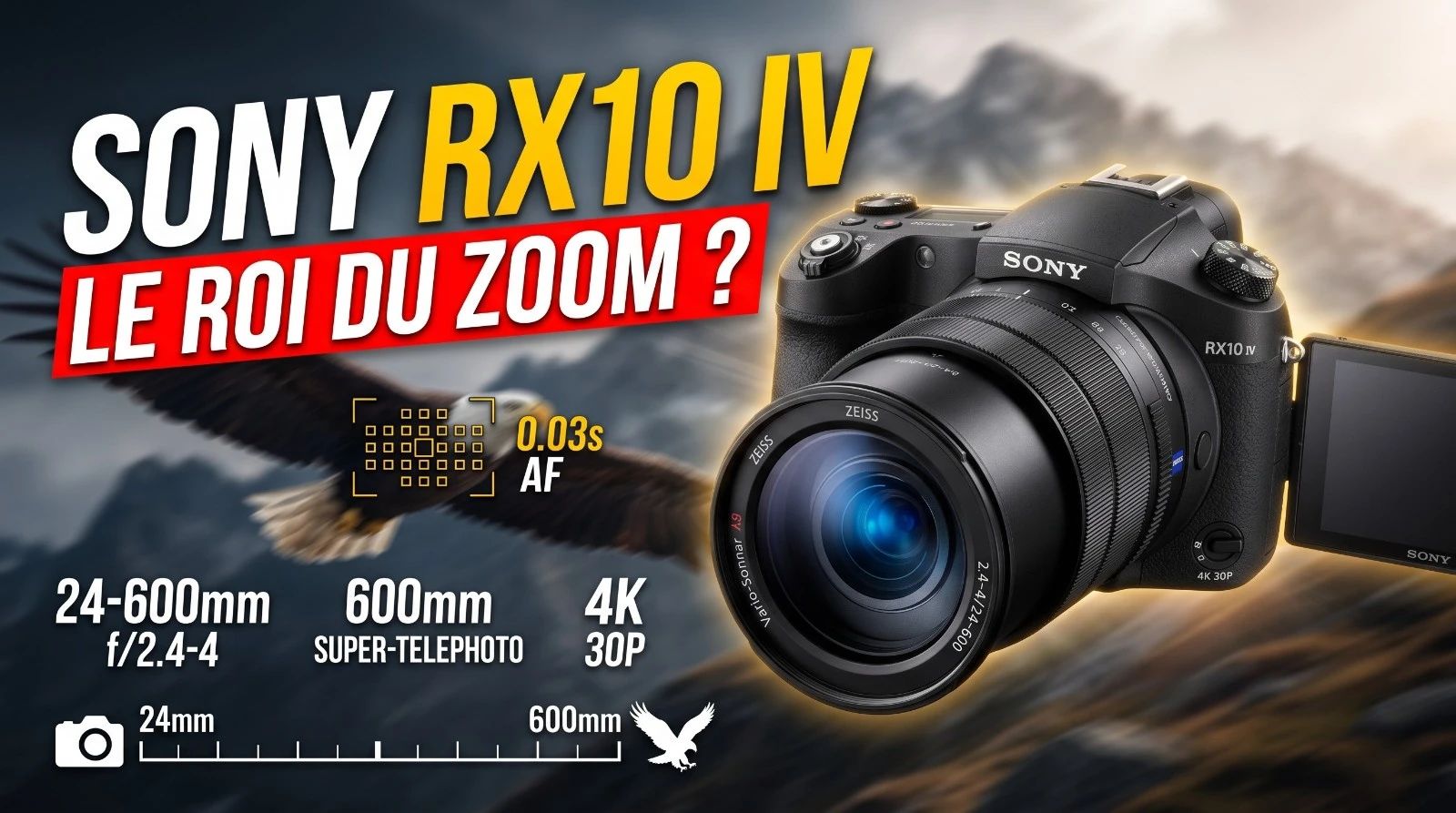
Sony RX10 V: the 1-inch sensor bridge camera that returns after 9 years
The Sony RX10 V revives the 1-inch bridge camera after a 9-year gap. No housings available yet, the 600mm zoom is irrelevant underwater, but the stacked sensor changes the equation. What it means for underwater photography.
Is the Sony RX10 V compatible with existing underwater housings?
Not yet. At the time of the RX10 V announcement, no specialised housing manufacturer (Nauticam, Ikelite, Sea&Sea) had announced compatibility. The physical design of the body has evolved from the RX10 IV, making older housings unusable. Expect 6 to 12 months after commercial availability before the first dedicated solutions appear.
Is the 600mm zoom useful for underwater photography?
Very little. Water absorbs light and reduces contrast as distance increases. Beyond a few metres, the aquatic medium requires working at short focal lengths to maximise sharpness and colour. The RX10 V's 600mm zoom is an asset on land for wildlife, not underwater where proximity to the subject remains the golden rule.
What is a stacked 1-inch sensor and why does it matter?
A stacked sensor integrates the processing circuits directly beneath the photodiodes, which dramatically accelerates read speed. The result is better autofocus tracking in burst mode, reduced rolling shutter in video, and significantly improved high-speed performance. For underwater photography involving movement (pelagics, fish schools), this is a concrete advantage.
Can the RX10 V replace a mirrorless camera for diving?
No. Even an excellent bridge camera does not replace the performance of an APS-C or full-frame mirrorless in difficult conditions (low light, depth). The RX10 V has the advantage of compactness and an integrated zoom, but its low-light limits remain those of a 1-inch sensor, smaller than mirrorless formats. It answers a different need.
Sony RX10 V: the 1-inch sensor bridge camera that returns after 9 years
Nine years. That is the gap between the Sony RX10 IV and the RX10 V. In a camera market that refreshes its line-ups every two or three years, this pause deserves an explanation Sony has not fully provided. What is certain is that the professional bridge camera with a long zoom and a 1-inch sensor effectively vanished from shelves during that period, and the RX10 V marks a return to a segment many had written off.
For underwater photography, this return is interesting without being immediately usable. Here is why.
What the RX10 V actually brings
The first thing to note is the sensor. The RX10 V carries a stacked 1-inch sensor - meaning a layered architecture - a technology Sony has progressively deployed across its camera range and one that concretely changes high-speed performance.
A stacked sensor reads data faster than conventional sensors, reducing rolling shutter in video and improving autofocus tracking in burst mode. For a wildlife-oriented bridge camera, that is a direct advantage. For an underwater bridge camera, it could prove useful on fast subjects: pelagics, circling schools of fish, sharks passing at close range.
It is also the common thread with another 1-inch sensor that drew attention previously: our article on the 1-inch sensor and underwater photography covered the reasons this sensor format offers an interesting balance between compactness and performance for diving.
The 24-600mm f/2.8-4.0 zoom is the second headline feature of the RX10 V. On land, that range is remarkable for wildlife and sports photography. Underwater, it is a different story.
The 600mm zoom: nearly irrelevant underwater
Water is not air. Beyond a few metres of distance in water, sharpness drops, contrast fades, and colours degrade to the point where the image becomes unusable regardless of how good the sensor is. The golden rule of underwater photography - one I have repeated through every session of the underwater photo and video training - is to get as close to the subject as possible.
The RX10 V's 600mm zoom is designed to capture an eagle at 300 metres in raking light. Underwater, that same focal length will not let you photograph anything at distance without losing most of the image quality.
The real advantage of the zoom underwater is its short end. A 24mm underwater corresponds to a reduced actual angle of view due to refraction, and that is where the RX10 V can express something interesting: the versatility of a quality short focal length in a compact body, without changing lenses between dives.
That positioning differentiates it from action cameras like the GoPro Mission 1 or the Insta360 X5, which offer no focal length control but dominate on extreme wide-angle and immediate water resistance without an additional housing.
The immediate problem: no housing available
This is the main brake on enthusiasm for underwater photography.
At the time of the RX10 V announcement, no specialised housing manufacturer (Nauticam, Ikelite, Sea&Sea, Isotta, or Aquatica) had announced a dedicated solution. The RX10 IV had its own housings, but the body design has changed enough to make those solutions incompatible.
In practice, this means a waiting window of at least 6 to 12 months before the market offers serious options - time to design, test and certify a housing for a new body. That is the reality of the underwater photo market: housings always arrive after camera bodies, and the first available models are not always the most refined.
For divers considering the RX10 V as a future underwater camera, an immediate purchase makes limited sense. Buying in anticipation, to build familiarity with the camera on land before eventually diving with it, could make sense for photographers who split their time equally between topside wildlife and underwater work.
A camera to watch, not to buy today
The DJI Osmo Action 6 and the Insta360 X5 remain the most direct choices for diving quickly with a capable camera. For hybrid land-sea photography with a single body, the RX10 V deserves real attention once housings become available.
What makes it potentially interesting for underwater photography is not its zoom - it is its sensor. A stacked 1-inch in a compact bridge body, with autofocus noticeably improved over the RX10 IV, opens possibilities for dynamic situations where previous bridges struggled to keep up.
The first underwater images will probably appear in 12 to 18 months, once testers have received their housings and completed their initial dives. That is the moment when it will be possible to draw a clear conclusion: does the stacked sensor genuinely change the underwater equation, or do the physical limits of the aquatic medium cap its performance as they cap every predecessor's?
In the meantime, a used RX10 IV with its existing housings and years of field feedback often makes more sense for someone who wants to dive now.
An announced return is worth less than images already made.
Sony RX10 V: the 1-inch sensor bridge camera that returns after 9 years | AquaExposure