The TG-6 has been replaced by the TG-7, but the principles of shooting in natural light are identical. What determines the quality of your images remains your white balance, your colour profile, your distance to the subject and your dive timing. Gear changes, the method stays.
How do you photograph mantas in natural light without flash?
Dive between 10am and 2pm for vertical light. Position yourself beneath the animal or in a low angle (15-45 degrees upward), sun at your back. Set white balance to 5000K, shutter speed 1/500s minimum to freeze the moving wings. Wait for the animal to pass above you rather than swimming up to meet it.
Can you learn pelagic photography without going to the Maldives?
Yes. Many pelagic species are accessible in the Mediterranean (groupers, barracuda schools) or in the Atlantic (blue sharks in the Azores, common dolphins). The positioning and light-reading technique can be learned on these species before heading to more distant destinations.
TG-6 without flash in the Maldives: how I learned to photograph pelagics with a compact
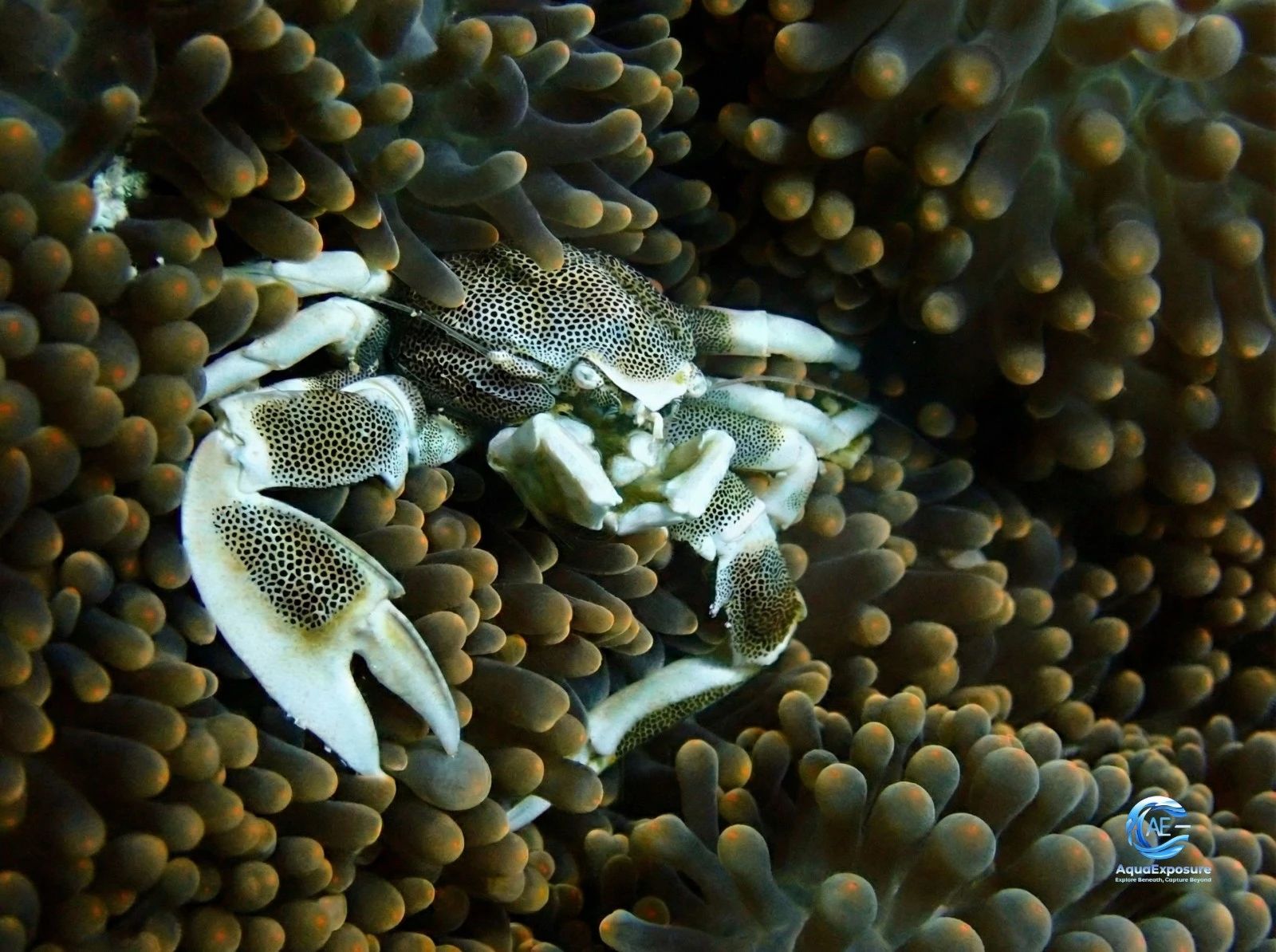
When I arrived in the Maldives as a diving instructor, I had a TG-5 in my pocket and a passion for photography that was far greater than my experience. The first thing I was taught to do with it: macro. It was gorgeous. But around me, there were mantas.
I will be honest: at the start, I did not really know what I was doing with that camera. I knew it was tough, waterproof, that it had a macro mode capable of impossible things 5 cm from a subject. And I had been trained like the vast majority of diver-photographers who start with a compact: nudibranchs, cleaner shrimp, small fish hiding in the coral. Everyone does that. The forums are full of it. So are the YouTube tutorials.
Except the Maldives are not just that.
The Maldives mean pelagics all the time. Mantas at cleaning stations. Blacktip reef sharks on the shallow flats. Leopard rays resting on the sand. Schools of trevally forming silver tornadoes at 8 metres depth. And there I was, spending my dives watching all of this from my macro position, lens pressed against a reef, wondering how I could ever bring back a photo of what was happening around me.
The problem was not the gear. The problem was that I did not yet know how to use it for anything other than what I had been taught.
The constraint that changed everything
I could have bought strobes. I could have built an artificial lighting system and shot pelagics with external light.
I did not. Not for budget reasons, even though a diving instructor's salary in the Maldives does not leave enormous room to manoeuvre. I did not because I had observed, dive after dive, what flashes did to the animals.
A manta being lit up by a strobe at a cleaning station leaves. Not necessarily fast, not necessarily far, but it changes her behaviour. It interrupts something. And I wanted these animals to stay. I wanted to observe them, understand their circuits, anticipate their trajectories. The photo came second. Respect for the animal came first.
So the question became: how do you take good pelagic photos with a waterproof compact, in pure natural light, without disturbing anyone?
It took me hundreds of dives to build an answer. Here is what I learned.
What the TG-5, then the TG-6, taught me about light
The first thing I understood is that my camera had a weapon I was not using: its f/2 lens.
f/2 is an aperture that most underwater compacts do not have. And underwater, where light is the most precious commodity, it is a difference that counts. At equal ISO sensitivity, the TG captures twice as much light as a camera at f/2.8. Without changing anything else.
But that aperture does not do everything. It gives you headroom. What you do with it is up to you.
Timing: parameter zero
Between 10am and 2pm, the sun penetrates the water surface at a sufficiently direct angle for light to truly reach down. Before 10am, it skims. After 2pm, it skims again. Those low-angle windows are what produce that soft, bluish effect associated with "atmospheric" underwater photos. It is beautiful. It is not what you need if you want colours.
To shoot in natural light without flash, I planned my dives around timing as much as around the site. A dive at 11am on a shallow flat at 6 metres is a golden dive for photography. A dive at 8am on the same site is a dive for wildlife, not for photography.
Depth: where colours still exist
Without flash, underwater colours vanish with depth. Red disappears first, from 3 to 5 metres. Orange follows. At 15 metres, only blue and green remain.
The useful working window for the TG without artificial light sits between 3 and 10 metres. That is where you still have enough light spectrum to produce images that do not need massive correction in post-production.
This is not a limitation. The Maldives have enormous amounts of life between 0 and 10 metres. Manta cleaning stations are often between 8 and 15 metres: by positioning yourself smartly, you can shoot from 6 to 8 metres looking slightly downward at an animal at 12 metres. You work with your depth, not the animal's.
Position: the only setting that changes everything
This is the parameter nobody mentions when discussing flash-free photography, because it has nothing to do with the camera.
If your subject is between you and the surface, you are photographing its shadow. Light comes from behind it. Its colours do not exist in your image.
If you are between your subject and the surface, with the sun at your back or at zenith, you are photographing its colours in direct light. The manta passes at 80 cm, you are slightly below her, the sun is behind you: her gills, her markings, her colours appear. Fully.
This positioning demands anticipation. It demands understanding the animals' circuits, their habits, their movement axes. It demands being in place before them, not chasing after them.
That is exactly what the Maldives taught me to do. And it is infinitely more useful than learning to fire a strobe.
The TG-6 is not just a macro camera
This is the misunderstanding that has clung to this range since its early days.
The microscope mode is spectacular. The ability to focus millimetres from the lens, to reveal textures invisible to the naked eye, is a rare feature at this price point. And it is what sellers highlight, because it is differentiating and impressive in a display.
But the TG-6 is also a 25mm equivalent wide angle. It is f/2 across the full focal range. It has effective stabilisation. It is a camera that, in the right conditions, produces images nobody expects from it.
A coral reef shot from below with the luminous surface in the background. A school of trevally in open water. A leopard ray approaching, resting on white sand. A manta photographed from underneath in surface light.
All of that, the TG-6 does. Without flash. That is what the photos in this article show.
What this constraint truly taught me
I am not necessarily recommending shooting without flash out of purism. Strobes are legitimate and powerful tools that enable things impossible in natural light, particularly at great depth or in difficult lighting conditions.
What I do recommend is spending a period, a season, a series of dives shooting without artificial light. Not for ideological reasons. Because this constraint forces you to develop skills you will never develop otherwise.
Reading light. Anticipating animals. Positioning yourself before they arrive. Understanding at what time, at what depth, at what angle your camera can produce something useful.
These skills, you then carry everywhere. With any camera. With or without flash.
That is the entire AquaExposure philosophy: first understand what is happening underwater, then choose your tool with full knowledge.
If you want to learn to read underwater light, to position yourself relative to animals, to move beyond macro and explore everything your compact can do, the training is right here.
The TG-6 has been replaced by the TG-7, but the principles of shooting in natural light are identical. Whether you use a second-hand TG-6, a TG-7 or an equivalent compact, what determines the quality of your images remains your white balance setting, your colour profile, your distance to the subject and your dive timing. Gear changes, the method stays.
How do you photograph mantas in natural light without flash?
The technique rests on positioning and timing. Dive between 10am and 2pm for vertical light. Position yourself beneath the animal or at a low angle (15-45 degrees upward), sun at your back. Set white balance to 5000K, Flat profile, shutter speed 1/500s minimum to freeze the moving wings. Do not swim up to meet the animal: wait for it to pass above you.
What shutter speed for photographing sharks in motion?
Minimum 1/500s for slowly swimming species (nurse sharks, resting reef sharks). 1/1000s for active species (grey reef sharks, hunting whitetip sharks). Speed sacrifices light, so compensate by opening wider (larger aperture) or by slightly raising ISO, within the 1600 limit on a compact.
Can you learn pelagic photography without going to the Maldives?
Yes. Many pelagic species are accessible in the Mediterranean (groupers, dentex, barracuda schools) or in the Atlantic (blue sharks in the Azores, common dolphins). The positioning and light-reading technique can be learned on these species before heading to more distant destinations. What you master in the Mediterranean, you apply in the Maldives with a higher wow factor.
Want a practical summary to take on your next dive? The free AquaExposure guide "The 7 Essential Underwater Photography Settings" is downloadable as a PDF. White balance, exposure, focus, distance, angles, pre-water checklist and natural light: the basics you can apply on your very next outing, without buying any gear. Download the free guide