How do you enter the Underwater Photographer of the Year?
Entries typically open at the end of the year for the following edition. The competition is open to everyone, amateurs and professionals alike. There are several categories (wide angle, macro, behaviour, black and white, conservation, smartphone). Entry fees are modest and submissions are made online.
Why is the smartphone category important for underwater photography?
It officially validates that photographic quality no longer depends on equipment price. A smartphone in a DiveVolk housing costing a few hundred euros can produce award-winning images in an international competition. This lowers the barriers to entry and encourages new divers to get started.
How can you improve your chances in an underwater photo competition?
The winning images at UPY 2026 share common traits: patience over expensive equipment, mastery of natural light, careful composition that looks spontaneous. Knowing your subjects and returning to dive the same sites lets you capture rare behaviours.
Is AI allowed in underwater photography competitions?
UPY 2026 allows standard digital processing (colour correction, noise reduction, cropping) but prohibits the use of AI to generate images or substantial portions of a photo. The distinction is clear: technically improving what existed at the moment of capture is acceptable, inventing what was not there is not.
UPY 2026: complete results and underwater photography lessons
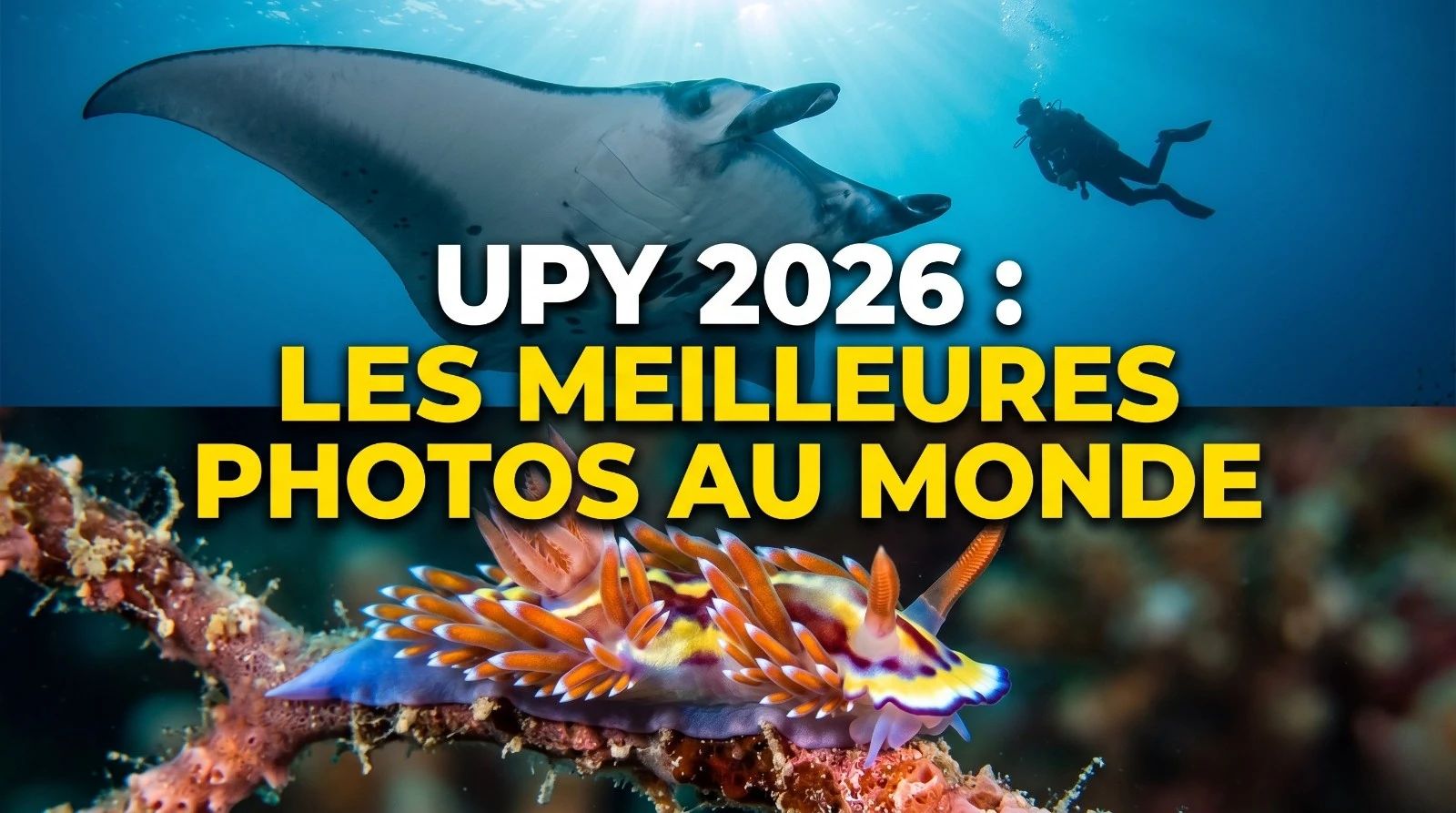
Every year, when the Underwater Photographer of the Year results drop, there is a moment of silence in the underwater photography community. You look at the winning images, you look again, and you think: this is why we dive with a camera. The 2026 edition, with over 7900 entries from around the world, is no exception.
The grand prize: "Rockpool Rookies" by Matty Smith
Australian Matty Smith takes the title of Underwater Photographer of the Year 2026 with "Rockpool Rookies", an image of two baby elephant seals in a rockpool in the Falkland Islands.
What strikes you about this image, beyond the technique, is the choice of subject and approach. No abyssal depth, no exotic equipment, no rare subject. Two baby seals in a pool. The beauty lies in the gaze, the composition and the natural light. It is a powerful reminder that the best underwater photos are not necessarily taken at 40 metres depth with 10,000 euros of gear.
The winners by category
In Wide Angle, French photographer Cecile Gabillon Barats wins the category with "Happy Baby". A francophone victory worth highlighting in a competition historically dominated by Anglo-Saxon and Japanese photographers.
In Behaviour, Japanese photographer Kazushige Horiguchi captures the precise moment when clownfish eggs hatch under a parent's watch. Timing measured in fractions of a second, requiring hours of motionless waiting in the water.
In Coral Reefs, Israeli Dr Tom Shlesinger presents "Underwater Meteor Shower", an image evoking an underwater starry sky, most likely corals in a nocturnal spawning phase.
In Black and White, Japanese photographer Shunsuke Nakano offers an image demonstrating that the absence of colour can reveal forms and textures invisible in colour.
The Up and Coming prize goes to American Sam Blount for his close encounter with a leopard seal lunging towards his lens. The kind of photo that makes you hold your breath just looking at it.
The conservation category and its message
The Save Our Seas Foundation Marine Conservation Photographer of the Year prize goes to Malaysian photographer Khaichuin Sim with "Innocence Meets Tradition", an image documenting the annual pilot whale hunt in the Faroe Islands. It is the type of image that makes you uncomfortable, and that is exactly its purpose. Conservation photography is not there to look pretty. It is there to bear witness.
The smartphone revolution
The landmark event of this edition is the creation of the first dedicated smartphone photography category, won by Jack Ho with a macro shot taken using a DiveVolk SeaTouch 4 Max housing. This subject deserves a full article of its own (and we wrote one), but its presence in the UPY results confirms a deep trend: the barriers to entry for quality underwater photography have never been lower.
What the winners teach us
Looking through the awarded images, a few common threads emerge.
Patience beats equipment. The animal behaviour photos that win prizes are almost always the product of hours of motionless observation, not superior technological setups.
Natural light remains queen. The 2026 grand prize was shot without flash or artificial lighting. The ability to read and use ambient light remains the skill that separates good photos from great ones.
Subject matters more than destination. You can win an international competition in a rockpool in the Falklands. You do not need to book a flight to the Maldives to make a memorable image.
And finally, composition is invisible. The best UPY photos look natural, spontaneous, almost accidental. But behind every "obvious" framing lie years of practice and dozens of dives on the same site.
7900 photos were submitted this year. The winners are those that make you want to look at them a second time. That might be the only rule that truly counts.
FAQ
How do you enter the Underwater Photographer of the Year?
Entries typically open at the end of the year for the following edition. The competition is open to everyone, amateurs and professionals alike. There are several categories (wide angle, macro, behaviour, black and white, conservation, smartphone) with beginner and advanced levels. Entry fees are modest and submissions are made online on the official UPY website.
Why is the smartphone category important for underwater photography?
It officially validates that photographic quality no longer depends on equipment price. A smartphone in a DiveVolk housing costing a few hundred euros can produce award-winning images in an international competition. This lowers the barriers to entry and encourages new divers to start underwater photography without a massive investment.
How can you improve your chances in an underwater photo competition?
The winning images at UPY 2026 share common traits: patience over expensive equipment, mastery of natural light, careful composition that looks spontaneous. Knowing your subjects and returning to dive the same sites lets you capture rare behaviours. Technique is necessary, but it is the story told by the image that makes the difference.
Is AI allowed in underwater photography competitions?
UPY 2026 allows standard digital processing (colour correction, noise reduction, cropping) but prohibits the use of AI to generate images or substantial portions of a photo. The distinction is clear: technically improving what existed at the moment of capture is acceptable, inventing what was not there is not.
Ready to submit your images to competitions? Our underwater photography training covers shooting, composition and post-processing to produce competition-level images.