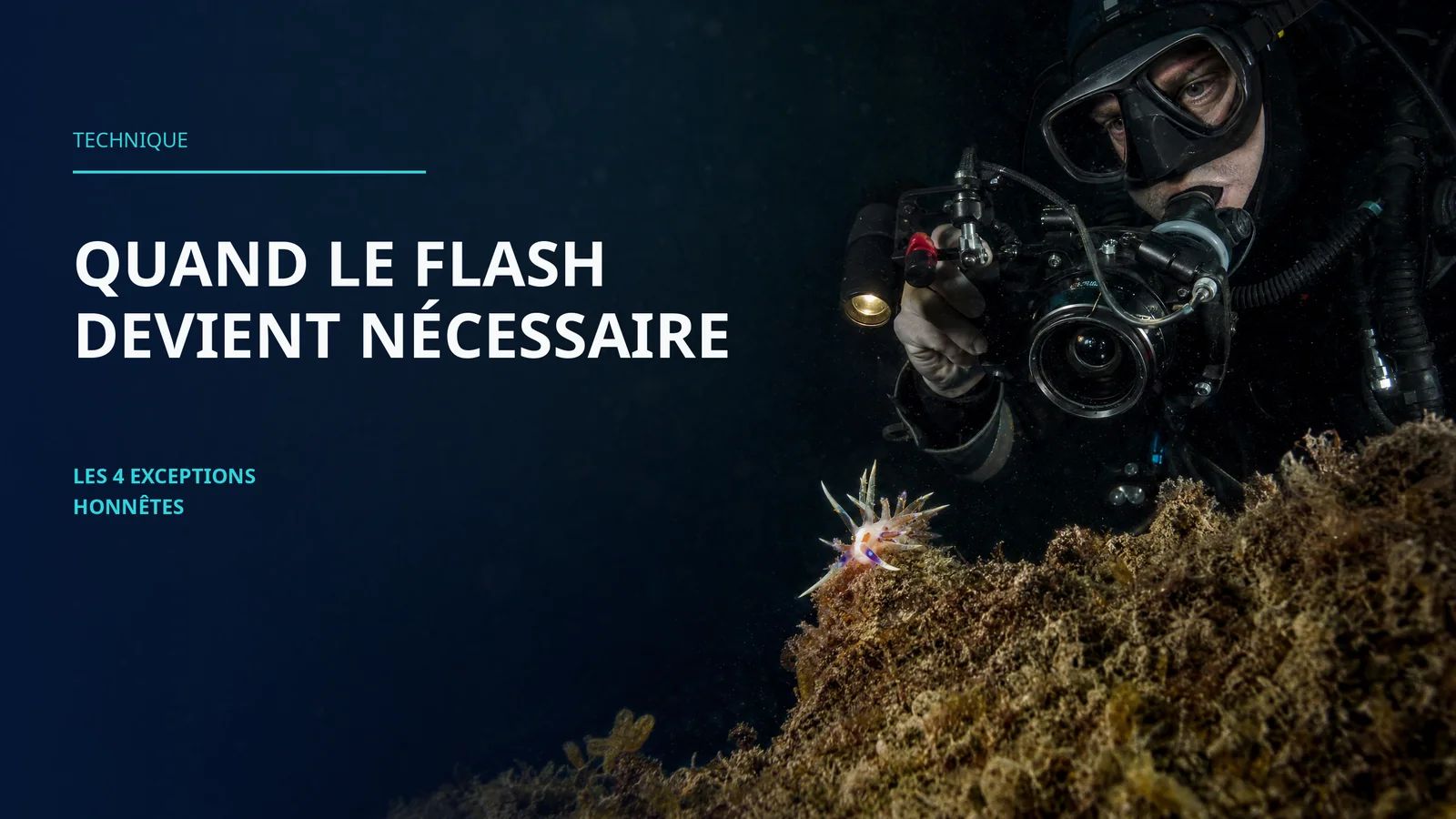
No. AquaExposure is against the reflexive and systematic use of flash. The four exceptions (night, dark macro, caves/wrecks, scientific documentation) are situations where flash is a legitimate tool, used with method and moderation.
What flash power should I use underwater?
The general rule is to use the lowest power possible. In macro, 1/16 to 1/8 is often enough. For night diving, 1/4 to 1/8. Backscatter increases with power, so always start low and increase if necessary.
Does flash really stress marine animals?
Yes. Studies from the University of Queensland have shown that repeated flashes stress wildlife and affect coastal ecosystems. Fish flee, cephalopods show signs of chromatic stress, and corals retract their polyps.
Can an LED torch replace flash?
For macro and ambient lighting, yes. An LED torch offers the advantage of continuous light: you see exactly what you're illuminating. For wide angle in dark environments, flash remains more effective.
Are red filters an alternative to flash?
No. At AquaExposure, red filters are not recommended. Post-production correction offers more control and flexibility than a physical filter whose effectiveness varies with depth.
How do I avoid backscatter with flash?
Three techniques: reduce the power, position the flash laterally (45 degrees minimum from the lens axis), and don't dive in water heavy with particles.
Can you photograph at night without any flash at all?
Yes, if you're photographing bioluminescence, it's actually mandatory. For other night subjects, a low-power LED torch can suffice if your camera handles high ISO well. But most underwater night photographers use controlled flash for macro subjects.
When Underwater Flash Becomes Necessary: The 4 Honest Exceptions
Flash in underwater photography is rarely necessary, but four situations justify it: night diving, macro in dark environments, caves and wrecks, and scientific documentation. In each case, responsible use (minimum power, indirect angle, counted triggers) makes the difference between a legitimate tool and an assault on marine life.
At AquaExposure, we teach natural light by default. That's our position, our conviction, and it's what produces the most authentic images in 95% of situations. But claiming flash never serves a purpose would be dishonest. There are contexts where natural light isn't enough, and ignoring them out of dogma would serve nobody.
This is the honest article. The one where I tell you exactly when flash has its place, and above all how to use it without turning your dive into a torture session for marine wildlife.
Why flash is problematic by default
Before talking about exceptions, let's remember why the rule exists. Underwater flash poses three fundamental problems.
The first is biological. A full-power flash at close range stresses marine animals. Fish flee. Cephalopods change colour (a sign of stress). Corals retract their polyps. Studies conducted by the University of Queensland showed that repeated flashes affect the immune responses of coastal ecosystems. This is not trivial.
The second is aesthetic. Flash creates frontal lighting that flattens volumes, generates hard shadows, and produces backscatter (suspended particles in the water that become white dots in your image). Natural underwater light creates atmosphere, depth, and mood that flash systematically crushes.
The third is practical. An underwater flash setup is bulky, fragile, expensive, and adds cognitive load to an activity that already demands plenty. The heavier your gear, the less agile you are, the less discreet you are, and the less animals accept you.
All of this remains true. And all of it explains why natural light is the first approach to master. But there are four situations where these drawbacks become acceptable when faced with the impossibility of doing otherwise.
Exception 1: Night diving
At night, there is no natural light. This is the most obvious and least debatable situation.
Why it's different
At night, the "flash or no flash" debate doesn't apply in terms of alternatives. Either you illuminate, or you don't photograph. The question becomes: how to illuminate responsibly.
The responsible method
Use a dive torch as your main focus light, set to the lowest possible power. Some torches offer a red-light mode, which is less disturbing for nocturnal wildlife. This is your primary working tool.
The flash serves only for the actual trigger. A single shot, reduced power (1/4 to 1/8 of maximum), indirect angle (the flash doesn't point directly at the animal but slightly above or to the side).
The basic rule: one to two triggers per subject, no more. If the image isn't good in two tries, move on to the next subject. Night diving offers extraordinary wildlife (crabs, shrimps, hunting octopuses, active nudibranchs), but this wildlife is vulnerable because it relies on darkness to feed and protect itself.
The best underwater night photos are those where flash reveals colours without destroying the nocturnal atmosphere. A flamboyant nudibranch on a dark rock, lit by a soft off-centre flash - that's an image that justifies the compromise.
Exception 2: Macro in dark environments
Macro is the discipline where flash makes the most technical sense, because lighting conditions at very close range are rarely sufficient.
Why it's different
In macro, your subject measures a few centimetres. You're 10-20 centimetres away. At this distance, even in full daylight, the subject is often in shadow (under an overhang, in a crevice, in the folds of a coral). Natural light doesn't always penetrate these micro-environments.
At close range, backscatter is less problematic because the water column between your lens and the subject is reduced. Less water between you and the subject means fewer illuminated particles.
The responsible method
Flash in macro is positioned laterally, not frontally. A 45-degree angle from the lens axis illuminates the subject without creating direct reflection or hard shadows. Power is reduced to the minimum needed: in macro, the subject is so close that even 1/16 power often suffices.
If you work with a smartphone in a housing or a GoPro, you don't have a dedicated external flash. A small LED torch positioned laterally does the same job. It's actually often preferable because the continuous light lets you see exactly what you're illuminating before you press the shutter.
What it looks like
Underwater macro with controlled lateral lighting produces spectacular images: the colours of nudibranchs, cleaner shrimps, and flatworms are revealed in all their richness. This is a case where flash adds genuine value with no simple natural alternative.
Exception 3: Caves, wrecks, narrow passages
The interior of a cave or wreck is an environment where natural light is absent or residual. Like night diving, this is a context where the question of alternatives doesn't arise.
Why it's different
In a cave, natural light sometimes creates extraordinary effects at the entrance (light beams, shadow play). But as soon as you go deeper, it's dark. Flash or a powerful torch becomes the only way to capture the interior.
Wrecks pose the same problem: the structure blocks light. Corridors, engine rooms, cabins are fascinating photographic environments but totally dark.
The responsible method
In caves and wrecks, the ethical constraint towards wildlife is lesser (there's generally less sessile life inside). The main constraint is safety: never sacrifice your attention to navigation and air management for a photo.
Flash in caves works best as off-camera lighting: a flash or torch placed on a rock or held by your buddy, creating lateral lighting that reveals rock textures and formations. Frontal lighting in caves is flat and uninteresting.
Tip: cave entrances offer the best photos. The contrast between interior darkness and the blue light outside creates silhouettes and spectacular natural frames, all in natural light.
What it looks like
Wreck and cave images with controlled lateral lighting have strong narrative power. Darkness is part of the story. Flash should not eliminate it, but reveal details within the darkness.
Exception 4: Scientific documentation
This is the least common exception for an amateur photographer, but it deserves mention because it illustrates a case where precision takes priority over aesthetics.
Why it's different
In citizen science and biodiversity documentation, the goal isn't to make a beautiful image. It's to produce an identifiable one: accurate colours, visible details, diagnostic angle. Marine observation protocols (Reef Check, BiObs) sometimes require standardised images where exact colour reproduction is critical.
The responsible method
A diffused flash at moderate power, at sufficient distance (30-50 cm minimum), with a single trigger per subject. The goal is identification, not portfolio. Take the image and move on.
If the identification photo is achievable in natural light with post-production correction, that's always preferable. Post-production colour correction is often sufficient to make an image identifiable without needing flash.
What it looks like
Useful images, not necessarily beautiful ones. And that's perfectly fine. Underwater photography has several functions, and documentation is one of the most important. If controlled flash helps identify a rare species or document the state of a reef, the compromise is justified.
The false exceptions: when flash seems necessary but isn't
"It's dark at 25 metres"
No. It's blue at 25 metres. That's not the same thing. Light is present, but warm colours are absorbed. Post-production correction recovers those colours without flash. This is exactly the topic of our article on colour loss at depth.
"My subject is dark"
A dark subject (a brown grouper, a grey sand bottom) doesn't need flash. It needs correct exposure and possibly a slight shadow adjustment in post-production. Flash on a dark subject produces an overexposed subject on a black background. That's never the desired result.
"I want true colours"
"True colours" underwater don't exist the same way they do on the surface. A clownfish at 15 metres isn't orange to your eyes, because red has been absorbed by the water column. Flash restores surface colours, not the colours of the environment. It's a legitimate aesthetic choice, but it's no more "true" than the natural blue underwater palette.
The AquaExposure bottom line
The AquaExposure position is not "never flash". It's: flash is a last-resort tool, not a reflex. If you can get the image without flash, do it. If you can't, use it with the minimum power, indirect angle, and number of triggers necessary.
It's a position that respects wildlife, produces more authentic images, and simplifies your equipment. And in the four exceptions above, flash has its place, provided it's used with awareness.
No. AquaExposure is against the reflexive and systematic use of flash. The four exceptions described in this article (night, dark macro, caves/wrecks, scientific documentation) are situations where flash is a legitimate tool, used with method and moderation.
What flash power should I use underwater?
The general rule is to use the lowest power possible. In macro, 1/16 to 1/8 is often enough. For night diving, 1/4 to 1/8. In caves, the power depends on distance, but always start low and increase if necessary. Backscatter increases with power.
Does flash really stress marine animals?
Yes. Studies from the University of Queensland have shown that repeated flashes stress wildlife and affect coastal ecosystems. Fish flee, cephalopods show signs of chromatic stress, and corals retract their polyps. The impact is all the greater when flash is powerful and triggers are numerous.
Can you photograph at night without any flash at all?
Yes, if you're photographing bioluminescence, it's actually mandatory. For other night subjects, a low-power LED torch can suffice if your camera handles high ISO well. But most underwater night photographers use controlled flash for macro subjects.
Can an LED torch replace flash?
For macro and ambient lighting, yes. An LED torch offers the advantage of continuous light: you see exactly what you're illuminating. The downside is generally lower power and less directional light. For wide angle in dark environments, flash remains more effective.
How do I avoid backscatter with flash?
Three techniques: reduce the power, position the flash laterally (45 degrees minimum from the lens axis), and don't dive in water heavy with particles. Backscatter is caused by suspended particles illuminated by flash. Less power and a lateral angle drastically reduce the problem.
Are red filters an alternative to flash?
No. At AquaExposure, red filters are not recommended. Post-production correction offers more control and flexibility. A red filter partially compensates for the loss of warm colours, but it reduces the amount of incoming light and its effectiveness varies with depth. Software correction is preferable.