Buddy Diving as an Underwater Photographer: Communication and Hand Signals
Buddy diving as an underwater photographer changes everything: roles, signals, protocols. Practical guide to keeping your buddy safe and informed underwater.
Can I dive solo to avoid buddy tension when I photograph?
Solo diving is not prohibited but requires specific training, appropriate equipment (SMB, redundant air, accessible cutting tool), and solid experience. It is not the answer to buddy tension. The right answer is a well-briefed buddy and clear signals.
My non-photographer buddy always gets impatient. How do I handle it?
Impatience usually comes from having no role. A buddy who waits without knowing what to do gets bored and anxious. Give them an active role: watching the environment, monitoring other divers' ascents, looking for other subjects. That transforms passive waiting into active participation.
Which photography-specific signals do you recommend as a priority?
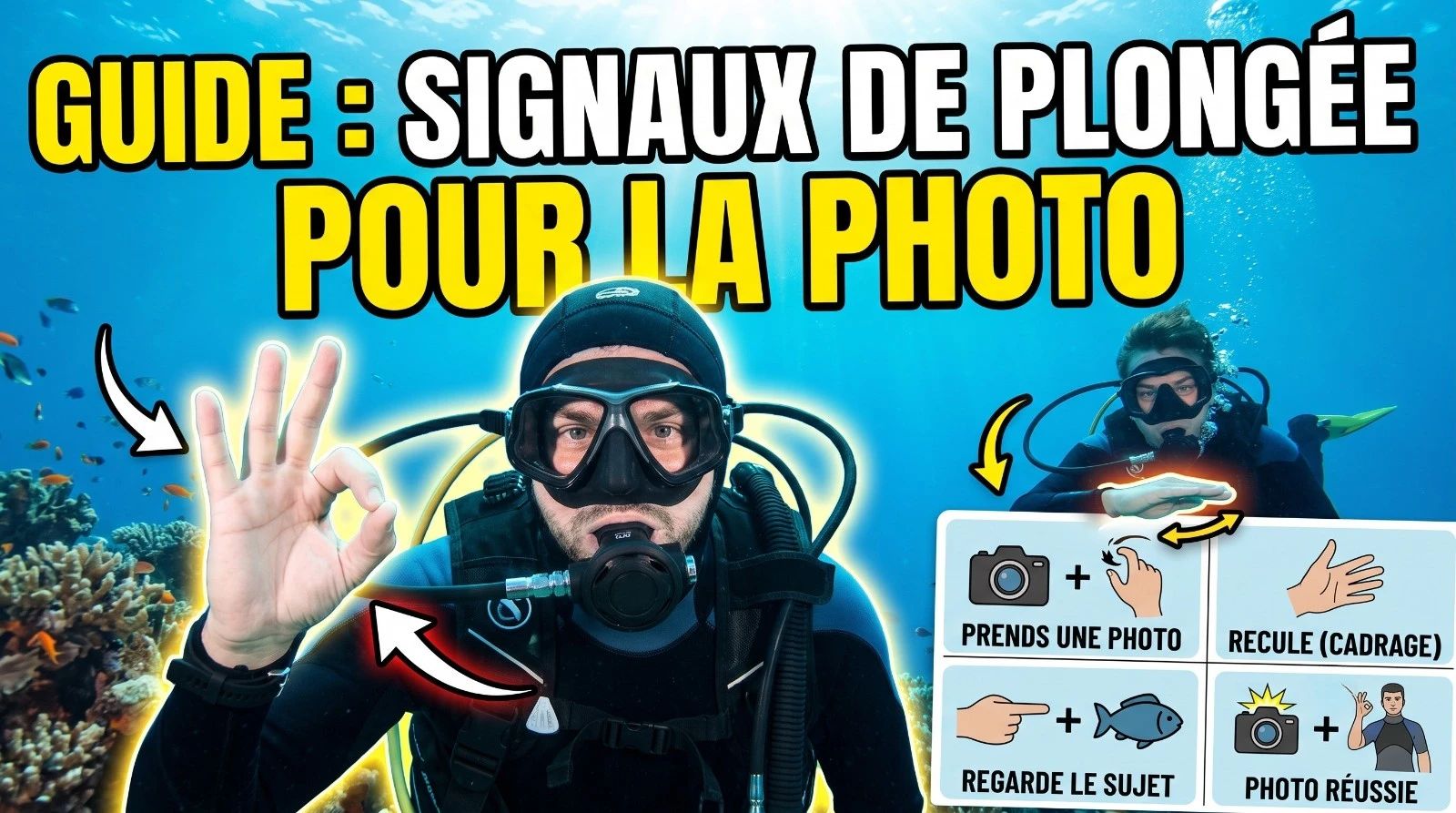
Three cover the majority of situations: "I found a subject, stay back" (closed fist, index pointing down toward subject, then open palm pushing toward buddy), "follow me at distance" (open palm in direction of travel, then two-finger "come" gesture maintaining distance), and "I need you right now" (repeated tapping on the head). These three handle 90% of photo-specific exchanges.
Should the buddy stay right next to the photographer?
No. The buddy rule is "maintained visual contact and rescue distance possible." In practice, 3 to 5 meters works well for a photo buddy: far enough not to disturb the subject, close enough to intervene. More important than distance: each diver knowing where the other is at all times.
How do I manage the buddy during macro work when I cannot look up?
In macro, full-concentration sequences can be long. Before diving into a subject, agree on a regular check-in signal: you look up every two minutes, confirm your buddy sees you, signal all is well. Set this internal clock before the dive, not underwater.
How do I handle end-of-dive when I am still on a subject?
This is one of the most common tensions. The rule: either diver's return signal always takes priority. If your buddy signals return, you finish your current frame and ascend. Not "just one more sequence." A missed shot can be replaced. Poorly managed buddy tension cannot be undone underwater.
Is it better to dive with two photographers to avoid these problems?
Two photographers manage subjects better together but tend to focus on their own images rather than each other's safety. Neither a magic solution nor a problem in itself. What matters is that both maintain environmental awareness and that signals are clear, regardless of the combination.
To learn how to get the most out of your gear underwater, discover the AquaExposure training.
Standard buddy diving assumes both divers are doing the same thing at the same time. In dive photography, that is almost never the case. The photographer looks through a viewfinder while the buddy waits. This asymmetry creates tension that neither party always understands. The solution is straightforward: the right signals and a proper briefing before entering the water.
What photography changes in the buddy dynamic
In standard diving, both partners explore at the same pace, change direction together, and naturally check each other's air and buoyancy. Communication is minimal because context is shared.
When one diver photographs, that shared context disappears.
The photographer is absorbed in their composition. Attention is concentrated on a subject. They may stay motionless for several minutes. They may move suddenly to follow an animal. They are no longer monitoring their buddy with the same regularity.
The non-photographer buddy, on the other hand, has nothing to do but wait. They do not know how long this will last. They do not know if the photographer needs them. The longer the wait, the more they wonder what they should be doing.
That is where tension comes from, not from bad intentions on either side, but from an information asymmetry and the absence of clear signals.
The limits of standard signals in a photography context
The standard dive signal code covers the needs of ordinary diving. It was not designed for photography.
"OK" means everything is fine. It does not mean "everything is fine, I am staying focused on this subject for three more minutes, please watch the right side during that time."
"Go that way" indicates a direction. It does not clarify "I am going there because I spotted a subject - follow me at a distance without approaching."
"Ascend" means go up. It does not say "I will finish this sequence and be ready to ascend in 45 seconds."
These nuances are not minor details. They are the difference between a fluid photo dive and a tense one. And they are resolved with two or three additional signals agreed before the dive, not improvised underwater.
Photography-specific signals
These signals do not replace the standard code. They complement it. They must be defined and tested before every dive, not improvised underwater.
"I found a subject - stay back"
Suggestion: closed fist with index finger pointing down toward the subject, then open palm pushed toward the buddy (stay there).
This signal indicates you are approaching the subject and need your buddy not to follow immediately. It gives the buddy a clear role: hold position, monitor the surroundings, wait for your "come see" signal.
"Follow me at a distance"
Suggestion: open palm in the direction of travel, then two-finger "come" gesture maintaining the current distance with the hand.
Useful when following a moving animal. It informs your buddy of your direction without asking them to shadow your path, which would often disturb the subject.
"Come see"
Suggestion: standard "come" signal (curled index) combined with a precise point toward the subject.
Invites the buddy to join your position to see the subject. Use when the sequence is done or when something is worth sharing.
"I need you right now"
Universal light-distress signal: repeated tapping on the head. Not photography-specific, but its interpretation must be clear: "stop what you are doing and come immediately," regardless of reason.
"X more minutes"
Suggestion: fingers indicating the number (1, 2, 3.) combined with a circular gesture (ongoing).
This is often the most missing signal. It gives the buddy time information that converts indefinite waiting into bounded waiting. Even if you are not sure of the exact time, a "two more minutes" signal settles the buddy's anxiety considerably.
The non-photographer buddy's role
A photographer's buddy is not on pause. They have a specific, active role that requires as much presence as photography itself.
Monitor the environment the photographer is no longer watching. When a diver looks through a viewfinder, they no longer see what is happening left, right, and behind them. The buddy sees all of that. They must alert if another group approaches, if a current picks up, if visibility changes.
Track the photographer's safety information. The buddy can monitor the photographer's surface computer if distance allows, and give the return signal when air or time reaches the agreed limit.
Scout for other subjects. A buddy who actively looks for interesting subjects in the surrounding area participates in the dive instead of waiting. And often they find what the photographer, focused on a single subject, would have missed.
Maintain visual contact. That is the primary responsibility. Not shadowing the photographer. Maintaining constant visual contact from a reasonable distance.
The photographer buddy briefing
I emphasize this in every AquaExposure session: a buddy briefing for a photo dive lasts at least 2 minutes more than for a standard dive. That time is rarely wasted.
The briefing covers:
Target subjects and zone: where exactly you are going, what you are looking for, at what depth.
Specific signals: the 4 or 5 signals agreed for this dive. Say them aloud and mime them at the surface.
Buddy role: be explicit. "While I am shooting, your role is to monitor the environment and alert me if anything changes." This is a task division, not a demotion.
Time management: maximum concentration time on a subject without a check-in, return signal, air reference.
Veto rule: remind yourselves that either diver's return signal always takes priority, without discussion underwater.
The buddy who approaches the subject during the shot. Often out of curiosity or impatience, the buddy moves closer and disturbs the subject at the moment of release. A clear "stay back" signal resolves this.
The photographer who gives no signal during a long sequence. The buddy does not know if everything is okay. Rule: lift your head from the camera at minimum every 2 to 3 minutes, locate the buddy, confirm a visual "OK." For the consequences of too long an absorption in a subject, see the article on task loading in dive photography.
The buddy signals return and the photographer ignores it. This is the most serious breach of the buddy rule. It must not happen, even for the shot of a lifetime.
Two photographers who lose track of each other. When both divers are photographers, the temptation is to scatter toward different subjects. The rule remains: maintained visual contact, rescue distance possible.
What night diving changes
Night diving amplifies all of this. Visual communication is limited to the torch beam. Signals must be even more explicit. Check-ins must be even more frequent.
For night photo dives, I add one extra signal to every briefing: the localization signal. Each diver should be able to make an identifiable torch gesture to signal their position to the other without having to approach. A circle of light pointed toward the bottom, for example, means "I am here, all good."
Getting better together
Photographer buddy dynamics can be developed. They improve with shared experience, post-dive debriefs ("did you have enough information from me?" "when were you worried?"), and the willingness of both parties to understand the other side.
A buddy who has photographed understands a photographer's needs better. A photographer who has played the guardian role understands the frustrations of waiting better. Both perspectives build finer underwater communication.
To work on buddy communication in a structured learning context, AquaExposure underwater photography training includes dedicated sessions on this topic, with exercises in the pool and in open water.
AquaExposure earns no affiliate commission on gear mentioned in its articles. Recommendations are based solely on field experience.
Buddy Diving as an Underwater Photographer: Communication and Hand Signals | AquaExposure