How to photograph cleaner shrimp and their cleaning stations: read the behaviour, position yourself without disrupting, and capture the moment of care.
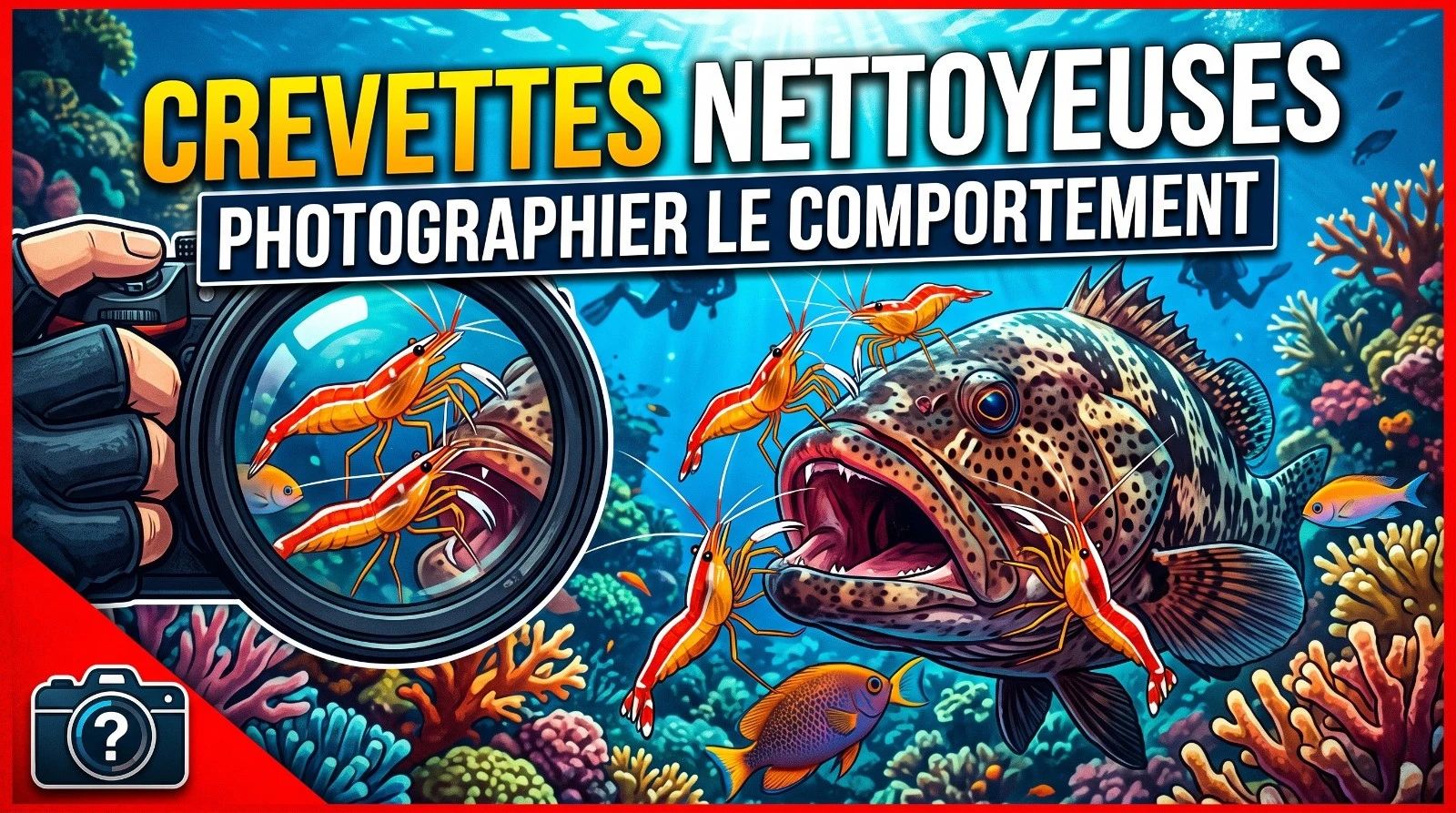
It is a fixed spot on the reef, often a coral head or an anemone, where cleaner shrimp and certain cleaner fish remove parasites and dead skin from the bodies of client fish. The same stations run for years. Finding a station means finding a natural theatre where behaviour repeats.
How do I photograph cleaner shrimp without interrupting the cleaning?
Approach the station before a client arrives, settle at a distance on a neutral support, and wait. Never wedge yourself between the shrimp and the fish coming to be cleaned. If the client leaves at your approach, you are too close. Let the interaction happen and shoot without moving.
What settings for behavioural macro?
Focus on the shrimp's appendages or on the client's eye, a fast enough shutter to freeze the movement, and a short burst to catch the right instant. In natural light at shallow depth, favour slight underexposure to keep detail. A close-up wet lens on a smartphone or GoPro handles most species.
Can cleaner shrimp clean a diver's hand?
Some species will climb onto a held out, motionless hand, but this is not good practice for the photo. The goal is to document natural behaviour, not to provoke it. A forced interaction gives an image that rings false and disrupts how the station works.
Where do I find cleaner shrimp while diving?
On tropical reefs, around anemones, coral heads and overhangs. In the Mediterranean some shrimp occupy crevices and gorgonians. Look for zones where fish hold a frozen posture, mouth open or fins spread: that is the signal that a station is active.
Why do my cleaning station photos miss the action?
Most often because you arrive during the interaction and make it stop. Timing is prepared in advance. Spot the station, set up before the client, and anticipate the moment of care. Behavioural photography rewards the one who waits, not the one who barges in.
Do I need a flash for these subjects?
Not systematically. Many stations sit at shallow depth where natural light is enough. In dark overhangs, a low intensity side light is preferable to a frontal burst that freezes the fish and breaks the interaction.
To learn how to get the most out of your gear underwater, discover the AquaExposure training.
There is a scene I can watch for long minutes without ever pressing the shutter, just for the pleasure of understanding what is happening.
In the Maldives, on a coral head the guides knew well, I once settled at a good distance from a cleaning station. A large fish arrived, held still, opened its mouth and spread its fins. Two small shrimp came out of their shelter and started working over its body, even inside the mouth and under the gills. The fish, which would have swallowed those shrimp in open water, stayed perfectly still and trusting. That truce, that tacit contract between potential predator and cleaner, is one of the finest behavioural subjects you can photograph underwater.
And most divers swim right past it, because they arrive too fast and make the whole thing stop.
A cleaning station is a theatre, not a backdrop
A cleaning station is not a point on a map, it is a place of life that runs on rules. Cleaner shrimp, sometimes joined by small cleaner fish, remove parasites, mucus and dead skin from the bodies of client fish. In exchange they get a meal and protection. This mutualism, where everyone wins, replays several times a day in the same spots, sometimes for years.
For the photographer it is a windfall. Unlike a fleeting encounter, the station is predictable. If you know where it is and how to behave, you can come back, settle in, and let the behaviour come to you. It is the opposite of hunting a subject, it is a stake-out.
This stake-out logic extends the spotting work I describe in the article on finding your macro subjects while diving. The cleaning station is one of the most rewarding micro-habitats to memorise on a site.
Spotting an active station
The most reliable sign is not the shrimp, it is the client. Look for a fish held still in an unusual posture: suspended in open water or settled, mouth wide open, fins spread, sometimes head down. This frozen posture is an invitation. It signals that the fish is putting itself in the position to be cleaned and that a station is working right there.
Around it, spot the shrimp's shelter: a crevice, the base of an anemone, an overhang under a coral head. In the Mediterranean some shrimp occupy rocky recesses and the base of gorgonians. On tropical reefs, anemones and coral bommies concentrate most of the activity.
This kind of reef reading is part of the macro eye you develop by exploring discreet subjects. I cover it in the guide to hidden macro subjects beyond nudibranchs, where cleaning stations rank among the richest scenes to document.
Positioning yourself without breaking the interaction
This is where it all plays out. A cleaning station is fragile. If you wedge yourself between the shrimp and its client, or if you arrive too fast, the fish leaves and the show stops.
Arrive before the client
The ideal is to spot the empty station, settle at a distance, and wait for a client to arrive. By getting into place before the action, you do not disrupt it. You become part of the decor, exactly as for a seahorse or a turtle. I detail this skill of erasure in the article on the scenography of erasure.
Keep perfect buoyancy
Behavioural macro demands total stability. A photographer who drifts or stirs up the bottom scares off the client and damages the station. Buoyancy and handling work is a prerequisite, not a detail. I break it down in the housing handling exercises.
Never provoke contact
Some shrimp will climb onto a held out hand. It is tempting, but it is not the subject. A provoked interaction gives an image that rings false and pulls the shrimp away from its role. We document natural behaviour, we do not stage it.
The photo technique of behaviour
Once in place, the difficulty becomes timing.
Focus and depth of field
Decide your point of attention before the action. Either the client's eye, or the shrimp's appendages at work. In macro, depth of field is tiny, so focus must be locked on the element that tells the story. On a smartphone in a housing or a GoPro, a close-up lens and a tap-focus on the key zone are enough. I detail accessible macro gear in the article on macro with a smartphone and GoPro.
Freeze the right instant
The moment of cleaning is brief. The shrimp enters the mouth, the fish shivers, a fin opens a little wider. Shoot a short burst to multiply your chances of catching the moment where everything aligns. A single isolated frame almost always misses the action.
Natural light first
Many stations sit at shallow depth in full light. Make the most of it. A frontal flash freezes the fish and often breaks the interaction. In dark overhangs, prefer a discreet side continuous light. I explain this no-flash doctrine in the article on the exceptions where flash becomes necessary, and behavioural macro is almost never one of them.
Why this subject is worth the patience
Behavioural photography tells a story the portrait cannot tell. A shrimp sitting on coral is pretty. A shrimp cleaning the mouth of a fish ten times its size is a narrative, a relationship, a moment of trust between two species. That is exactly what a good macro image looks for.
This subject connects naturally to the other species we learn to respect, like seahorses, which I cover in the guide to photographing seahorses. The common thread is always the same: observe first, understand the behaviour, and only release the shutter once your place is found.
If you want to learn to read the reef, anticipate behaviour and build this kind of image step by step, it is at the heart of what we work on in the AquaExposure course.
Cleaner Shrimp: Photographing Behaviour Up Close | AquaExposure