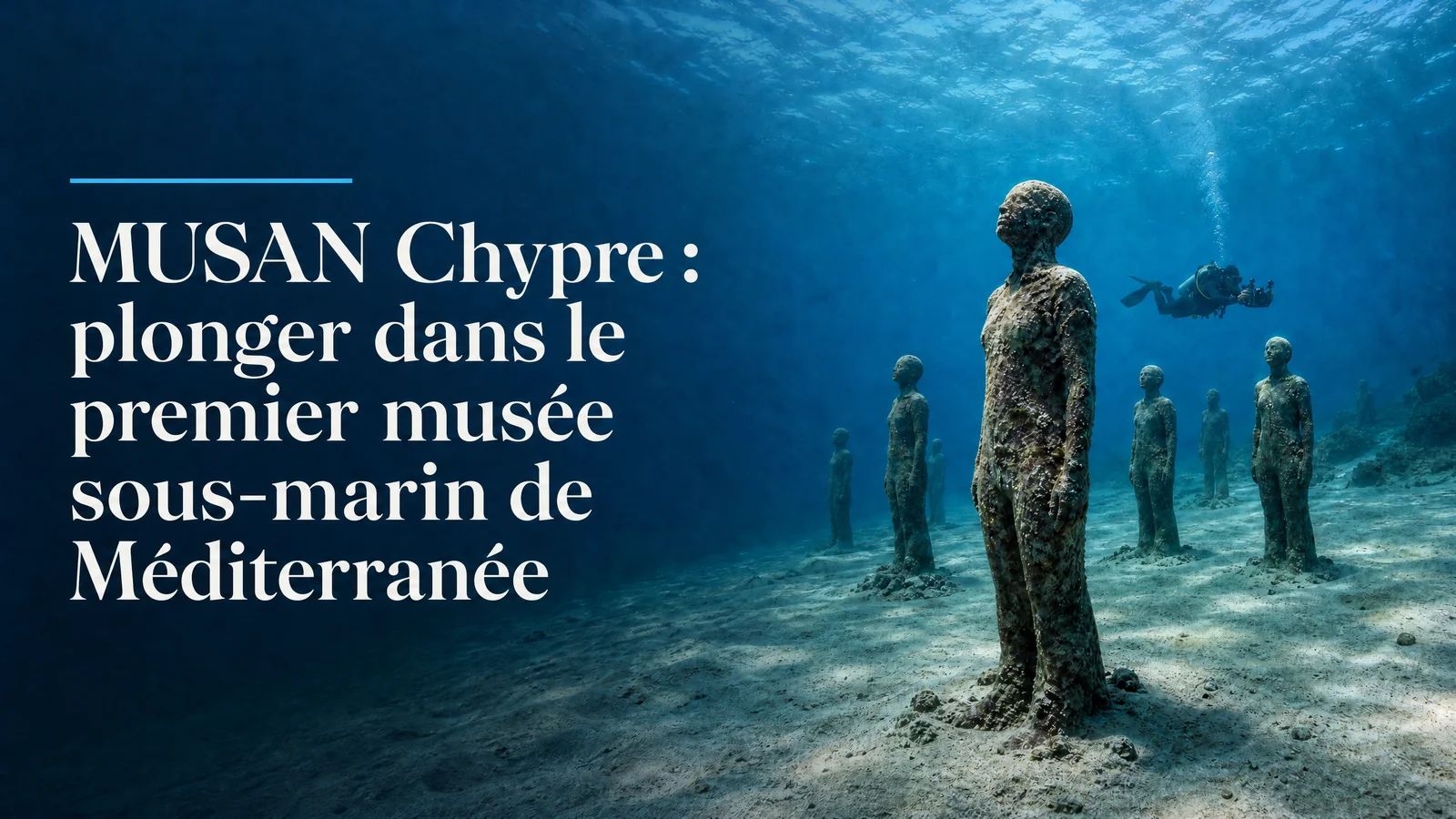
MUSAN Cyprus: Diving the Mediterranean's First Underwater Museum
93 underwater sculptures at 8 metres depth off Ayia Napa. MUSAN is one of the most singular dive sites in the Mediterranean, and exceptional terrain for underwater photography.
MUSAN (Museum of Underwater Sculpture Ayia Napa) is the first underwater museum in the Mediterranean. 93 marine concrete sculptures submerged at 8-10 metres depth, designed to become artificial reefs.
Do you need to be a certified diver to visit MUSAN?
No. The site is at 8 metres depth, accessible by snorkelling in calm weather and through a Discover Scuba Diving experience (introductory dive). Certified divers have more time and comfort to photograph the sculptures.
How do you photograph the MUSAN sculptures?
Wide-angle is essential to frame the complete installations. Natural light at 8m is excellent. The best times are morning for direct light and afternoon for spectacular backlighting.
To learn how to get the most out of your gear underwater, discover the AquaExposure training.
MUSAN Cyprus: Diving the Mediterranean's First Underwater Museum
There's a category of dive site I'd call "paradox sites", places where what you find underwater completely contradicts what you expected.
MUSAN (Museum of Underwater Sculpture Ayia Napa) belongs to this category in a fascinating, absolute way.
About 200 metres off Pernera beach, outside Ayia Napa, at 8 to 10 metres depth, you'll find ninety-three submerged sculptures. Life-size human figures, architectural forms, seated and standing silhouettes, grouped arrangements, all created by British artist Jason deCaires Taylor, and all progressively colonised by marine life since their installation.
The Mediterranean has made the art its own. And the result is something very few sites in the world can offer.
Jason deCaires Taylor: The Man Who Sculpts Reefs
Jason deCaires Taylor isn't simply a sculptor. He is, since his first underwater museum off Cancún (MUSA, Mexico), one of the most singular artists of our time, precisely because his work is designed to disappear, to be consumed by the sea, to become something other than what it was at the moment of creation.
His sculptures use inert, pH-neutral materials specifically chosen to encourage coral colonisation and the attachment of marine organisms. These aren't works that resist the sea. They're works that invite the sea to transform them.
At MUSAN Ayia Napa, the 93 installations depict human figures in everyday postures, scenes of life frozen in artificial stone. Discovering them underwater for the first time, the effect is striking: a silent community inhabiting the seafloor, covered in algae and coral, populated by fish moving between forms as in a miniature city.
What You See and Feel Underwater
The site is only 200 metres from Pernera beach, making it one of the world's most accessible underwater museums. At 8-10 metres depth, with the characteristic clarity of Cypriot waters, the sculptures are visible from the surface in calm conditions.
Underwater, the site reveals itself gradually. The 93 works aren't all clustered in one spot. They spread through a sand corridor framed by natural rock formations, creating a "gallery" experience that you traverse rather than view from a single fixed point.
What strikes you most, over multiple visits, is how the sculptures are becoming biological structures in their own right. Fish shelter, breed and feed there. Algae cover them in successive layers, occasionally revealing an almost landscape-like texture. Some figures are so heavily colonised they've already started losing their human legibility, which is precisely the artist's intention.
This is a site that ages well, and gets more interesting every year.
Photography at MUSAN: Natural Light as Your Main Tool
For an underwater photographer, MUSAN presents a rather exceptional combination of conditions.
The 8-10 metre depth is where Mediterranean natural light performs at its best: present enough to work without strobes, but filtered enough to create interesting contrasts and gradients. This is the zone where natural light images have the most character.
The human forms of the sculptures naturally create strong compositions. A face colonised with algae, photographed from below with the bright surface as background, produces the kind of image that appears in underwater photography competitions. Art and biology combine to offer subjects that nature alone wouldn't produce.
The light play on colonised textures, with the way algae create microreliefs, the way urchins and sponges add volume, are subjects that renew themselves with each dive, according to the time of day and season.
Practical recommendation: arrive mid-morning, when the sun is high enough to penetrate the water but not yet at zenith (which creates too much surface halo). A MUSAN dive between 9am and 11am in clear water is, photographically, an experience difficult to match anywhere in the Mediterranean.
A Marine Protected Area with Artificial Reef Status
MUSAN isn't only an artistic project. It received by Cypriot ministerial decree the status of Marine Protected Area with Artificial Reef, one of six such designated sites in the waters around Ayia Napa.
In practice, this means regulated access (you cannot descend freely without an accredited dive centre), a prohibition on any physical contact with the sculptures, and monitoring of colonisation that is the subject of regular scientific reports.
Ecologically, the results are already measurable. Fish inventories on the site show significantly higher density and diversity than surrounding bare sand areas. The project demonstrates that a well-designed artificial reef can, within a few years, contribute meaningfully to local biomass.
It's a fascinating case study in what art can do for marine conservation, provided it's approached with the same rigour as any scientific project.
How to Visit MUSAN: Snorkelling, Freediving or Scuba?
The site is accessible at three levels, making it one of the few places where an entire family can share the same marine experience from different perspectives.
Snorkelling: the shallower sculptures are visible from the surface. With good water clarity, you can get a clear sense of the whole installation without descending. For non-divers, it's a complete experience in its own right, particularly recommended with a wide-vision mask.
Freediving: for those with freediving ability (even at a beginner level, a descent to 8 metres is achievable with a few minutes' preparation), the sculptures reveal themselves in their entirety, in the silence specific to breath-hold diving. It's perhaps the most poetic mode of access.
Scuba diving: a PADI Scuba Diver certification (or equivalent) is required to dive the site on scuba. This is the access mode that allows the most complete exploration and the most developed photography. Viking Divers offers guided excursions to the site.
Visit MUSAN with Viking Divers
The Viking Divers team offers excursions to MUSAN as part of their Jeep safaris to the Ayia Napa region, a format that combines the underwater museum visit with diving in the region's marine caves and other sites along the Ayia Napa coast.
This is the most coherent way to discover everything this part of Cyprus has to offer underwater, in one or two days, with a guide who knows the area well.
MUSAN (Museum of Underwater Sculpture Ayia Napa) is the Mediterranean's first underwater museum, located 200 metres from Pernera beach in Ayia Napa, Cyprus. It features 93 sculptures by Jason deCaires Taylor, submerged at 8-10 metres depth. The site holds Marine Protected Area with Artificial Reef status.
#
Do I need to be a diver to visit MUSAN?
No. The site is accessible by snorkelling (sculptures are partially visible from the surface) and freediving. For complete exploration, a PADI Scuba Diver certification or equivalent is required.
#
Where is MUSAN and how do I get there?
MUSAN is 200 metres from Pernera beach in Ayia Napa, Cyprus. Access is either by swimming from the beach or by boat from a dive centre. Viking Divers organises excursions from Larnaca.
#
Who is Jason deCaires Taylor, the creator of MUSAN?
Jason deCaires Taylor is a British artist and sculptor known for underwater museums worldwide (MUSA Mexico, MOUA Bahamas, Museo Atlantico Canary Islands). His works use inert, pH-neutral materials designed to encourage marine colonisation and create artificial reefs.
#
Can I photograph the MUSAN sculptures?
Yes, photography is the primary activity on site. The 8-10m depth combined with Mediterranean natural light creates exceptional photographic conditions. Direct flash on the sculptures is inadvisable. Ambient light gives better results and protects the colonising marine life.
When Art Becomes a Reef
There's something, in the idea of a museum the sea is progressively consuming, that says something important about the relationship between human creation and natural time.
Jason deCaires Taylor didn't set out to create timeless works. He wanted to create works that age quickly, that disappear under life, that dissolve into something larger than themselves. In fifty years, some of these sculptures may be unrecognisable, covered in coral, inhabited by anemones, transformed into something other than what they once were.
That will probably be their most accomplished state.