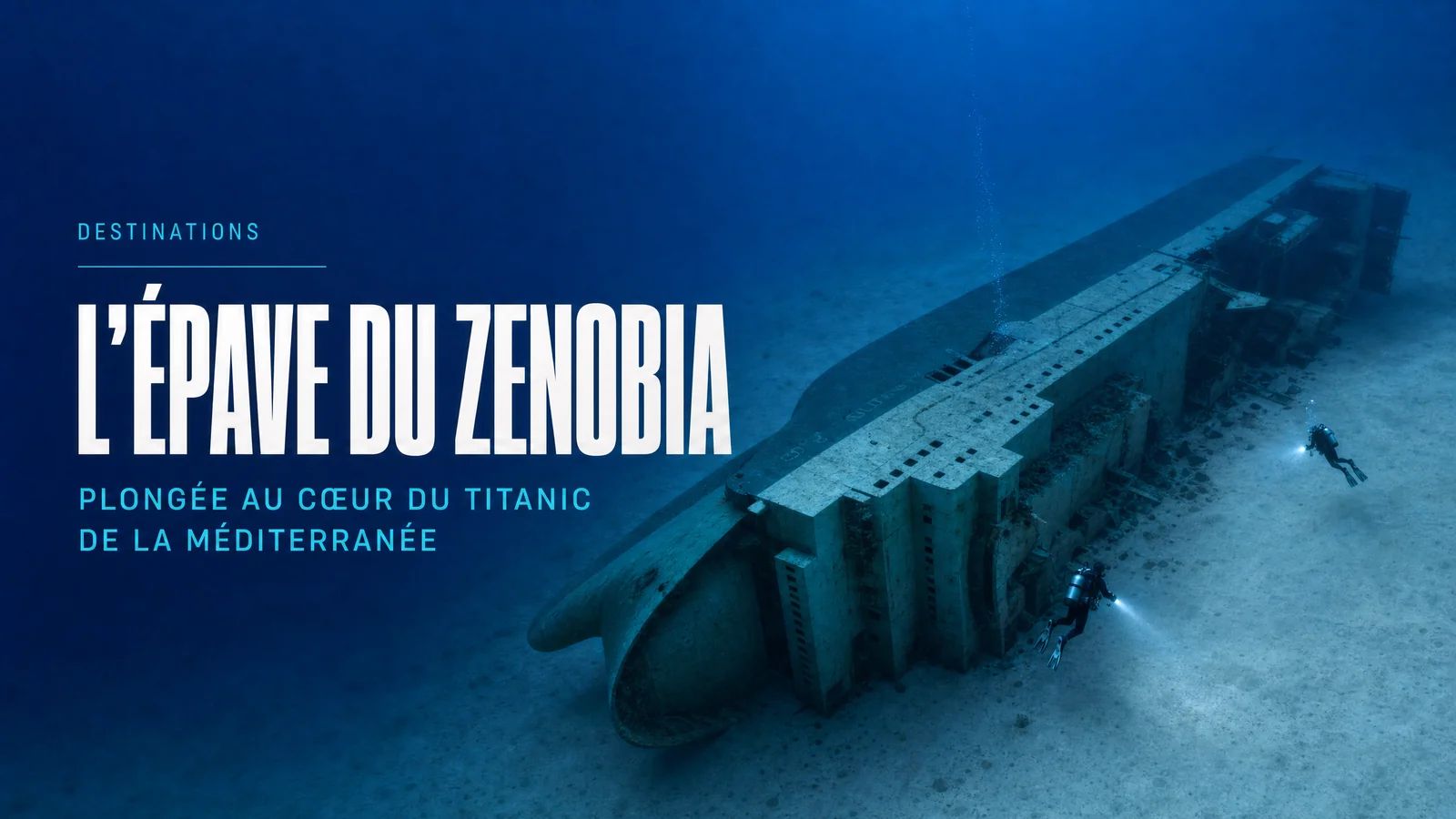
The Zenobia Wreck: Diving the Titanic of the Mediterranean
The Zenobia is one of the world's top 10 wreck dives. Complete guide: history, depth, marine life, photography tips, and why this site deserves far more respect than most divers give it.
To learn how to get the most out of your gear underwater, discover the AquaExposure training.
The Zenobia Wreck: Diving the Titanic of the Mediterranean
About one nautical mile off the coast of Larnaca, in waters of a clarity that still surprises first-time visitors, lies a 172-metre Swedish ferry that never reached its destination.
Since I first had the chance to dive the Zenobia with the Viking Divers team, I've understood why divers from around the world add Cyprus to their list, not as a beach destination, but as a genuine underwater pilgrimage.
It's also on this wreck that I learned one of the most important lessons of my time as a diving instructor: rigour is not optional. It is the single condition that guarantees you make it back to the surface.
The Story of a Ferry That Never Delivered Its Cargo
The MS Zenobia was a Swedish Challenger-class ro-ro ferry, built in 1979 at the Kockums shipyard in Malmö. At 172 metres long and 28 metres wide, it was among the most modern vessels of its type operating in the Mediterranean, designed to carry hundreds of trucks and trailers between Europe and the Middle East.
Its maiden voyage, in spring 1980, was supposed to connect Sweden to Syria via the Suez Canal.
It never made it past the eastern Mediterranean.
Shortly after departure, a computer fault in the ship's ballast system caused asymmetric seawater intake, creating a progressive list to port. Attempts to correct it failed. The ferry continued its route anyway, the list growing day by day, until the crew was forced to divert to Larnaca.
In the early hours of June 7th, 1980, the MS Zenobia sank just off the Cypriot coast, taking with it more than a hundred trucks and trailers still chained to its cargo decks. No lives were lost.
Since that evening, the wreck has rested on its port side, between 16 and 42 metres deep, less than an hour's boat ride from Larnaca harbour.
What You'll Find Down There
There are wrecks where imagination does most of the work, where you try to piece together what the ship might have been.
On the Zenobia, imagination barely gets a chance. Everything is still there, more or less intact, in a state of preservation that continues to astonish visitors more than four decades on.
#
The Truck Hold
The most striking scene on the entire wreck sits inside the hull. The trucks are still lined up, some still chained to their anchoring points, as if the cargo were still waiting to be delivered. Barracudas file past the sides of the trailers. Groupers settle beneath the chassis frames.
There is something very, very particular about this sight, something that holds both the feel of an industrial museum and the quiet of an underwater cemetery.
#
Superstructure and Deck
Moving back outside, the bridge, funnels, cafeteria windows and roro loading doors each offer natural frames for photography. The Mediterranean light, which penetrates cleanly down to 20-25 metres without losing its quality, transforms certain angles into genuinely painterly compositions.
The two massive propellers at the stern end of the wreck are probably the most photographed subjects in Cyprus. Not without reason. Their scale, their slightly tilted position following the wreck's list, and the decades of marine colonisation they've accumulated make them among the richest photographic subjects in Mediterranean diving.
Marine Life: From Grouper to Barracuda, and the Occasional Turtle
Forty-five years of continuous occupation have made the Zenobia one of the most densely colonised artificial reefs in the eastern Mediterranean. The site hosts spiralling columns of barracudas and jacks above the hull, morays installed in every crevice, octopuses tucked under truck frames, triggerfish in the outer sections, and stingrays deeper down.
And turtles. It isn't unusual to spot one or two per dive, resting calmly on a railing or rising to the surface above the superstructure.
This kind of animal presence isn't luck. It's the direct result of a protected wreck in relatively preserved waters, where human pressure remains measurable. One more reason to treat this site with the respect it deserves.
Underwater Photography on the Zenobia: What You Need to Know
Technically speaking, the Zenobia is one of the most rewarding sites for underwater photography in the Mediterranean. Visibility regularly exceeds 20 metres, often reaching 30. Currents are nearly non-existent. Natural light works down to unusual depths.
A few principles that make all the difference:
Ambient light first. The wreck is too large to be lit by strobes, and in most situations, flash tends to flatten exactly what you're trying to preserve: volume, atmosphere, the sense of depth. Learning to expose by natural light on the Zenobia is learning something you'll use on every large-structure site you ever visit.
Wide-angle as a narrative tool. A 10-17mm fisheye or a 10-20mm rectilinear lens will let you fit an entire truck inside the frame. That's what the Zenobia is: big. Very, very big.
Black and white for form. When light is low and the subject is industrial, converting to black and white reveals structures that colour would drown. The funnels, the propellers, the truck holds: these subjects gain enormously from monochrome treatment.
Rigour: What This Wreck Taught Me About Humility
There are dive sites that forgive approximations. The Zenobia is not one of them.
Its maximum depth of 42 metres places the full wreck well beyond the standard recreational frame. Penetrations into the truck hold require perfect buoyancy control, careful air management and, above all, an honest assessment of your own limits.
What I've seen on wrecks like this is what overconfidence produces in practice: a diver who misjudges their level, who commits to an interior section without the technical skills to exit it calmly, who panics and becomes a risk: to themselves, but also to their guide and their diving partners.
This isn't a hypothetical scenario. It's something instructors and dive guides encounter regularly in recreational diving today, where the democratisation of certification has sometimes left behind the humility that the practice requires.
What Viking Divers taught me on this site is precisely this: diving the Zenobia is fine. Diving it while honestly knowing your limits is better. And diving it alongside a guide who knows every section of it by heart is the only way to get the full experience.
Recommended level: Advanced Open Water (or equivalent) minimum for the outer structure and shallower zones. Experienced diver with wreck specialisation for penetration sections. Local guide strongly recommended at every level.
Dive the Zenobia with Viking Divers
The Viking Divers team runs daily boat trips to the Zenobia from their base in Pyla, on the Larnaca-Dhekelia road.
They're one of the few centres that combines genuine intimacy with the wreck and real technical standards, plus a complete infrastructure for photographers (equipment rinse stations, photo-specific briefings, guides who know the best angles).
Practical Info - Zenobia
Depth
16m (upper deck) to 42m (lower hold)
Average visibility
20 to 30 metres
Currents
Nearly absent
Minimum level
Advanced Open Water + wreck specialisation recommended
Best season
April to November (water 22°C–28°C in summer)
Distance from Larnaca
1.5 km (approx. 15–20 min by boat)
Access
Boat only
Recommended operator
Viking Divers, Pyla, Larnaca
FAQ - Diving the Zenobia
#
What diving level do I need to dive the Zenobia?
Advanced Open Water (PADI, SSI or equivalent) is recommended for the outer structure and shallower sections. For interior penetrations and the truck hold, wreck diving training is strongly advised. The 42m maximum depth places certain zones in the technical diving range.
#
How deep is the Zenobia wreck?
The Zenobia lies on its port side between 16 and 42 metres deep. The most accessible section (upper deck, superstructure) sits between 16 and 24 metres. The lower holds and cargo decks descend to 36–42 metres.
#
When is the best time to dive the Zenobia?
The site is accessible from April to November. Visibility is often best in spring, when the water is still cool and particularly clear. Summer brings water temperatures of 27–28°C for maximum thermal comfort. Avoid December–March due to surface conditions.
#
What marine life will I see on the Zenobia?
Abundant and varied. The wreck hosts barracudas, groupers, moray eels, octopuses, triggerfish, jacks and stingrays. Sea turtles are regularly spotted, particularly on the outer sections and above the superstructure.
#
How do I organise a dive on the Zenobia from Larnaca?
Viking Divers, based in Pyla on the Larnaca-Dhekelia road, runs daily boat dives to the Zenobia with experienced guides and detailed briefings. The site is 1.5 km offshore, about 15-20 minutes by boat.
A Wreck You Won't Forget
Forty-five years on from its sinking, the MS Zenobia hasn't stopped surprising those who make the trip.
There is something, in the sight of those trucks lined up in the dark of a hold at 36 metres, that goes beyond sport diving. Something that holds both the shock of scale and the meditative quality of stopped time: cargo that was never delivered, chains still taut, the Mediterranean having covered everything with its life and its shifting light.
Come back up with that in your eyes, and you'll understand why divers cross entire seas just to go down there.
Dive With Us in Cyprus
Planning a trip to Larnaca? Our partner Viking Divers runs daily boat dives to the Zenobia, for all levels, with guides who know every corner of the wreck.