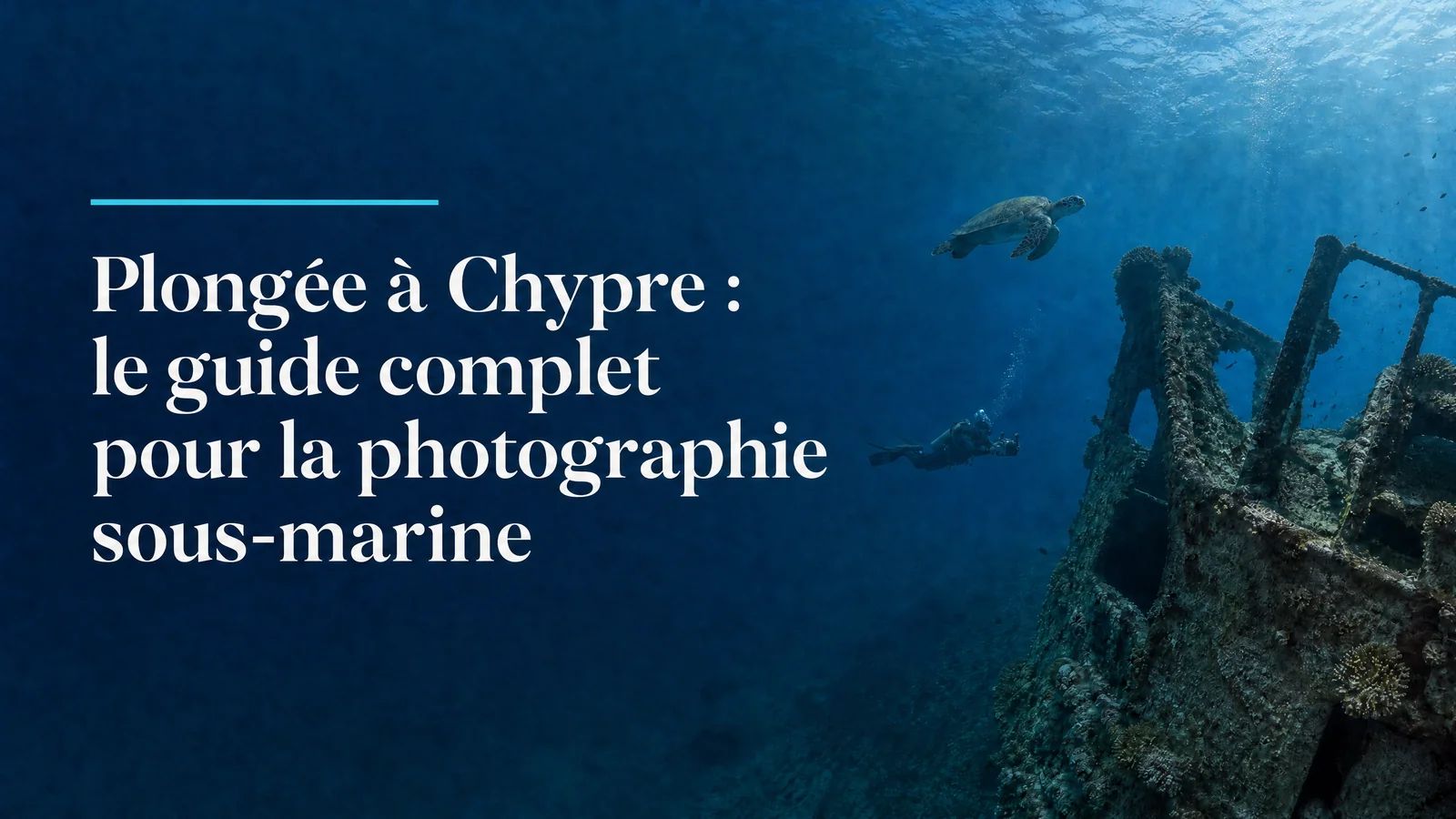
Diving in Cyprus: The Complete Guide for Underwater Photography
Cyprus is one of the most accessible dive destinations in the Mediterranean, and one of the least known to underwater photographers. A complete guide by an instructor who learned the craft there.
To learn how to get the most out of your gear underwater, discover the AquaExposure training.
Diving in Cyprus: The Complete Guide for Underwater Photography
For several years, I passed through Cyprus the way many diving professionals pass through a formative period: working there, accumulating hours underwater, gradually discovering that this island had far more to offer than its image as a Mediterranean beach destination suggested.
This guide is a summary of what I learned in Cypriot waters, from the perspective of an instructor and photographer who worked there with Viking Divers, who dived the Zenobia multiple times, who encountered his first regular sea turtles at Ayia Napa, and who had the chance to discover MUSAN when this underwater museum was still relatively new.
Cyprus doesn't occupy the same position in the global diving imagination as the Red Sea or the Maldives. And that's precisely why it deserves your attention.
Why Cyprus Is an Underrated Dive Destination
The eastern Mediterranean doesn't have the tropical biodiversity of the great dive destinations. That needs to be said honestly.
What it does have (and what many tropical destinations don't) is a water clarity and natural light quality that's difficult to find anywhere else in the world. Visibility around Larnaca and Ayia Napa regularly reaches 20 to 30 metres, sometimes more. Currents are weak. Summer water temperatures (27-28°C) allow diving in a light wetsuit or shorty.
And above all, Cyprus has the Zenobia.
The Zenobia wreck, 1.5 km off the coast of Larnaca, is regularly ranked among the world's top 10 wreck dives. A 172-metre intact ferry at an average visibility of 25 metres, with over a hundred trucks still secured to its cargo decks. A site of a scale and quality that the Mediterranean offers nowhere else.
The Key Sites
#
The Zenobia: The Centrepiece
The MS Zenobia wreck is the main reason thousands of divers choose Cyprus each year over other Mediterranean destinations. A Swedish ferry that sank on 7 June 1980 during its maiden voyage, the Zenobia rests on its port side between 16 and 42 metres depth, 1.5 km from Larnaca.
What you'll find: trucks in the cargo holds, an almost intact superstructure, two monumental propellers, barracudas, groupers, moray eels, octopuses, rays, turtles.
What to know: Advanced Open Water minimum recommended, local guide strongly advised, wide-angle lens essential, natural light preferred.
An hour's drive from Larnaca, the Ayia Napa region concentrates a second set of major dive sites.
MUSAN (Museum of Underwater Sculpture Ayia Napa) is the Mediterranean's first underwater museum: 93 sculptures by Jason deCaires Taylor at 8-10 metres depth, accessible by snorkelling, freediving or scuba. A site where art and ecology combine in a genuinely singular way.
The marine caves along the Ayia Napa coast offer penetrations through limestone formations with fascinating light effects, a different type of experience, complementary to the wreck and the museum.
Sea turtles frequent the posidonia meadows in this area, particularly at Konnos Beach, Kalamies Bay and Sirena Bay, as well as Green Bay at Protaras. Encounters with these animals are possible, provided you adopt a respectful approach.
Cape Greco, accessible from Larnaca via Viking Divers' Jeep safaris, offers boat dive sites of a visual quality that often surpasses even the sites in Larnaca Bay. Visibility there is remarkable and marine life is denser than you'd expect for the Mediterranean.
The HMS Cricket wreck is a local secondary site, less spectacular than the Zenobia but genuinely interesting for divers who want to vary their wreck experience.
And some sites occasionally offer encounters with seahorses, one of the most unexpected surprises Cyprus has to offer those who know how to look quietly.
Our Partner on the Ground: Viking Divers
For over thirty years, Viking Divers has been based in Pyla, on the Larnaca-Dhekelia road. It's one of Cyprus's first PADI 5 Star centres, run by Tasos and Mina, a family whose teaching rigour and technical expertise have trained hundreds of divers and instructors.
What sets Viking Divers apart from more anonymous operations: intimate knowledge of the sites (Zenobia, MUSAN, caves, Cape Greco), Tasos's equipment repair skills (a rare and valuable service in the region), adaptation to all levels including families with children, and a philosophy of rigour that shows in every briefing and every outing.
This is the team we dive Cyprus with. Without reservation.
Underwater Photography in Cyprus: Why the Conditions Are Ideal
For underwater photographers, Cyprus offers a combination of conditions that's difficult to find elsewhere in the Mediterranean.
Visibility: 20-30 metres on average, sometimes more. This is the primary condition for wide-angle photography.
Light: the eastern Mediterranean has a natural light quality that allows working without flash on virtually all sites. This is what makes the Zenobia so photogenic.
Diversity of subjects: monumental wreck (Zenobia), art museum (MUSAN), marine caves, wildlife (turtles, barracudas, groupers, seahorses). In a week in Cyprus, a photographer can cover very different photographic registers.
Accessibility: the depth of the main sites (16-24 metres for the Zenobia at its shallower sections, 8-10 metres for MUSAN) makes them accessible from Advanced Open Water level, without specialist technical equipment.
Best period: April to November. Visibility is often at its best in spring (April-May). Summer (June-September) offers the most comfortable water temperatures (27-28°C) and the most stable weather conditions.
Getting there: Larnaca International Airport is the main airport, 10 km from Viking Divers. Direct flights from most European capitals are available in season.
Accommodation: the Larnaca region offers a complete range of hotels across all budgets. For dives from Viking Divers, any accommodation within a 20 km radius of Larnaca is practical.
Formalities: Cyprus is a member of the European Union. EU nationals: national ID card sufficient. Non-EU: check visa conditions for your nationality.
FAQ - Diving in Cyprus
#
Is Cyprus a good destination for underwater photographers?
Yes, particularly for wreck photography and large-structure subjects. Visibility of 20-30 metres, quality natural light and the presence of the Zenobia (world top 10 wreck) make it one of the best Mediterranean destinations for this type of photography.
#
What diving level is required for Cyprus?
Most main sites are accessible from Open Water level. The full Zenobia requires Advanced Open Water minimum. Penetration zones require additional experience. MUSAN is accessible by snorkelling at all levels.
#
When is the best time to dive in Cyprus?
April to November. Visibility is often best in spring. Summer offers the most comfortable water temperatures (27-28°C). July-August are the busiest months. Book ahead.
#
Are there sea turtles in Cyprus?
Yes. Loggerhead turtles (Caretta caretta) and green turtles (Chelonia mydas) frequent Cypriot waters, particularly around Ayia Napa and Protaras. Best observation period: June to October.
#
Can families dive in Cyprus?
Yes. Viking Divers offers activities adapted to all levels and ages, including beginner PADI courses and children's equipment. The Ayia Napa region also offers snorkelling sites accessible to the whole family.
#
Which dive centre do you recommend in Cyprus?
Viking Divers, based in Pyla on the Larnaca-Dhekelia road, is our trusted partner in Cyprus from our time working and training on the island. Family-run PADI 5 Star centre founded in 1993, with particular expertise on the Zenobia and Ayia Napa sites.
Cyprus, as You May Never Have Heard It Described
There are destinations you know because they make the cover of dive magazines. And there are others you discover by working, spending weeks diving them in all conditions, at all hours, with all kinds of groups.
Cyprus belongs to the second category.
It isn't a spectacular destination at first glance. But it's a destination that rewards those who take the time to understand its sites, dive them with the right people, and come back.
The Zenobia is there, 1.5 km from shore. So are the turtles, for those who know how to wait. And Viking Divers has been there since 1993 to make sure the diving goes well.