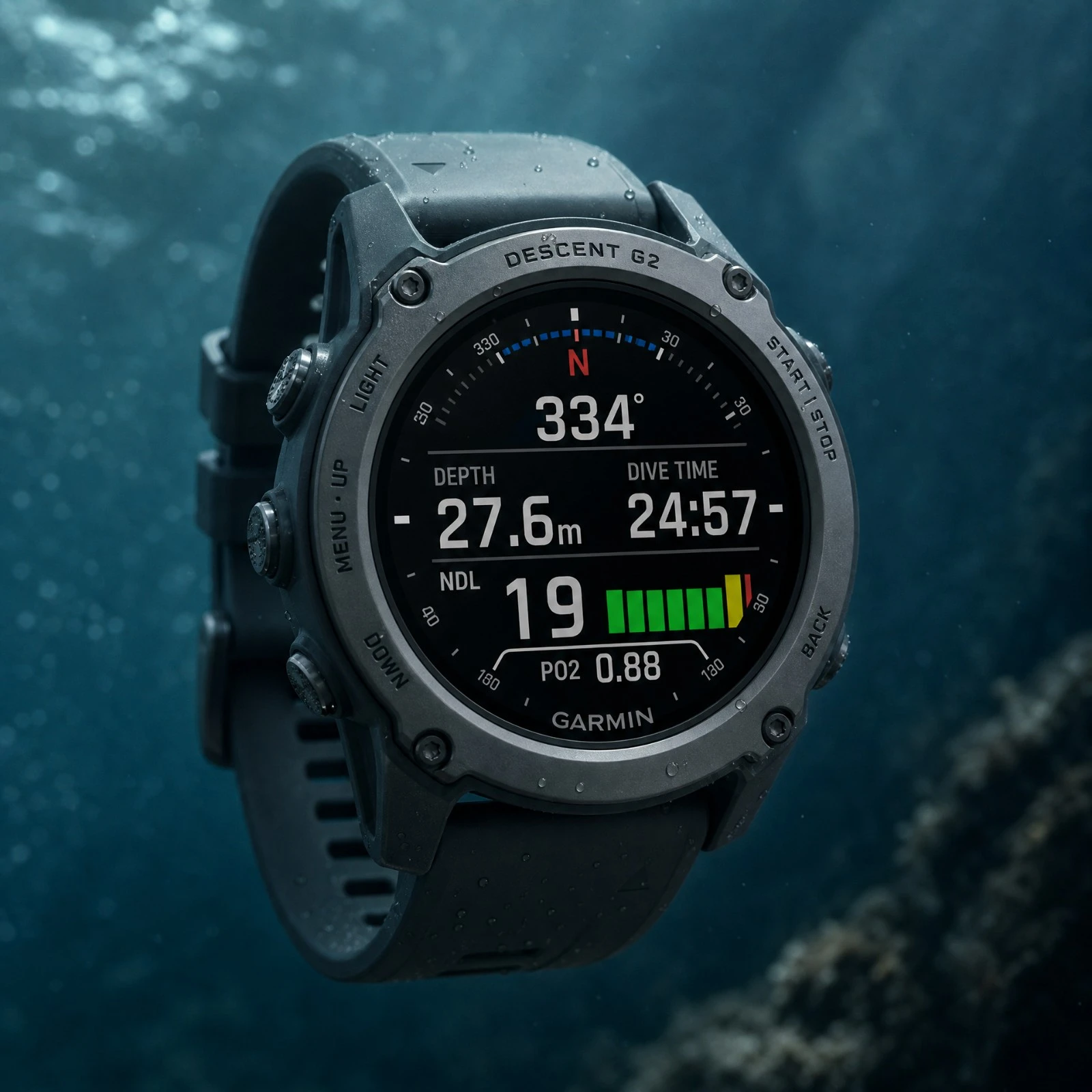
Technical review of the Garmin Descent G2 smartwatch computer. Features AMOLED screen, 100m depth rating, Trimix/CCR support, but no air integration.
To learn how to get the most out of your gear underwater, discover the AquaExposure Training.
Introduction
In the world of diving, choosing a dive computer is a decision that goes far beyond simple aesthetic preference. It's an essential companion, a guarantor of our safety underwater, and its ergonomics, readability, and algorithm are all aspects that deserve careful consideration. For a long time, the equation between compactness and visual comfort seemed unsolvable, often forcing compromises. Dive watches, while practical for everyday use, struggled to offer the rich display capabilities of larger models. The arrival of the Garmin Descent G2 in 2025, with its stunning AMOLED screen, promises to challenge these assumptions. But beyond this visual innovation, it's crucial to understand whether this instrument meets the requirements of demanding dives, where reliability and precision are paramount.
The Verdict in Summary
Overall score: 4.7/5
| Criterion | Score | What it means |
|---|---|---|
| Algorithm & settings | 5.0/5 | The Bühlmann ZHL-16C, which can be modified with Gradient Factors, offers a reference decompression safety level. |
| Air & multi-gas | 5.0/5 | Exceptional software versatility, managing up to 12 gases and the rebreather (CCR) mode. |
| Screen & ergonomics | 4.4/5 | The 1.2-inch AMOLED screen, bright and touch-sensitive, significantly improves readability underwater. |
| Battery life | 4.6/5 | With 27 hours in dive mode, the rechargeable battery provides peace of mind for several days. |
| Connectivity & app | 4.5/5 | The Garmin Dive ecosystem allows for smooth and intuitive management of dive data. |
| Compass & instruments | 5.0/5 | A three-axis digital compass and a precise variometer ensure reliable underwater navigation. |
| Robustness & depth | 4.6/5 | A sapphire crystal and a robust case, certified to 100 meters, provide exceptional durability. |
| Price & customer service | 4.5/5 | A competitive price for a computer offering advanced features. |
Detailed Analysis
O1 Algorithm & Tiers: The Core of Security
Diving safety relies on a solid foundation, and the decompression algorithm is its cornerstone. The Garmin Descent G2 utilizes the Bühlmann ZHL-16C model, an undisputed reference in the world of technical diving. This choice is not arbitrary, it offers divers the ability to customize the Gradient Factors, allowing them to adapt the decompression process to their individual profile, fatigue level, or the nature of the dive. The display is so clear that even with thick gloves, the information on decompression stops and ascent time (TTS) remains easily accessible. The addition of a "Large Numbers" mode further enhances this clarity, even in conditions of limited visibility. This approach inspires confidence, and transparency is essential for divers who know that every decision underwater matters. The reliability of this algorithm, combined with a clear presentation of information, gives the G2 a perfect score in this category, providing peace of mind for even the most demanding dives.
O2 Air & Multi-Gas: Remarkable Software Versatility
Gas management is a cornerstone of modern diving, whether it involves air, enriched Nitrox, or complex Trimix mixtures. The Garmin Descent G2 excels in this area, offering the ability to manage up to 12 different gases, with Nitrox compatibility reaching up to 100% oxygen. Even better, it natively integrates rebreather (CCR) mode, a feature often reserved for high-end dive computers. This software versatility is highly appreciated because it opens the door to a wide range of dives, from recreational explorations to the most advanced technical dives. However, it's important to note the complete lack of air integration on this model. This is a deliberate choice by Garmin, which positions the G2 as a compact computer for those who prefer the reliability of a mechanical pressure gauge or who use it in conjunction with another system. While this absence does not detract from the quality of the algorithm, it should be considered in your diving workflow.
O3 Screen & Ergonomics: The Visual Revolution
The screen is often the first point of contact with a dive computer, and its quality is crucial for comfort and safety. The Garmin Descent G2 marks a significant departure from its predecessor, the G1, by adopting a 1.2-inch color AMOLED touchscreen display with a resolution of 390 x 390 pixels. This technology offers exceptional brightness and contrast, making information perfectly readable even in bright light or in dark depths. To compensate for the compact size of the screen, an "Large Numbers" mode has been intelligently implemented, allowing users to highlight essential data such as TTS (Time-To-Surface) or depth. Underwater, the touchscreen gives way to five waterproof inductive buttons, which are remarkably responsive even when wearing thick gloves. This is ergonomics designed for action, an interface so intuitive that you almost forget it's there, allowing you to focus fully on the marine environment.
O4 Autonomy & Battery: Endurance for Exploration
Even a bright AMOLED screen can be power-hungry. However, the Garmin Descent G2 successfully combines visual performance with remarkable battery life. Powered by a rechargeable battery, it promises up to 27 hours in dive mode. This endurance is a major advantage for diving cruises or multi-day expeditions, where access to a charging source may be limited. No need to worry about the battery after each dive, the G2 accompanies you with consistent reliability. This peace of mind is invaluable, offering such generous battery life that you can string together dives without any anxiety, allowing you to focus solely on the beauty of the underwater world.
O5 Connectivity & App: The Garmin Ecosystem
In an increasingly connected world, dive computers are no exception. The Garmin Descent G2 integrates Bluetooth, enabling seamless synchronization with the Garmin Dive app. This app is a true digital dive logbook, offering detailed analysis tools for your dive profiles, bottom times, and decompression stops. It's such a comprehensive interface that managing your data becomes effortless, a simple and effective way to track your progress and share your adventures. Firmware updates via OTA (Over-The-Air) ensure that your computer always benefits from the latest improvements and features, without complex intervention. The Garmin ecosystem promises a consistent and enriching user experience, from underwater to post-dive analysis.
O6 Compass & Instruments: Precision at Your Fingertips
Underwater navigation is an art that requires precision and reliability. The Garmin Descent G2 features a three-axis digital compass with compensation, which works perfectly underwater. This compass is an essential tool for orientation, whether it's to follow a course, find your starting point, or explore a new site. In addition, a variometer with audible and vibrating alerts provides you with real-time information about your ascent and descent speed, a crucial element for respecting decompression stops and preventing decompression accidents. The integration of an apnea mode, with specific features, further expands the capabilities of this instrument. It's such a comprehensive suite of instruments that you have all the necessary information for safe and secure navigation, even in the most complex environments.
O7 Durability & Depth: Designed for Adventure.
Diving is a demanding environment, and the equipment must be up to the challenge. The Garmin Descent G2 is certified EN13319 for a depth of 100 meters, attesting to its robustness and reliability. Its case, made from recycled plastic recovered from the oceans (OBP), is topped with sapphire glass. This choice of materials is not insignificant: sapphire glass is renowned for its exceptional scratch resistance, ensuring perfect screen readability even after numerous dives. It's a design so carefully considered that it reflects Garmin's desire to offer a durable instrument, respectful of the marine environment we explore. The G2 is ready for adventure, a reliable companion that won't let you down, even in the most challenging conditions.
O8 Price & Customer Support: A Thoughtful Investment.
The price is often a determining factor when choosing a dive computer. Launched at around €700, the Garmin Descent G2 positions itself aggressively in the market, offering access to cutting-edge features in a compact format. This is such a competitive price that one might wonder how Garmin manages to offer this level of performance. Regarding after-sales service (customer support), Garmin benefits from a premium network worldwide. However, the customer support of a large multinational electronics company can sometimes be a frustrating experience. While replacement units are often offered in case of recognized defects under warranty, the representatives are not always specialized in diving, and the processing times can be longer. It is sometimes necessary to return the device at your own expense. This isn't necessarily a negative point on the overall rating, but it's a factual reality to consider. The standard 2-year warranty meets expectations, but the quality of the experience will often depend on the user's persistence.
Who is this computer for?
The Garmin Descent G2 is designed for a diverse range of divers, but with specific needs in mind. It's ideal for technical or recreational divers who want an ultra-bright display and a discreet watch format, while preferring to manage air using a mechanical pressure gauge. It's the perfect companion for those who appreciate the versatility of Garmin's software (multi-gas, CCR) and its connected ecosystem, without requiring integrated air management on the wrist. Its robustness and battery life make it an excellent choice for travelers and those who enjoy dive cruises. However, this computer is not ideal for divers who absolutely rely on air management via a transmitter, or for those who, due to presbyopia, require a very large screen for optimal readability. It's a matter of finding the right balance, choosing the tool that precisely matches your diving style and preferences.
Customer Service and Support
The After-Sales Service (SAV) is often overlooked when making a purchase, but it becomes very important in case of need. For Garmin, the SAV is that of a large multinational consumer electronics company. This means you benefit from an extensive network and the possibility of replacement if the failure is recognized under warranty. This is a strength, guaranteeing that you won't be left without a solution. However, the experience can sometimes be less smooth than that offered by brands specializing in diving. The representatives are not always experts in the underwater world, which can lead to delays or misunderstandings. Sometimes it is necessary to persevere, and the cost of returning the device may be your responsibility. Therefore, it is recommended to go through an authorized reseller who can act as a liaison and guide you through the process. The standard 2-year warranty is a legal minimum, but the quality of support will depend heavily on your ability to navigate a system that can sometimes be complex.
Nutrition
The Garmin Descent G2 is powered by a rechargeable battery, a choice that has both advantages and disadvantages. The main advantage is convenience: no need to change batteries, just a simple recharge is required. It's such a practical solution that you almost forget about the limitation. The 27-hour battery life in dive mode is more than sufficient for most uses, including multi-day cruises. However, this means remembering to bring your charging cable and having access to a power source. For long trips or expeditions in remote areas, it's always wise to have a portable power bank or adapter on hand. This is a different management system compared to replaceable batteries, a habit to get used to, but which offers great flexibility and reduces waste.
Links to other models from the same brand.
If the Garmin Descent G2 has caught your attention, it's worth exploring other offerings from the brand. Garmin offers a diverse range of dive computers, each with its own specific features. For wrist-mounted air integration, you might consider the Garmin Descent Mk3. If you're looking for a simpler and more affordable model, the Garmin Descent S1 could be a relevant option. Each model caters to different needs, and it's essential to compare them to find the one that best suits your diving activities.
CTA Comparator
To compare this computer with other models, see our diving computer comparison tool.
© 2026 AquaExposure. All rights reserved. Reproduction prohibited without authorization.
Share
Table of Contents
- 01Introduction
- 02The Verdict in Summary
- 03Detailed Analysis
- 04O1 Algorithm & Tiers: The Core of Security
- 05O2 Air & Multi-Gas: Remarkable Software Versatility
- 06O3 Screen & Ergonomics: The Visual Revolution
- 07O4 Autonomy & Battery: Endurance for Exploration
- 08O5 Connectivity & App: The Garmin Ecosystem
- 09O6 Compass & Instruments: Precision at Your Fingertips
- 10O7 Durability & Depth: Designed for Adventure.
- 11O8 Price & Customer Support: A Thoughtful Investment.
- 12Who is this computer for?
- 13Customer Service and Support
- 14Nutrition
- 15Links to other models from the same brand.
- 16CTA Comparator
Questions about the Journal
Can I use the photographs from this journal?
All images are protected by copyright. For any commercial or editorial use, please contact us via our form.
How can I be notified of new articles?
Follow us on social media or join the Sentinels Circle to receive our immersion stories before anyone else.
Do you offer hands-on workshops?
Yes, we organize masterclasses and field expeditions for members of our school. Check the Training page for details.


