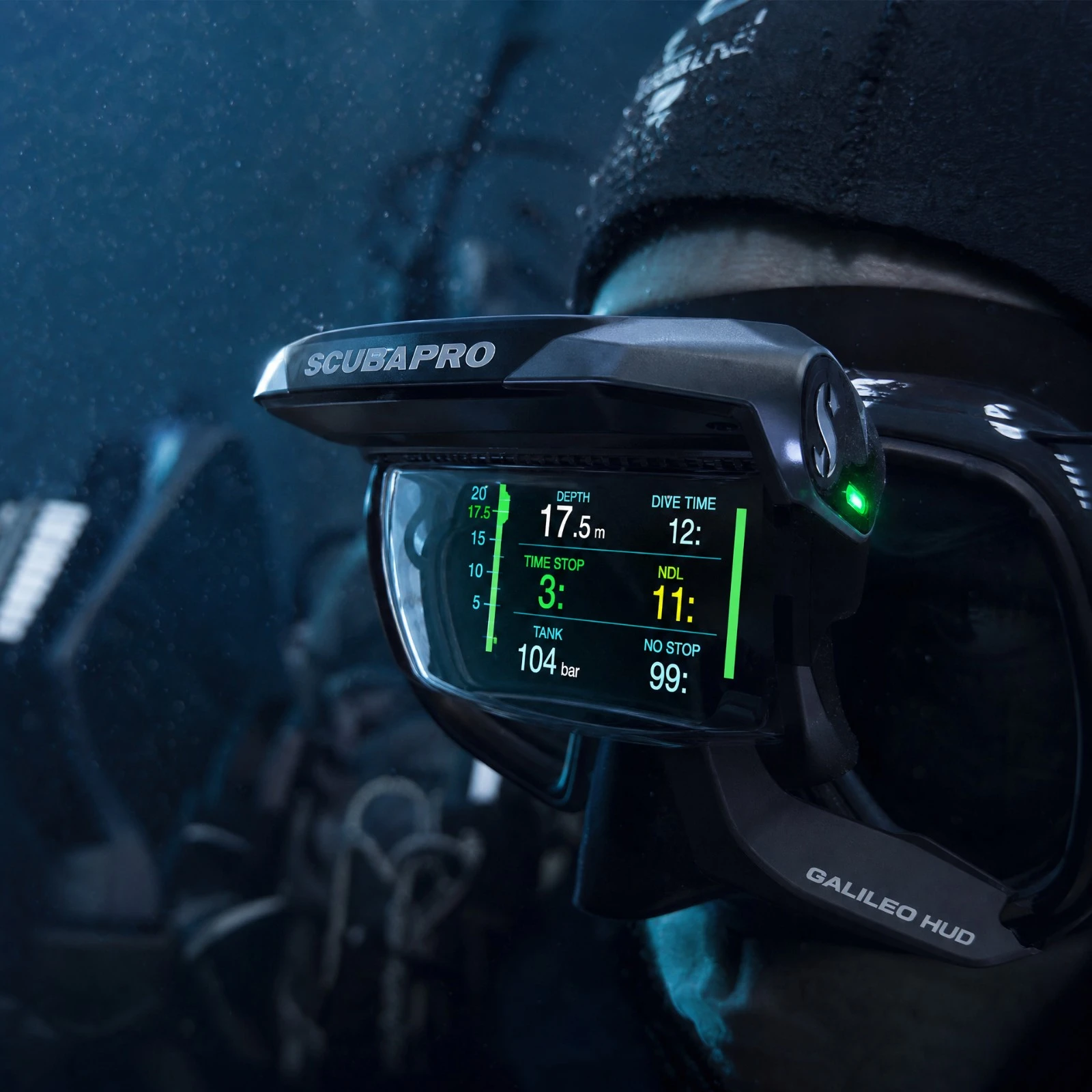
Detailed review of the Scubapro Galileo HUD. Discover its head-up display, adaptive algorithm, and wireless air integration features.
To learn how to get the most out of your gear underwater, discover the AquaExposure Training.
1. Introduction
There are moments underwater where every fraction of a second counts. Whether you're handling heavy equipment, adjusting your photographic settings, or following a trail in the dim light of a shipwreck, taking your eyes off your surroundings to check your wrist can be enough to lose an essential reference point. The Scubapro Galileo HUD (Head-Up Display) aims precisely to eliminate this friction.
The idea of projecting decompression data directly into the field of vision is not new, but its technical implementation has long been a challenge. This test addresses this extraordinary piece of equipment to determine whether heads-up display technology is a genuine safety asset for the technical diver, or simply an encumbering gadget. Dedication, repetition, and self-improvement are at the heart of technical diving, and such a tool must prove its value in the field.
2. The Verdict in Summary
Overall score: 4.6/5
| Criterion | Score | What it means |
|---|---|---|
| Algorithm & levels | 5.0/5 | Complete transparency and the ability to use Gradient Factors. |
| Air & multi-gas | 5.0/5 | Equipped to handle everything, from simple Nitrox to Trimix/CCR. |
| Screen & ergonomics | 4.8/5 | Spectacular micro-OLED technology and excellent dial navigation. |
| Battery life | 4.4/5 | Solid rechargeable battery (approximately 20 hours), requiring planning for trips. |
| Connectivity & app | 4.8/5 | Very smooth Bluetooth transfer to the mobile application. |
| Compass & instruments | 5.0/5 | The compass in the field of view is a major tactical advantage. |
| Robustness & depth | 4.0/5 | Cutting-edge hardware, waterproof to 120m, but the tilt mechanism requires attention. |
| Price & customer service | 3.8/5 | A significant investment, justified by the technical innovation. |
3. Detailed Analysis
Algorithm and Levels (Score: 5.0/5)
The mathematical engine is the same as that of the G2. Scubapro offers a choice between its classic adaptive algorithm and the Bühlmann algorithm with adjustable gradient factors. Having this critical data constantly visible allows you to react within seconds if the ascent rate exceeds the limit.
The ZH-L16 ADT MB PMG or ZH-L16C GF algorithm can be selected according to your preferences. The Gradient Factors are freely adjustable for the GF mode. The permanent display of the decompression ceiling and TTS, combined with unavoidable visual alerts, provides such direct readability that even when wearing thick gloves, managing decompression becomes intuitive.
Air and mixed gases (Score: 5.0/5)
The HUD doesn't compromise. It's a complete Tek computer. It calculates your mixture changes in real-time while allowing you to keep an eye on your teammate.
It can manage up to 8 mixes simultaneously. It is fully compatible with Nitrox, Trimix (hypoxic and normoxic), and it includes a native CCR mode. Air integration is done wirelessly via a low-frequency radio transmitter.
Screen and Ergonomics (Score: 4.8/5)
The micro-OLED screen doesn't look like a traditional display. The internal optics create a virtual image one meter in front of you. The brain adapts to this very quickly. Navigation is done using a single "push/turn" knob, which is surprisingly intuitive even when wearing waterproof gloves.
The color Micro-OLED display with "near-eye" optics is extremely precise. The hinge mechanism allows the computer to be raised out of the field of view if necessary. The unique, multi-function control dial is a model of ergonomics.
Battery Life and Performance (Score: 4.4/5)
Despite the power required for the OLED screen, energy optimization allows for approximately twenty hours of use. However, it will need to be charged frequently during intensive use.
The battery type is a rechargeable battery. The advertised battery life is up to 20 hours in dive mode. The charging indicator is clear and easy to read.
Connectivity and Application (Score: 4.8/5)
The dive data is easily downloaded. The heads-up display (HUD) communicates perfectly with current smartphones and tablets to keep its logbook up to date.
It uses Bluetooth Low Energy and a USB cable. It is compatible with LogTrak 2.0. Software updates are performed via PC/Mac or smartphone. Standard export functionality is available.
Compass and Instruments (Score: 5.0/5)
Having a compass that displays "heads-up" on the underwater landscape is this device's most impressive feature. Navigation becomes natural, without ever having to twist your wrist.
The integrated 3D electronic compass with tilt compensation is remarkable. It offers Scuba, Gauge, and Apnea modes.
Robustness and Depth (Score: 4.0/5)
The casing is extremely compact and pressure-resistant, but the product's design (mounted on the top of the mask) makes it particularly vulnerable to impacts during immersion or when being lifted back onto the boat.
The certified depth rating is 120 meters. The mask attaches to the frame using a specific bracket (several adapters are included). The buoyancy is neutral.
Price and Customer Service (Score: 3.8/5)
It is an ultra-specialized niche product, and its price reflects that. It is one of the most expensive computers on the market, but the warranty and the presence of Scubapro's customer support provide reassurance for this long-term investment.
The observed price ranges from 950 to 1050 EUR (often sold with its transmitter). Scubapro's customer service is very effective in the French-speaking region.
4. Who is this computer for?
This computer is designed for photographers, videographers, or technical divers who need to keep both hands free and their eyes focused on their viewfinder.
This computer is not ideal for minimalist divers or those with severe binocular vision problems.
5. Customer Service and Support
Scubapro has an excellent global network through its dealers. Exchanges are quick and guaranteed. The quality of the service depends on the quality of the local dealer.
6. Nutrition
The Galileo HUD uses a rechargeable battery. The advertised battery life is approximately 20 hours in dive mode. The charging indicator is clear. It will be necessary to plan for recharging during intensive trips or cruises.
7. Links to other models from the same brand.
If you're looking for a more classic alternative from Scubapro, you can check out our review of the Galileo 2 (G2) or the Aladin Sport Matrix.
8. Comparator
To compare this computer with other models, see our diving computer comparison tool.
© 2026 AquaExposure. All rights reserved. Reproduction prohibited without authorization.
Share
Table of Contents
- 011. Introduction
- 022. The Verdict in Summary
- 033. Detailed Analysis
- 04Algorithm and Levels (Score: 5.0/5)
- 05Air and mixed gases (Score: 5.0/5)
- 06Screen and Ergonomics (Score: 4.8/5)
- 07Battery Life and Performance (Score: 4.4/5)
- 08Connectivity and Application (Score: 4.8/5)
- 09Compass and Instruments (Score: 5.0/5)
- 10Robustness and Depth (Score: 4.0/5)
- 11Price and Customer Service (Score: 3.8/5)
- 124. Who is this computer for?
- 135. Customer Service and Support
- 146. Nutrition
- 157. Links to other models from the same brand.
- 168. Comparator
Questions about the Journal
Can I use the photographs from this journal?
All images are protected by copyright. For any commercial or editorial use, please contact us via our form.
How can I be notified of new articles?
Follow us on social media or join the Sentinels Circle to receive our immersion stories before anyone else.
Do you offer hands-on workshops?
Yes, we organize masterclasses and field expeditions for members of our school. Check the Training page for details.


