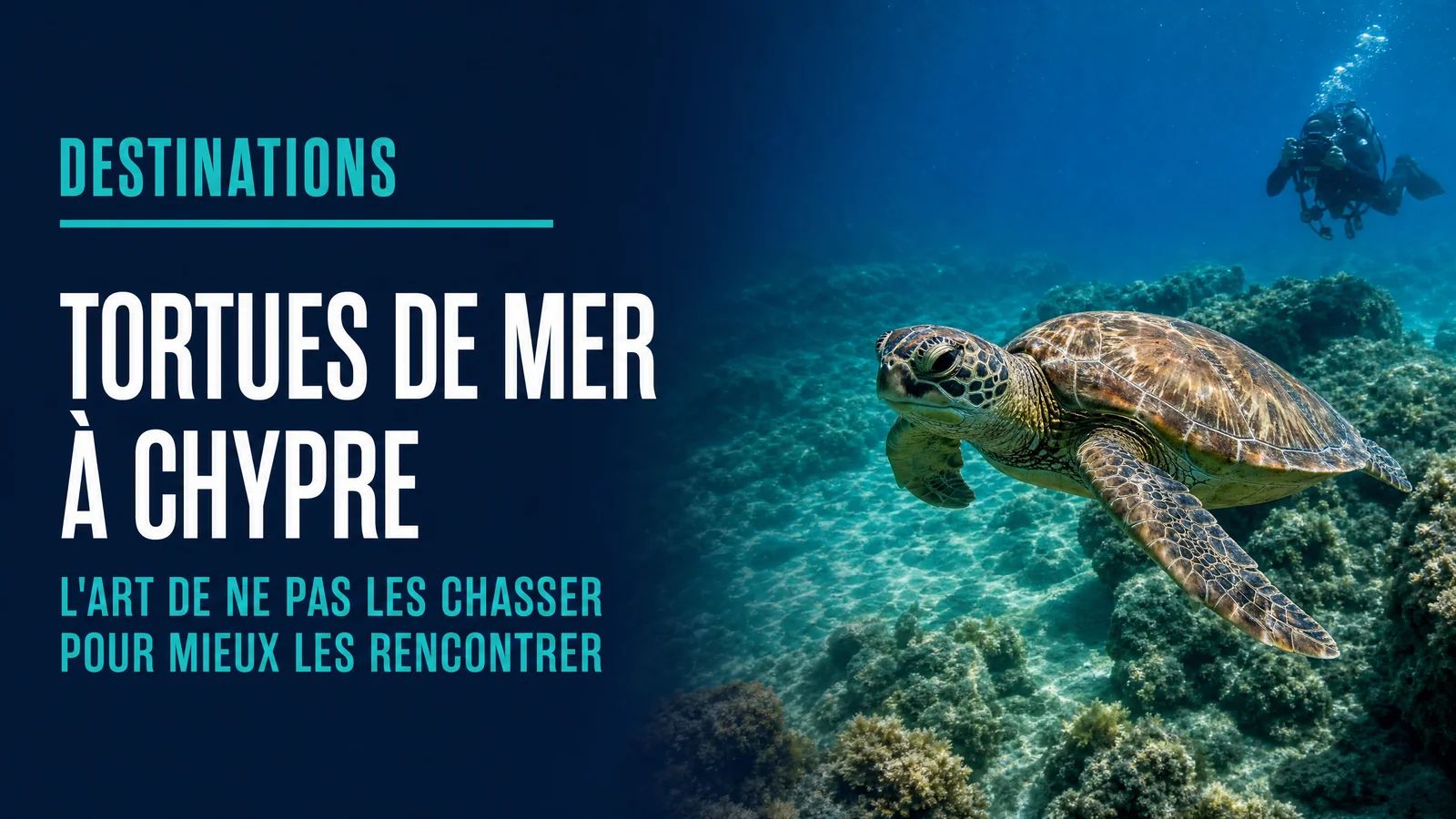
Sea Turtles in Cyprus: How Not Chasing Them Changes Everything
My first regular sea turtle encounters were in Cyprus. Not because I chased them. Precisely because I didn't. What I learned about animal interaction, and why those sites have almost no turtles left today.
To learn how to get the most out of your gear underwater, discover the AquaExposure training.
Sea Turtles in Cyprus: How Not Chasing Them Changes Everything
There are underwater encounters that divers spend an entire career searching for without ever really finding.
Not because the animals aren't there. But because they're looking the wrong way, or more precisely, because they're looking too hard.
The sites around Ayia Napa, on Cyprus's south-east coast, are where I had my first regular, almost weekly encounters with sea turtles, during a period of my life spent diving on the island with the Viking Divers team. What I learned there about approaching wild animals underwater changed me. And what I observe there today concerns me.
The Turtle That Came to Me
First, it's worth understanding why Ayia Napa was, at the time, a remarkable place for turtles.
The posidonia meadows that cover the seafloor in this region are an extraordinary food source for both loggerhead turtles (Caretta caretta) and green turtles (Chelonia mydas), the two species present in these waters. Water quality, the relatively lower human pressure outside the main tourist season, and the site topography with its rocky zones and sandy plateaus created conditions where turtles felt comfortable enough to stay, rest and be observed.
The first time I genuinely understood what "observing" meant, I hadn't planned anything particular. I sat on the bottom, stopped moving, and waited.
What happened next taught me more about underwater photography than any manual had.
The turtle stayed. Then it came closer.
Not dramatically. There was no shiver, no cinematic revelation. Just a turtle that, after a while, no longer perceived me as a threat, and continued along its normal path, which happened to pass very close to my camera.
At some point it came to rest its head against my lens. It wasn't an interaction in any deliberate sense. It was shared curiosity. It was looking at this strange thing that wasn't fleeing. I was looking at something no amount of pursuit would ever have given me.
What Most Divers Do
The opposite scene, I've seen hundreds of times.
A diver spots a turtle fifteen metres away. They swim towards it. The turtle (which is not unintelligent) reads the direct approach as a danger signal, because in nature, something coming towards you quickly in a straight line rarely has good intentions. It moves away. The diver speeds up. The turtle dives deeper or heads for the surface to breathe, changing trajectory.
At the end of the dive, the diver says they "saw a turtle." What they saw was a turtle fleeing.
That's not an observation. That's a disturbance.
And that disturbance, multiplied by dozens, hundreds, thousands of divers on the same sites over years, produces something very concrete: turtles gradually abandon areas that are too disturbed, or alter their behaviour durably.
This is what has happened on certain sites around Ayia Napa.
Sites where turtle encounters were almost guaranteed a few years ago are today far less reliable. Not because of an environmental disaster. Not because of a disease or mass pollution. Because of repeated, invisible, normalised behavioural pressure, from divers chasing what they could have by simply staying still.
The Stillness Technique
What I teach in my dives about approaching marine animals comes down to a few principles, and the first of them is counter-intuitive for most divers.
You don't approach the animal. You wait for the animal to approach you.
In practice, it looks like this:
You spot a turtle. You stop kicking. You settle into neutral buoyancy at a respectful distance, ten to fifteen metres minimum. You stay within its peripheral field of vision without being in its path. And you wait.
The turtle, observing this unusual behaviour (most marine animals are more accustomed to moving divers than to still ones), will begin to analyse you. If you don't move, if you don't produce unusual vibrations, if your equipment isn't blasting bubbles directly in its direction, it will gradually incorporate you into its environment, as a static element, like a rock, like something that isn't a threat.
This isn't anthropomorphism. It's basic behavioural biology.
From the moment you are no longer perceived as a potential predator, the distance between you and the animal can naturally reduce, on its initiative, not yours.
That's when photography becomes possible.
Sea Turtle Photography: Patience as Technique
The direct consequence of this approach on photography is radical.
When the animal comes to you rather than you going to it, you get images that pursuit never produces. The animal is relaxed, its behaviour is natural, it isn't looking over its shoulder, and the distance between it and your lens is sometimes so small that a 10-12mm wide-angle fills the entire frame.
The turtle that came to rest against my camera at Ayia Napa. I hadn't kicked towards it once. I had simply waited, settled on the sand, letting the sea do what the sea does when you stop interrupting it.
This rule applies far beyond turtles. It applies to curious groupers, to rays that continue their route if you don't pursue them, to octopuses that stay within lens range if you move slowly. Underwater photography and patience are two sides of the same philosophy. Our Cyprus photography guide develops this in detail.
Where to See Turtles in Cyprus Today
Despite human pressure on some historic sites, Cyprus remains one of the Mediterranean's most reliable areas for sea turtle observation.
Ayia Napa and its surroundings remain a key zone, particularly outside the peak tourist months. The more sheltered sites along the coast still host turtles for divers who know how to look without disturbing.
Protaras and Green Bay are noted for snorkelling encounters with green turtles. Green Bay remains one of the most reliable spots in the region, though tourist pressure there is also higher in summer.
Konnos Beach, Kalamies Bay and Sirena Bay are other sites in the area where turtles are part of the ordinary underwater landscape, provided you arrive with the right approach.
Best period: June to October, with peak sightings in August and September.
For guided dives on these sites with a team that shares this philosophy, our Viking Divers outings are organised around deep knowledge of animal behaviour at each specific location.
What the Disappearance of Turtles Tells Us
I'm not a marine biologist. I'm someone who has spent years underwater in areas where certain species were present, and who returns to those same areas noticing that something has changed.
The loggerhead turtle (Caretta caretta) is classified as "Vulnerable" on the IUCN Red List. The green turtle (Chelonia mydas) is classified as "Endangered." These aren't bureaucratic abstractions. They describe field realities that regular divers can measure at their own scale.
What the retreat of turtles from certain sites tells us is that our collective behaviours, even without any intent to harm, can produce real and lasting ecological effects.
That isn't a sermon. It's an observation.
And one of the most direct ways to act on this reality requires no special equipment, no additional certification, no complex procedure.
It just requires stopping swimming.
FAQ - Sea Turtles Cyprus
#
Where can I see sea turtles in Cyprus?
The main observation areas are Ayia Napa, Protaras (Green Bay), Konnos Beach, Kalamies Bay and Sirena Bay. For diving, Viking Divers-guided sites around Ayia Napa and the Larnaca-Dhekelia area are among the most reliable for both loggerhead and green turtles.
#
When is the best time to see sea turtles in Cyprus?
From June to October, with peak sightings in August and September. Summer conditions (water 26-28°C) are particularly favourable for turtle presence at Ayia Napa and Protaras sites.
#
Can I snorkel with sea turtles in Cyprus?
Yes, particularly at Green Bay (Protaras) and several snorkelling-accessible sites around Ayia Napa. Non-disturbing behaviour is essential: no direct approach, no sudden movements, no physical contact with the animal.
#
Is it illegal to touch sea turtles in Cyprus?
Physical contact with marine turtles is strongly inadvisable and may be restricted in marine protected areas. Both loggerhead and green turtles are protected species in Cyprus. Beyond the legal framework, touching a turtle disrupts its natural behaviour and can cause it to abandon the area.
#
How do I photograph sea turtles underwater without disturbing them?
The core technique: stop at 10-15 metres distance and let the animal approach on its own. Use a wide-angle lens to compensate for remaining distance. Avoid direct flash on the animal. Never kick above or behind a turtle ascending to breathe. This creates direct pressure on its vital behaviour.
A Sea Turtle Isn't Caught. It's Accepted.
There's a logic to that statement that isn't poetry. It's applied photography.
The best images I have of sea turtles, I didn't obtain by being faster, more agile or more courageous. I obtained them by being more patient, more discreet and more honest about what I represent to the eyes of a wild animal.
A black thing with bubbles, coming towards you while waving its legs: that's a threat.
A black thing with bubbles, sitting there without moving: that might be a reef with an anomaly.
Become the reef. The turtles will take care of the rest.
Dive the Turtles with Us in Cyprus
Our Viking Divers outings around Ayia Napa and Larnaca include sites regularly frequented by loggerhead turtles. The team shares this approach philosophy: the encounter is always worth more than the chase.